How to shape a trident maple bonsai? Detailed shaping method explained
Trident maple (Acer buergerianum) is a deciduous tree of the Aceraceae family, also known as duck-foot tree. A bonsai made from trident maple has tender leaves covering the branches in early spring, strikingly red and alluring; in early summer, green leaves are lush and graceful; in late autumn, yellow leaves fill the tree, brilliantly orange and elegant; in deep winter, leaves fall and branches are revealed, refined and noble. Because of its many advantages, it is widely used in the bonsai world.
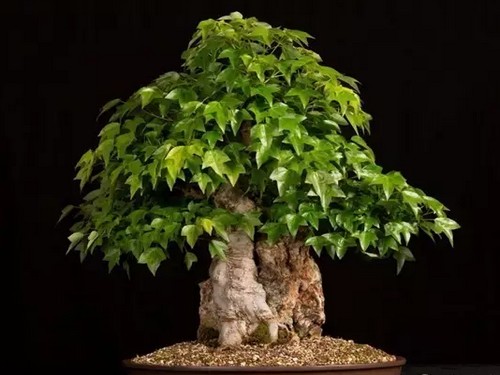
When a normally growing collected trident maple stump enters late May, its branches are already about one meter long, and at this point branches can be selected according to future shaping needs. The following is the shaping process:
Before selecting branches, observe carefully, plan, ponder over it more, and ask friends for their opinions more; cut off absolutely useless branches, then select branches step by step from bottom to top. Because trident maple grows fast and its branches grow straight upward, horizontally growing side branches need to be manually bent with wire or metal wire and pulled to the ideal angle. After the branch angle is changed, the branch tip should be fixed with a bamboo stick to make it grow upward, because trident maple branches grow more slowly when drooping or growing horizontally, which is related to apical dominance in plants.
Entering June means the plum rain season, when strong winds and heavy rain occur from time to time. At this time, new branches, the thick ones already nearly one cm, are not yet fully lignified, so strong winds breaking the branches is very likely to happen. It is necessary to fix and reinforce them with wood or bamboo, which can be done together with branch selection.
Useless branches and buds should be pruned regularly to concentrate nutrients for the branches that are needed. Grafting can be done in places lacking branches. Trident maple has fast healing ability; you only need to peel the bark off the mother stump, graft on a new branch, tie it tightly and wrap it well, and it will heal together in one month. After a year of growth, the mother branch can be cut off the next year. The same method can be used for missing roots; find some small old trees for grafting.
Trident maple has opposite buds, and during cultivation two opposite branches will grow. At this time, one branch should be removed as early as possible; if left for a long time, a swollen branch will form and affect the appearance. After one growing season, once the thickness reaches the desired range, it should be shortened; those not thick enough continue to be grown out. If a certain branch reaches the desired thickness during the growing season, the method of pinching the top can be used to control further thickening, and by the next spring it can be pruned into place. This avoids the possibility of losing branches due to unbalanced tree vigor. Many friends like to prune heavily after leaf fall, but in fact this is not appropriate.
Processing: Trident maple shaping mostly uses a combination of bending with wire and pruning to carry out posture processing.
Because its branches are rather brittle, when bending with wire you must use gentle force, gradually take the curve, advance little by little, so as to avoid breaking them. In addition, it is best to do this during the plum rain season when the new tissue of the branches grows vigorously and has strong flexibility. Large branches are mainly shaped by bending with wire, while small branches are mainly shaped by pruning.
Tree form: Trident maple bonsai is best when it is simple, elegant, natural and unrestrained. They are mostly made into tree forms such as curved-trunk style, slanting-trunk style, straight-trunk style, dead-peak style, connected-root style or cascade style. Old stumps can be made into stump scenes such as connected-root style, dead-peak style or root-on-rock style.