How to prune a trident maple bonsai? Master the correct pruning method
The trident maple has a graceful tree form and elegant leaves, with three shallow lobes at the leaf tip, just like a duck's webbed foot, and it is highly ornamental. In early spring, the new leaves first emerge, delicate and emerald green; after autumn arrives, the leaf color turns dark red or old yellow, becoming even more pleasing to the eye. If in late summer and early autumn you remove its old leaves and apply a quick-acting nitrogen fertilizer once, after half a month it will send out fresh tender new leaves, pale green or tinged with red, which can enhance its ornamental effect.
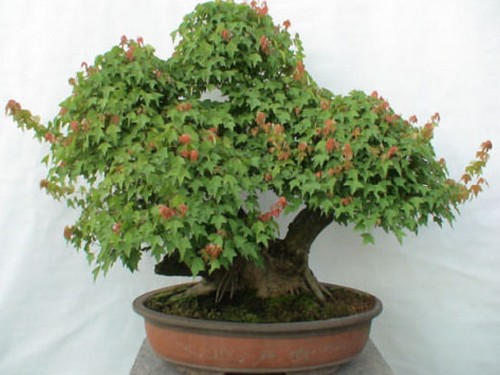
To cultivate a trident maple well, we need to have a full understanding of it. In nature it is found generally growing near water sources, on riversides with ample light, on field ridges; some roots have already extended into the sand and mud by the river's edge, some grow among piles of loose stones, and so on. From analyzing such environmental factors, we can conclude that the trident maple likes a humid environment with ample sunlight, and is not demanding about soil. After being transplanted home, the environment suddenly changes, so the required environment needs to be created artificially. Here I will introduce the pruning aspect and share some of my own experience.
For a normally growing stump, by late May the branches are about one meter long, and at this point the branches can be selected according to future styling needs. Before selecting branches, observe carefully, conceive, ponder more, and ask friends for reference more often, cut off absolutely useless branches, then select branches step by step from bottom to top. Because the trident maple grows fast and its branches grow straight upward, horizontal side branches need to be manually pulled to the ideal angle with aluminum wire or rope. After the branch angle is changed, the branch tip should be fixed pointing upward with a bamboo stick; branches that droop or grow horizontally will slow down, which is related to apical dominance in plants. Entering June is the plum rain season, and windy and rainy weather occurs from time to time. At this time new branches, the thick ones, are already nearly one cm, but have not yet fully lignified, so it is very likely that strong wind will break the branches, and they need to be fixed and reinforced with wood or bamboo, which can be done together with branch selection.
Useless branches and buds should be pruned off regularly to concentrate nutrients for the branches that are needed. Where branches are lacking, approach grafting can be used; the trident maple heals quickly, so you only need to peel the bark of the mother stump, bring the new branch up against it, tie it tightly and wrap it well, and in one month they will have healed together. Through one year of growth, the mother branch can be cut off the next year. The same method can be used for missing roots; find some small old trees for approach grafting.
The trident maple has opposite buds, and during cultivation it will grow two opposite branches; at this time one branch should be removed as early as possible, because over time a swollen branch will form and affect the appearance. After one growing season, once the thickness reaches the expected range, it should be cut short; those not thick enough continue to be grown out. If during the growing season a certain branch reaches the desired thickness, the method of tip pinching can be used to control further thickening, and by the next spring it can be pruned into place. This avoids the possibility of losing branches due to unbalanced tree vigor. Many friends like to do a great deal of pruning after leaf fall, but in fact this is not appropriate. In terms of the climate of southern Anhui, winter is still rather cold; after frost damage, if sprouting is not in place, it needs to be cultivated again, increasing the cultivation time. If there is a greenhouse, then that is another matter.
When pruning, pay attention to preserving a good main trunk, and often watch its whole body; it easily grows small buds all over, and they grow very fast. A short and effective pruning method can be adopted, that is, frequent pruning and frequent trimming. In the early stage of making a bonsai, there needs to be a long period of branch accumulation to ensure sturdy branches and trunk. After the branches grow to 40 cm long, wiring should be carried out. At this time the processing technique should be mainly wiring, with pruning as a supplement. The branches of the trident maple are rather brittle and hard, so be careful when wiring and do not snap the branches.
Once the bonsai has basically taken shape, pruning should be the main method to maintain the tree form. Around early August, remove the old leaves in several sessions, which can make the trident maple leaves smaller and the autumn leaves red. Shorten and prune overly long branches as needed. In styling, the early stage is mainly pulling and wiring, and the later stage is mainly pruning. The pruning of branch pads, branch angles and branch bends must be done carefully; observe after leaf fall, and clean up before sprouting. Grow thick and cut short, then grow out again and cut short again; after repeating several times, it becomes a fine specimen!