Detailed Explanation of Tamarisk Bonsai Shaping Methods and Techniques
In tamarisk shaping, the trunk is valued for its twists, the branches for their sparseness, the flowers and leaves for their density, and the roots for being exposed. The tamarisk trunk should be aged, twisted and cracked. Tamarisk has extremely strong sprouting ability, so through pruning, sprouts on the trunk must be promptly removed so that scars accumulate and form a mottled, varied effect. Tamarisk branches are soft and drooping, and through pruning and wiring they can be formed into weeping-branch or semi-weeping-branch bonsai.
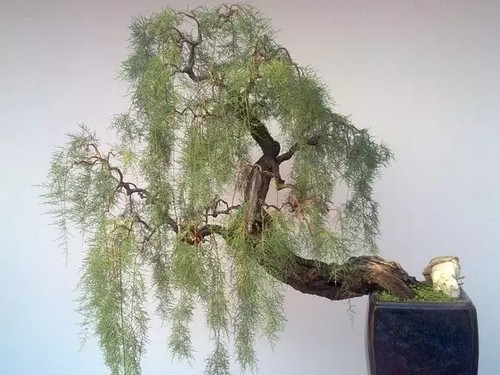
Older tamarisk branches are relatively brittle and break easily, so pruning should be the main method. Current-year branches are relatively soft, so wiring can be combined with pruning. Thin branches can be pruned into pads; the pads should be reasonably distributed in space, staggered with one another, and have natural tops. About half a month after buds sprout in early spring, begin flat-top pruning, and after 20 days another flat-top pruning can be done. The top branches should spread out in a semi-elliptical flat form, while the middle and lower branch pads should be pressed downward, echoing and complementing the top pads and the natural tree form. Longer branches or those in improper positions can be tied and pulled with lead wire, etc., and once the curvature is fixed, the lead wire can be removed.
In shaping and pruning tamarisk, the weeping-branch style is generally the most common. When making a natural weeping-branch style, the difficulty lies in creating the weeping branches. This is because under natural growing conditions, the new branches of tamarisk tend to grow upward most easily. Small branches and side branches, however, tend to droop most easily. When making a weeping-branch bonsai, the branches cannot be allowed to grow freely; the position, number, density, length, thickness, layered variation and overall outline of the drooping branches must be determined according to the layout requirements. If the methods of early branch selection, shading treatment, branch pulling and side-branch thinning are correctly applied, good results can be achieved.
Tamarisk has strong sprouting ability, and the sprouts mostly appear in clusters, so bud rubbing and bud selection should be carried out in time according to the design intent. After flowering, pruning should be done in time to renew old branches and increase the number of bloomings.
Tamarisk has a deep root system, and the roots are well developed and wonderfully twisted. A shallow planting method or root-raising method can be used to make the roots rise and emerge above the soil surface, some high and some low, some thick and some thin, interlacing and coiling, highlighting their natural beauty.
Tamarisk grows quickly. During the vigorous growth periods in spring and summer, pruning once a week is necessary to maintain the tree shape. As for new buds sprouting on the trunk, any that are not needed for the design should be removed in time to avoid consuming nutrients. To improve the ornamental value of tamarisk, advantage can be taken of its strong sprouting ability by removing all the leaves during the vigorous growth period, then placing it in a place with ample sunlight, strengthening fertilizer and water management, and spraying water on the branches and trunk once each in the morning and evening. New buds can sprout in 5 to 6 days, and in 20 days the leaves will be as full as before, tender green and lovely.
1. Weeping-branch style
First, choose a suitable trunk, such as a slanting trunk or crooked trunk. Second, cultivate primary, secondary and tertiary main branches. To make it lifelike, the main branches should be trained to slope upward, and as few horizontal branches as possible should be developed, because in nature weeping willows rarely have large horizontal branches. After the main branch framework is formed, when new buds grow to 3 cm, keep the strong buds needed for the design and rub off all useless buds. When the retained buds grow to 15 cm, that is, after side buds appear, cut 10 cm from the main bud branch, keeping only 4 to 5 side buds. When the retained side buds grow to 20 to 25 cm, remove overly weak and short branches, and cut off overly thick, overly long and overly dense branches, that is, remove the "five excesses" branches, and keep enough suitable branches required for the design. Then use metal wire to pull branches that do not droop into place, or use heavy objects to weigh them down for 6 to 10 days, after which they will be in place and set in shape.
2. Pine-and-cypress imitation style
Tamarisk not only has bark resembling pine and cypress branches, but its leaves also resemble theirs. To imitate the pine-and-cypress style, first choose one with an upright trunk, vigorous and imposing. Then focus on developing horizontally extending branches or slanting flowing branches; the main branches near the trunk should be appropriately left long without foliage to show age, making the framework resemble that of pine and cypress. Finally comes the making of foliage pads; each pad should be high and low in staggered arrangement, with pads within pads and clusters within clusters, striving to resemble pine and cypress foliage.
3. Natural style
In the natural style, thin branches are kept relatively short, 10 to 15 cm is sufficient. No external force is needed; let them grow naturally, with the branches and leaves drooping slightly, approximating a parabola.