A detailed guide to shaping Chinese elm bonsai to create a beautiful tree form
When buying a Chinese elm bonsai, you must carefully examine the trunk. The fresher the raw trunk material, the better. Do not assume that a withered, decayed trunk has more charm. Some even have poorly developed root systems. Beginners should first keep the Chinese elm alive, then gradually shape it!
The processing and shaping of Chinese elm can be carried out by combining pruning with wiring. Brown coir or metal wire can be used for wiring. Since Chinese elm branches grow quickly, once the shape is set by wiring, the wire should be removed promptly to avoid wire bite and preserve the appearance. During the growing season, newly sprouted shoots can be cut back to encourage branching, and the branches can be twisted into shape.
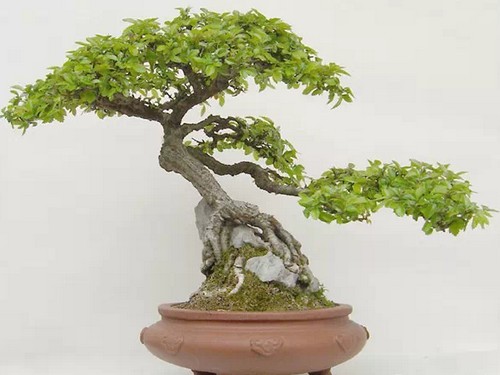
Chinese elm is highly malleable and can be trained into many forms. Common ones include the formal upright style, slanting style, semi-cascade style, cascade style and root-over-rock style. The branches and foliage can be pruned and wired into pads, or pruned into a natural canopy. The root-over-rock style Chinese elm bonsai in particular allows a certain degree of exaggeration in its design: the tree can be positioned above the rock, with the tree as the main element and the rock as secondary, free from the restriction of "a zhang for the mountain, a chi for the tree."
Processing:
Chinese elm can be shaped by pruning, or processed in combination with wiring. Brown coir or metal wire can be used for wiring. Since Chinese elm branches grow quickly, the wiring material should be removed promptly to avoid "wire bite" and preserve the appearance. For old tree stumps collected from the wild, overly thick main trunks can be carved and shaved to reduce their bulk so they match the side branches, while also adding a sense of antiquity. The shaping of Chinese elm is best done before bud break in spring or during the plum rain season.
Tree form:
Chinese elm is highly malleable and suitable for training into many tree forms. Common ones include the formal upright style, slanting style, semi-cascade style, cascade style, root-over-rock style and multi-trunk planting style. The branches and foliage can be wired into pads or pruned into a natural canopy. Especially when creating a root-over-rock style Chinese elm bonsai, a corner of nature can be captured in the concept, and a certain degree of exaggeration is allowed. To enhance the charm of a particular part, the tree can be positioned above the rock, with the tree as the main element and the rock as secondary, free from the restriction of "a zhang for the mountain, a chi for the tree." Among Chinese bonsai styles, the Lingnan school, Su school and Yang school often use Chinese elm as their main tree species.