When is the right time to sow lobelia (Lobelia erinus)?
The autumn sowing season is here. So, you are getting ready to sow, and the questions come with it. Today I have listed some of the most common questions and shared my solutions. I have encountered all of these problems myself, and many friends have asked about them too. The solutions I provide have all been verified through repeated practice, and are for reference only.
Generally, plants that bloom in winter or early spring need to be sown in autumn, such as petunia, pansy, dahlia, lobelia (Lobelia erinus) and so on. The sowing time depends on the specific plant; some can be sown right now, while others must wait until after National Day. For every plant, the flower grower or retailer marks the suitable germination temperature.
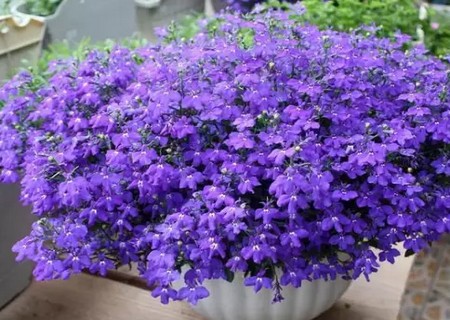
Lobelia (Lobelia erinus) is a species in the genus Lobelia, family Campanulaceae. It is a perennial herb, often grown as an annual, and is semi-trailing. It needs long daylight and only blooms under low-temperature conditions. The raceme is terminal, and the small flowers have long stalks. Its cold tolerance is not strong, it dislikes intense summer heat, and it prefers a light soil rich in humus. To grow lobelia well and achieve the ideal ornamental effect, mastering the sowing time is the first step to success.
[Sowing time]
Lobelia can be sown from January to March, and it blooms after July; if sown from August to October, it blooms the following year. Lobelia seeds can germinate 20 days after sowing at 22°C, and can bloom 65 days after sowing. In the Yangtze River basin, sowing in mid-to-late September is most suitable.
If sown before September, the seedlings grow quickly and take shape early, and can bloom around February to March. At this time the temperature is relatively low, and temperature and sunlight are usually hard to guarantee, so the flowering effect is less than ideal, with few and sparse flowers.
As the temperature rises, the internodes of the branches lengthen, and the flowering effect also becomes loose, failing to reach a very full, ideal effect. (Of course, if you like the flowing-hair look, then that is a different kind of charm.)
If sown after October, the temperature drops quickly, the seedlings grow slowly, and this really tests the patience of every gardener.
As the temperature rises, the seedlings grow rapidly, the time for pinching and shaping is relatively short, and the flowering often fails to reach the ideal density.
[Sowing method]
Lobelia seeds are tiny. When sowing in the ground, you can mix in some fine sand before broadcasting, and use a spray bottle to water by misting, so that the seeds are not washed away.
When sowing in plug trays, sow 8-12 seeds per cell. Because the seeds are tiny and hard to pick up, you can use a sheet of white paper, pour the seeds onto the white paper, then fold the paper to make a crease, so that the seeds all run into the fold line, then flick the white paper lightly with your finger, and the seeds will be scattered little by little.
This sowing method can be used for all tiny seeds.
Of course, if your eyesight is good, you can also use the method of sowing one seed per cell.