How to Dwarf and Shape Bamboo Bonsai? A Detailed Guide to Practical Techniques
Bamboo sprouts and grows quickly, so regular pruning is necessary to keep the bamboo bonsai looking graceful. Each year between June and July, once the new bamboo has finished growing, carry out renewal and shaping pruning. Any new shoots that emerge afterward should be removed immediately, so they do not disrupt the shape of the bamboo bonsai, consume nutrients, and affect the vigor of the parent bamboo. With just a little careful routine care to keep it looking beautiful with fresh green, elegant, and attractive foliage, a bamboo bonsai can be enjoyed for a long time.
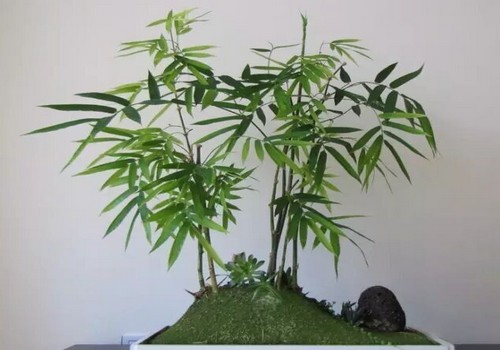
To enhance the beauty of a bamboo bonsai, you can plant it higher when potting so the roots are raised. After the bamboo has grown for a period, remove part of the surface soil so that some bamboo roots are exposed above the soil surface, creating a suspended-root, exposed-claw look that reveals the beauty of the bamboo roots and is very pleasing to view. Of course, to create a beautiful bamboo bonsai, the dwarfing step is especially important. Below is an introduction to the dwarfing and shaping techniques for bamboo bonsai:
[Selecting Varieties]
For potted bamboo, it is best to choose small bamboo types with uniquely slender and short culms, narrow leaves, and slow growth, such as Buddha Belly Bamboo, Bambusa ventricosa 'Nana' (Luohan Bamboo), Chimonobambusa quadrangularis (Square Bamboo), Guanyin Bamboo, Black Bamboo, Spotted Bamboo, Mi Bamboo, and King Kong Bamboo.
[Suitable for Shallow Pots]
Bamboo prefers acidic, slightly acidic, or neutral soil. In northern regions where the soil is strongly alkaline, add 0.2% iron sulfate solution. Use loose, well-drained sandy loam as the potting soil. When transplanting potted bamboo, first place it in an ordinary clay pot; after a 30 to 40 day recovery period, once it has survived, transplant it into a shallow pot. Do not fill in too much soil; too much potting soil makes the root system grow too quickly, making it difficult to control the height of the bamboo.
[Keep Good New Shoots]
The shoot-emergence period for potted bamboo is generally from April to September, with July to August being the early peak and peak periods. At this time, many shoots emerge, the internodes are short and thick, and the quality of the mature bamboo is good, so keep as many as possible.
[Controlling Water at the Right Time]
Bamboo likes moisture but fears waterlogging. After potting, water thoroughly the first time, then keep the potting soil moist, following "water thoroughly once dry." During the emergence of new shoots and the period of vigorous growth, appropriately control watering, keep the potting soil on the dry side, and give more sunlight to control top growth and make the plant short and sturdy. Watering is best done before 9 a.m. or after 4 p.m. In hot summer, spray water on the leaves 2 to 3 times a day to prevent leaf tips from drying and scorching. On rainy days, avoid rain exposure and waterlogging to prevent root rot.
[Apply Less Fertilizer]
Bamboo likes fertilizer, and fertilization should be mainly organic fertilizer, such as compost, barnyard manure, and green manure. However, for potted bamboo, topdressing should be minimized, and only light fertilizer may be used. In spring and summer, apply 0.5% urea and 1% compound fertilizer with water. To promote robust growth of potted bamboo, appropriately apply phosphorus and potassium fertilizer in the later growth stage.
[Proper Shoot Peeling]
After new shoots emerge, 7 to 10 days later, when they are about 10 cm tall, depending on the growth condition, peel off 1 to 2 shoot sheaths from bottom to top every other day to help them mature early, suppress growth, and promote dwarfing.
[Reasonable Shaping]
Potted bamboo should be short and concentrated, and the number of shoots is often an odd number, with 3, 5, or 7 shoots planted per pot. For shoots with long internodes, improper positions, or overly dense or weak growth, prune them promptly. Once the retained shoots reach the ideal height required by the composition, remove their tips to encourage side branches; when the side branches reach a certain height, also remove their tips.