A illustrated guide to the grafting technique for golden bullet persimmon (Diospyros cathayensis): detailed steps you can master at a glance
The golden bullet persimmon is called "golden bullet" because its fruit turns golden yellow, is oval-shaped, and stays on the tree for a long time, hence the name golden bullet persimmon. Although the golden bullet persimmon bears fruit and also has the scientific name Chinese persimmon (Diospyros cathayensis), its fruit is not edible; the fruit is somewhat toxic and harmful to the body, so the golden bullet persimmon is only for looking at, not for eating. It feels a bit like a vase, good only as an ornament.
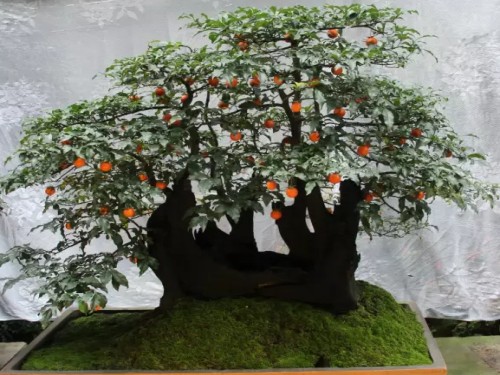
The golden bullet persimmon is dioecious, so surely many people have tried grafting by branch grafting or bud grafting without success. There is a certain technique to it. Today I will share a few insights about golden bullet persimmon grafting with everyone.
More than 70% of the trunks sold on the market are male plants, and native female trunks are very rare. Only genuinely responsible trunk growers will tell the truth. Male and female golden bullet persimmons have always confused buyers, but with mature grafting techniques this problem has been effectively solved. Mature grafting sometimes has more advantages than natively fruiting plants: you can choose small leaves, good shape, evergreen-type leaves in winter, large fruit, abundant fruit, a fruit stalk of moderate length, and late-maturing types with a long fruiting period. This way the ornamental value is stronger and the value higher. The low success rate of golden bullet persimmon branch grafting and bud grafting is not because branch grafting and bud grafting are unsuitable for golden bullet persimmon grafting, but because there are certain problems, or rather mistakes, in the grafting time and method.
For crown replacement and variety improvement grafting of the golden bullet persimmon, it is best to graft in early May; this is the optimal period. Here I will take a potted golden bullet persimmon trunk as an example and introduce it in detail.
On the golden bullet persimmon trunk, 3-5 vigorous branches should be kept. At the positions of the kept branches, cut off the remaining branches not intended for grafting from the base, and heavily reduce the kept branches, leaving only 4cm-5cm at the base.
Then use a sharp grafting knife to make a vertical split straight down the center of the cross-section, with the cut about 2cm deep; be careful not to make the cut too deep. Next, cut a thick branch from a female plant that has reached fruiting age, with a thickness similar to the rootstock branch being grafted, preferably one with a terminal bud, about 5cm long, with about 4-5 axillary buds on it. This will give a relatively high success rate.
Next, use a sterilized blade to peel off the cortex on both sides of the base of the scion, with the cut surface about 2cm long, matching the depth of the rootstock split, cutting until the xylem is slightly exposed.
Then insert the wedge-shaped base of the prepared scion into the split in the rootstock so that the cambium on at least one side aligns, and only then can you use a tying band to bind the joint between rootstock and scion.
Finally, put on a transparent plastic bag to cover the entire scion, including the rootstock-scion joint, and tie the bag tightly.
In this way the grafting is basically more than half successful. With careful attention in later care, the grafting will basically succeed.
Grafting not only requires technique; most importantly it requires patience. The grafting process is quite time-consuming, and you must be careful and patient at every step. That way the success rate only rises, never falls.