Detailed Guide to Diospyros cathayensis Seed Sowing: Master the Key Points for Easy Seedling Propagation
Diospyros cathayensis is distributed and cultivated in East China, South China and Central China. Market sales and exhibitions are dominated by Diospyros cathayensis from Sichuan and Hubei. Sichuan Diospyros cathayensis has small leaves and abundant fruit; as long as it reaches the cultivation age, small stumps (small and miniature bonsai) can bear fruit even in pots. Hubei Diospyros cathayensis comes in three types: large-leaf, medium-leaf and small-leaf; the large-leaf type has small fruit, the medium-leaf type has large fruit, and the small-leaf type has medium fruit. It is truly rare for an occasional small stump to flower and bear fruit after many years of cultivation. “Because Sichuan Diospyros cathayensis has many characteristics, sales of Sichuan Diospyros cathayensis seeds have been very good in recent years, mainly to Hubei and Hunan.” Feng Chuan said. According to his understanding, besides being used as bonsai material, Diospyros cathayensis has gradually been applied to landscaping, mainly as hedges.
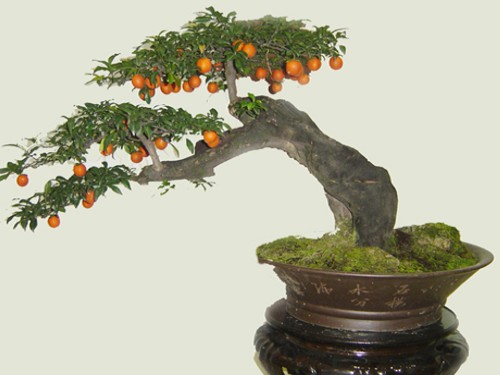
The seed propagation technique for Diospyros cathayensis is not complicated. After the fifteenth day of the first lunar month, pick the ripe fruits, take out the seeds, wash them clean, air-dry them, and in early April soak them in hot water at 30-50°C for 48 hours, then remove them, put them in a container that can drain water, and cover with a wet gauze.
After the fruit ripens in October, take out the seeds, dry them in the shade, and store them in moist sand stratification until sowing in February to March of the following spring. Dry-stored seeds need to be soaked in warm water for 1-2 days before sowing; moist sand-stored seeds do not need soaking treatment.
Sowing Diospyros cathayensis is similar to sprouting beans. Water it 3 times a day on top, with the water temperature at about 25°C, until the seeds crack and sprout. Then plant the cracked seeds in a seedbed or flower pot.
The substrate is best a loose, breathable nutrient soil or peat soil, kept moist. After the seedlings emerge, a relatively dilute liquid fertilizer can be applied appropriately to promote growth. Generally, it can only be used for bonsai cultivation after 3 years.
Because it is a cross-pollinated plant, plants grown from seed will show considerable segregation and variation. Therefore, before transplanting, the seedlings should also be selected in order to achieve better results.
Besides seed propagation, Diospyros cathayensis can also be propagated by cuttings. The advantage of cutting propagation is that it can ensure the offspring's traits remain unchanged, and at the same time make the male and female plants clear, which is conducive to cultivating fruit-bearing bonsai.