Key Points of Trunk Pruning Techniques for Stump Bonsai Material
Stump bonsai is a living art form in which old woody plants are planted in pots and, through years of artistic processing such as pruning, wiring and fertilizing, together with meticulous management, are made to develop powerful, vigorous trunks and lush, verdant foliage. It does not take its final form from the initial artificial shaping, but instead keeps growing and changing according to natural laws; therefore, routine care and management are very important.
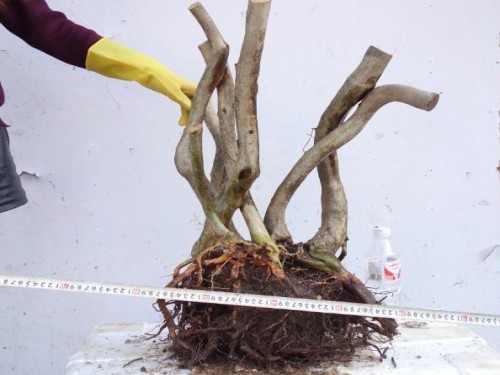
Stump bonsai usually uses woody plants as its material, selecting plants with graceful posture, short stature, small leaves, long lifespan, tolerance to pruning, strong resistance and ease of shaping. Without going against the growth habits of the trees, methods such as leaf removal and pinching are used to inhibit their growth and carry out shaping. In the process of cultivating this kind of bonsai, the maker can, according to his own intentions, shape it into various artistic forms such as gnarled and interlocking roots or a vigorous, upright bearing.
Whether it is a stump dug up from the wild or one cultivated artificially, in order to create an antique and elegant tree form, the trunk needs to be processed.
1. Bending
To prevent the trunk from breaking when bent forcefully, before bending you should first place a strip of hemp fiber along the outer edge of the curved surface at the bending site, then wrap it tightly with hemp bark, thereby increasing the toughness of the trunk and preventing splitting. Thicker trunks are difficult to bend; a boat-shaped longitudinal groove must first be chiseled into the outer edge of the curved surface, penetrating 2/3 into the xylem, and then wrapped tightly with hemp bark. Finally, a nylon rope is tied to both ends of the trunk to pull it into a bend.
2. Carving
The outer bark of some old stumps has mostly split open; to make them appear more ancient, a carving knife can be used to carve the outer bark appropriately, making the grain on the main trunk stand out more clearly. In addition, the cuts left from pruning are quite unsightly and should also be repaired by carving; carve grain into the flat cuts, but do not show stiff knife marks.
3. Compensation
The bark of some flowering and fruiting stumps is relatively smooth and cannot meet the requirements for bonsai making; in this case, the wood-application method can be used to compensate. First find a piece of old bark from a dead, rotten trunk and attach it to the front of the smooth stump's main trunk to disguise it. When attaching, do not apply glue over the entire surface, and do not use chemically synthesized glue; use resin glue and apply it in spots, so as not to hinder the growth of the trunk. If the skill is superb, after the trunk is covered the stump looks as if fresh, tender foliage has really grown out of the rotten wood, making it hard to tell true from false.