Detailed Guide to Shaping a Chinese Privet (Ligustrum quihoui) Bonsai
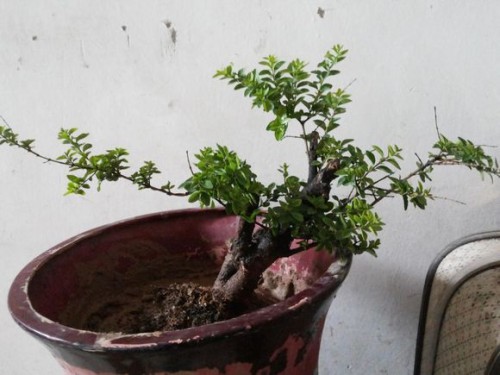
Chinese privet (Ligustrum quihoui) likes light, tolerates slight shade, is relatively cold-hardy, and resists many toxic gases, making it an excellent pollution-tolerant tree species. Its branches are soft and spreading, it sprouts vigorously, its leaves regenerate readily and it tolerates pruning, and it has the characteristic of taking shape quickly, making it an excellent material for modern horticultural plant shaping. Chinese privet plant shapes include architectural forms, animal forms, human figure forms, geometric forms, object forms, character forms, bonsai-style shapes and so on. These shapes greatly enrich the garden landscape, making the plant scenery more varied.
Shaping time:
Plant shaping is generally best done in spring and autumn, when there are many branches, good leaf density, and the branches are soft and readily sprout leaves and branches; however, for thick trunks and those with large bends, auxiliary objects such as bamboo poles and wire should be added to bend and fix them.
Design principles:
In the design and conception of plant shaping, the same basic principles of painting art and garden art must be followed: the four major principles of unity, harmony, balance and rhythm. When shaping plants, the tree form, lines, texture and proportion should have a certain degree of difference and variation, while also maintaining a certain similarity among them, so that they are both lively and harmonious and unified. When designing plant shapes, attention should be paid to mutual connection and coordination, reflecting the principle of harmony, so that viewers experience a soft, calm, comfortable and pleasant beauty.
Shaping techniques:
When shaping, first, according to the size and shape of the object being modelled, plant the trees together in a planned combination; based on the environment and tree vigor, conceive the design; according to the conceived design, build some auxiliary frameworks; finally carry out tying and pruning to shape them; or take pruning as the line, branches as the bone, shape according to the tree, apply artistic processing and beautification, and create scenery of different forms. Below, the hexagonal pavilion shape is taken as an example for detailed introduction.
This type of shape is completed by planting multiple plants in combination, and the main shaping methods are building frames, tying and so on.
1. Design sketch
Draw a regular hexagon with a side length of one meter, determine the plant spacing; calculate and mark the diagonal distances.
2. Selecting shaping seedlings
According to the plan, select 6 Chinese privets (Ligustrum quihoui) about 1.8 m tall, in small-tree form and with relatively straight trunks, plant them at the 6 points of the regular hexagon, and use bamboo poles, bamboo strips, wire and other tools to build the frame.
3. Tying bamboo poles
At 1.6 m and 1.8 m above the ground, use No. 16 wire and bamboo poles about 1 m long and 5 cm thick respectively to connect adjacent trees; between the tied bamboo poles, use No. 16 wire to vertically tie a 20 cm wide net for later use; on the trunk at 1.8 m above the ground, use No. 16 wire to diagonally tie 3 bamboo poles 5 cm thick, and at the intersection point, that is, the exact center of the six trees, use wire to tie a bamboo pole 6 cm to 8 cm thick and 4 m long and fix it vertically as the middle column of the bamboo pavilion cover, to facilitate construction of the pavilion top. From the top at 3.2 m, tie bamboo poles diagonally extended to each trunk, forming a consistent slope. In the middle, use bamboo strips 3 cm wide to fix them into a net.
4. Tying and pinching into shape
After the frame is basically set, carry out tying and pinching into shape, pull out branches and evenly weave and tie them onto the framework. Note that after fixing the large branches, smooth out the small branches, try not to expose the framework, and leave no gaps or depressions. Finally, treat the pavilion top tip: set up a ladder at the middle column 3.2 m above the ground in the center of the pavilion, use bamboo strips and wire to tie a cylinder 30 cm high with a flat diameter of 20 cm as the pavilion body tip, and pull out branches to tie them evenly. After shaping is complete, use large flat shears or hand shears to remove excess branches.
When making it, first shape the main trunk. The main trunk is bent by climbing and tying along irregular directions into a "" or reverse "" shape, an "S" shape or reverse "S" shape, or it can be shaped naturally according to the tree's appearance. Remove opposite branches, whorled branches, crossing branches, parallel branches, reversed branches, overlapping branches and so on, select and retain appropriate positions, and tie and fix the branches with metal wire (aluminum wire is best; iron wire rusts easily; copper wire needs annealing) to set the shape. After shaping, shade for more than 10 days and frequently spray water on the leaves; then Chinese privet grows vigorously. After more than 1 month, if the metal wire is found to be cutting into the tree, it should be removed promptly; if the shape has not set, brown silk or metal wire can be used for diagonal pulling and traction, and after the wound repairs, tie it again.
Specific winding steps:
The winding spacing is 0.5-1.5 cm, do not damage small branches; the metal wire and the branch being wound should form a 45-degree angle at the center, and the metal wire should be kept close to the branch, with moderate tightness: if too tight, the metal wire cuts into the tree and affects growth; if too loose, it cannot play a shaping role. After winding the metal wire, first practice-dry and then bend, so that the branch will not be broken. When selecting metal wire, if using aluminum wire or copper wire, it should be 2/3 of the branch diameter; lead wire should be 1/3; the length of the metal wire should be 1.5-2 times that of the branch. If one metal wire cannot set the branch, multiple metal wires can be used for tying. Multiple metal wires should be arranged in parallel and must not cross and wind around the branch.
If the branch is to rotate and bend downward, the metal wire should be wound counterclockwise, so that the metal wire can play a role in bending and fixing. After the branches are tied, pruned and pinched to form pads, the branch pads should be distributed in an orderly manner with varying lengths, and the outer edge line should form a scalene triangle, creating a sense of depth, layering and increased depth-of-field effect. At the same time, flexibly use the artistic beauty of lines: length, straightness and curvature, rigidity, smoothness and sluggishness, to give the tree shape a sense of movement. The "S"-shaped movement line created by metal wire climbing and tying gives people a feeling of softness, while the ""-shaped movement line created by pruning gives people a feeling of rigidity. When the trunk is rigid, the branches are soft; when the trunk is soft, the branches are rigid, thereby achieving the artistic effect of combining rigidity and softness, combining majesty and elegance, and appropriate density, allowing the viewer to experience slowness and speed, tension and relaxation, and after viewing enter the artistic realm of "sometimes drums resound, sometimes phoenix pipes sound."