Detailed Guide to Propagating Wax Begonia from Cuttings, Easily Grow New Plants
Wax begonia is the most common and most widely cultivated species among begonias. With graceful form, tender and glossy leaves, clustered flowers that bloom in all four seasons, and a slight fragrance, it is one of the main potted flowers for indoor and outdoor decoration. People use it in flower bed arrangements with excellent results. With the emergence of some relatively heat-tolerant varieties, wax begonia is very likely to become one of the most important flower bed plants in China, with advantages such as neat plant shape, abundant and dense flowers, easy combination with other flower bed plants, and a long ornamental period, thus becoming increasingly popular.
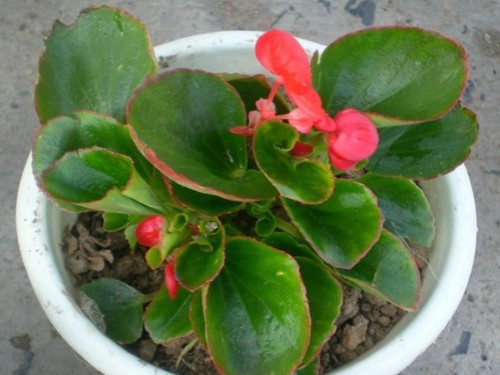
The leaves of wax begonia can be divided into two major types: one turns red-green after exposure to sunlight; the other is copper-red. Flower colors include red, pink, white, bicolor, and more. Flower forms are further divided into double-petaled and single-petaled. Double-petaled varieties are difficult to seed and are mostly propagated vegetatively by cuttings; commercially sold varieties are almost all hybrid F1 varieties, which are robust in nature.
Cuttings are a commonly used propagation method for begonias in general home cultivation, with the time being April to May. Before taking cuttings, select begonias of excellent variety, choose branches with strong disease resistance, robust growth, rich nutrition within the plant, and plump axillary buds as cuttings for propagation. Each segment should be about 10 to 12 cm long, with the base cut into a flat end, remove the lower leaves, and keep the upper leaves and tender tip. After cutting, place in a moist, ventilated, cool place, and it absolutely must not lose water and wilt.
For begonia cuttings, a wooden box seedbed of suitable size can be used. After the seedbed is made, wash it clean, then use a 0.1% potassium permanganate aqueous solution for disinfection. The substrate can be vermiculite, perlite, and peat soil, filled into the seedbed to a thickness of 20 cm, compacted and leveled, then insert cuttings at a spacing of 7 cm × 7 cm. Insert into the substrate to a depth of 5 to 6 cm. After watering thoroughly, insert bamboo pieces along the inner wall of the wooden box to form an arch, cover with plastic film, and place in a shaded, ventilated area, maintaining the temperature and humidity inside the bed.
Begonias heal and root quickly, and the survival rate is also very high. Generally, root primordia appear 15 days after insertion, a large number of fibrous roots grow in 20 to 30 days, and in 50 to 60 days the seedlings can be separated and planted in appropriately sized earthenware pots. If cultivated and managed properly, those cuttings taken in spring can bloom in autumn.
Wax begonia can be propagated by cuttings in all four seasons. In spring, cut robust side branches 8 to 10 cm long with more than 2 top tips, soak them in clean water, change the water every 1 to 2 d, and after rooting, plant them directly into pots. Alternatively, in May and September, cut young stem tips 5 to 6 cm long as cuttings, insert them into sand, taking care to shade and maintain moisture, keep the temperature at around 20°C, roots can emerge in about 20 d, appropriately increase light, and they can be potted after 30 d. Cuttings can also be taken in a greenhouse in winter. Select robust branches from the base of the plant, keep more than 3 buds, and make the cut smooth, located below a node. Cuttings taken in summer under high temperature and high humidity tend to rot.
Wax begonia has tender and glossy leaves, clustered flowers, vivid colors, and blooms in all four seasons, making it an excellent flowering houseplant. For its cutting propagation, the following steps should be mastered.
① Cutting time. Home cuttings are best taken between April and May, when the temperature rises above 20°C. At this time, air humidity is high, the temperature is warm, and management is simple, suitable for the rapid rooting of wax begonia.
② Cutting substrate. Wash river sand, dry it in the sun, and place it in a pot. River sand that has been washed and then sun-dried basically achieves the purpose of disinfection, and the sun-dried river sand helps raise the temperature through daytime sunlight, promoting the healing and rooting of the cut surface of the cuttings.
③ Cutting selection. Cut robust branches, each segment with 3 to 4 nodes, cut the top into a flat shape and the bottom into a horseshoe shape, to expand the contact surface with the sand and promote rooting.
④ Cutting and management. Insert cuttings into a sand pot at a spacing of 3 cm × 4 cm. When inserting, first use a bamboo stick of the same thickness as the cutting to poke holes in the pot sand, then insert the wax begonia branches. Within 2 days after insertion, do not water, to facilitate the formation of a healing callus on the cut surface. On the 5th day, spray water at a temperature similar to the sand, until water flows out from the bottom of the pot. Place in a cool place, and generally no further watering is needed. In about 10 days, a root system of 3 to 4 cm can grow. At this time, place the pot in sunlight and water according to weather conditions. After 6 to 7 days, it can be potted and planted.