What are the sowing methods for large-flowered coreopsis?
Large-flowered coreopsis is native to the Americas and is widely cultivated in China. Large-flowered coreopsis can serve as an ornamental and landscaping material, and is commonly used in the beautification design of flower borders, slopes, courtyards, and street-center gardens. At the same time, large-flowered coreopsis can also be used as cut flowers or ground cover, and can also be used for highway greening, with the function of stabilizing soil and protecting slopes, and at low cost.
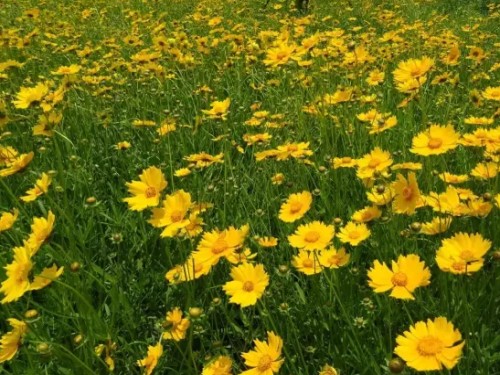
Although it is considered by some people to be an invasive alien species, we can optimize the way large-flowered coreopsis is used and carry out reasonable "control" and utilization. For example: by making use of its innate ability to adapt and survive in the wild, apply it more in poor soil in the wild (places with almost no plant community or where plants cannot survive); for urban application, reduce its use in garden city landscapes, and instead cultivate and domesticate it into potted flowers to decorate and accent indoor landscapes, which both satisfies everyone's ornamental needs and controls its seed reproduction in a limited space. Today I will briefly introduce to you how to sow large-flowered coreopsis seeds.
Large-flowered coreopsis is a perennial herbaceous plant with persistent roots in the Asteraceae family, with golden-yellow flowers, and a flowering period from June to September. It is native to the southern United States. It likes a warm, humid environment with plenty of sunlight, is relatively cold-tolerant, and extremely drought-tolerant. It is not demanding about soil and tolerates poor, thin soil, but grows well in loose, moderately fertile, and well-drained loam. It has the ability to self-sow and reproduce.
Large-flowered coreopsis can be propagated by sowing in both spring and autumn. The suitable temperature for germination is 15—20°C. In the north, sowing propagation is generally carried out in August, or direct sowing in the open field in late April in spring, with flowering in July—August, and the flowers continue to bloom until mid-October. The seeds are relatively small, so broadcast sowing can be used for sowing. Mix the seeds with sand, stir them, and evenly scatter them on a seedbed prepared in advance. The seedbed should be about 15 cm above the surrounding ground to facilitate drainage. The seedbed should not be too wide, and should be convenient for operation.
Watering should be even; if conditions permit, it is best to use a hose connected to a sprinkler head or a fine rose watering can. After watering, cover with a straw curtain. From then on, frequently observe the humidity of the seedbed, keep the seedbed moist, and do not let the seedbed become too dry or too wet. The seeds germinate 14—21 days after sowing, and the straw curtain can be uncovered after emergence. After the seedlings grow true leaves, apply 1 application of nitrogen fertilizer. Large-flowered coreopsis is drought-tolerant and afraid of waterlogging, so drain promptly after rain. During the growing period, apply nitrogen fertilizer 2—3 times as a top dressing, and when applying nitrogen fertilizer, also use phosphorus and potassium fertilizers.
Coreopsis, like most other plants, is sown in spring and harvested in autumn, so the sowing period for coreopsis is in early spring. Because the soil needs to be kept moist during the coreopsis sowing period, it cannot be subjected to large temperature changes; alternating dryness and wetness, or being too dry or too wet, are all unacceptable. In addition, coreopsis can only grow vigorously under ventilated and airy conditions, so spring is the best season for sowing coreopsis. Coreopsis is extremely easy to cultivate and can often grow on its own. In production, sowing or division propagation is mostly used; of course, cuttings can also be done in summer, but attention must be paid to temperature control.
If you want large-flowered coreopsis to bloom more, after flowering you can remove the spent flowers. Apply 1 top dressing in July—August, and by National Day it will have abundant flowers and lush leaves. In fertile soil, coreopsis has luxuriant branches and leaves but blooms less; therefore, in order to achieve a good flowering effect, fertilization should be moderate and not excessive. After the seedlings are planted and before new branches grow, loosen the soil; loosening the soil after rain helps respiration. During the rainy season, weed once a week. Pinch once when the plant height is 6 cm, pinch a second time when the branches are 10 cm, and remove willow buds in time.