Illustrated Guide to Sowing Petunia Seeds, with Detailed Planting Steps
The best way to enjoy the pleasures of gardening life is to start by sowing a single seed, watching it break through the soil, watching it grow strong, caring for it attentively, pruning it, fertilizing it, watering it, and recording its growth day by day. This feeling is just like the process of raising a child, and in the end your efforts will be richly rewarded.
Petunia is a perennial herb, often grown as an annual or biennial, 20—45 cm tall; the stems grow prostrate and are covered with sticky soft hairs; the leaves are soft, and the flowers are solitary, funnel-shaped and very beautiful. The flowering period is from April to December, and the seeds are very small. Pelleted seeds bought online are better and easier to succeed with.
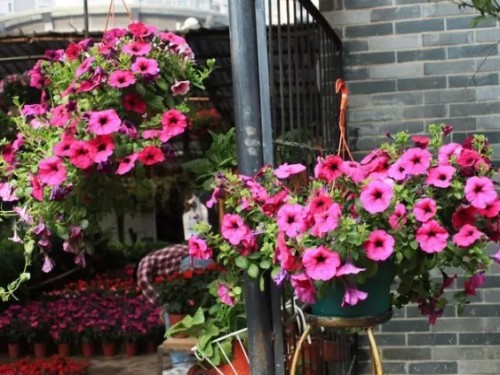
From sowing to flowering takes about one hundred days. Petunias like a warm environment with plenty of sunlight. They are not tolerant of frost and fear waterlogging. Their optimum growth temperature is 13-18°C; in winter the temperature should be 4-10°C, and if it is below 4°C, plant growth stops. In summer they can withstand high temperatures above 35°C. During the peak growth period in summer, they need sufficient water; especially in the hot summer season, water in the morning and evening to keep the potting soil moist.
I found an article online, let's study it together!
Today we have specially prepared for you petunia lovers a set of planting steps from sowing to flowering, which will definitely help those of you who hope to grow petunias well. Previously I saw many people start sowing in February or March; if there is no heating, I think that is rushing things.
Based on my experience from sowing many times, 28-30°C gives the fastest germination, a high germination rate, and strong seedlings during the seedling stage. In Guangdong, April and May are the golden season for sowing. Some people ask, if you sow this late, aren't you afraid the petunias will struggle to get through summer? Petunias that overwinter are indeed difficult to get through summer, but petunias sown in the current year, as long as they are watered enough, will absolutely have no problem getting through summer.
Since my previous records on sowing were not detailed enough, this time I specially photographed every step so everyone can learn from it. This is just my personal method, for everyone's reference only!
Step one: fill the soil (actually the first step is to label the flowerpot)
The soil is Fafard seedling peat; I like to press it down with my hand while filling, crush the large clumps of soil, and throw the ones I cannot crush into the bottom of another pot nearby.
Step two: use carbendazim (active ingredient 50%, diluted 800 times) to first drip-water the potting soil
In this way, dripping from above and soaking from below can ensure the soil is thoroughly wet.
Never directly soak dry soil in water, or it will tip over (the cat's painful experience). Soak it for a day and a night, take it out the next day, let it air for two or three hours, and then water it once more with clean water before sowing; then you do not need to worry about carbendazim causing any harm to the seeds.
I had been paying attention to the weather forecast, and finally, I saw that starting April 6 the maximum temperature would be above 25°C and rising day by day. So I resolutely decided that spring sowing in 2011 would be on April 6! (This time I bought a total of 25 seeds and sowed them in two batches, because during the seedling stage they have to be placed in an enclosure to prevent birds, and sowing too many at once would not fit.) Use a small spoon to scoop up one seed and place it on the soil surface (before sowing I had already used a small spoon to level the soil surface so it would not be bumpy, which ensures the seedlings can root better after germination; those using seedling blocks can skip the soil-filling step above, but personally I deeply loathe seedling blocks and would rather spend more effort filling the soil myself).
Pour some clean water into the box, with the water level soaking about half a centimeter of the pot bottom. In this way, during the sowing process I do not need to specially soak the pots to replenish water.
Put on the lid and place in a bright place with diffused light. Before the seeds germinate, they do not need sun.
Of the 3 that showed white yesterday, 2 have already opened their cotyledons, and the other has not yet shed its cap. I could not resist meddling, overestimated my own skill, pulled it out to manually help it shed its cap and then put it back. But somehow it fell to the ground, and I could not find it no matter what; one was sacrificed (though this seedling did not look very strong either, so it is not a pity. Still, everyone must not imitate this rough behavior and low-level mistake). At this point, 9 have officially germinated (10 counting the one sacrificed; 13 sown, 10 germinated).
Add netting to prevent birds from stealing the vegetables:
To make the seedlings grow faster, use light at night for supplemental lighting (lights off at 12, so the seedlings can sleep well at night). Hehe, this step does not necessarily have to be copied. Anyway, there is a light, so it would be wasted not to use it.
Management of light and water after germination:
As soon as the seedlings germinate, take them out of the seedling box and put them in another box, without a lid, with the pot bottom always soaking in water during the day, about half a centimeter. In the morning and evening, take them up to the rooftop to sunbathe, and at noon take them back to the lower-level terrace with a glass roof. This way the seedlings can get direct sunlight, and with a layer of glass in between they will not be scorched too badly by the sun (simply put, the soft sun in the morning and evening can be safely enjoyed, while the scorching midday sun should be avoided). At night, pour out a little of the water, but there is still water at the bottom of the box; only the pot bottom is no longer soaking in water. The next morning, add water again until the pot bottom is soaking in half a centimeter. Sunbathing must be accompanied by a sufficient water supply, otherwise sunbathing while not giving water is no different from suicide. (Since the potting soil has never dried out, there is no problem of soil blocks floating up during soaking.)
If it is relatively difficult to care for them when you are not at home during the day, I think using a plant light for supplemental lighting is also a good choice.
Moreover, sometimes even if they can get sunlight, if the light does not come from overhead but slants in through a window, the seedlings will still become leggy. With a light, it can be placed directly overhead shining down on the seedlings, so there is no fear of leggy growth.