A detailed guide to bending techniques in bonsai shaping: making branch bending and setting easier
Bending branches and trunks has always been one of the key techniques to master in bonsai shaping, and the quality of a bonsai's framework determines its value in the vast majority of cases; as an important means of shaping the bonsai framework, bending also reflects the depth of one's bonsai-making “skill”. Those with strong technique can always handle the framework with curving variation while keeping it natural, following their own intent without violating the tree's nature, rugged and full of movement.
Bending is a basic skill that must be mastered in bonsai making. When first learning bonsai, one is always afraid of breaking branches when bending. How can you bend easily and freely? Today let's talk about some basic bending skills.
The wood of every tree species is different. Some are more flexible and easy to bend. Some are more brittle and break easily, so they are not easy to bend. Common conifers such as pines and cypresses have very good flexibility. Deciduous trees like maples are more brittle. Also, relatively young branches (non-lignified or semi-lignified branches) are more flexible and easier to bend. So I generally suggest bending as early as possible.
The most commonly used bending method is the wire-wrapping method.
▲Figure 1, before bending
▲Figure 2, after bending with wire
What is being demonstrated is a small cypress. When you hear a slight crack or a small split appears in the branch (trunk), it means the bending has reached its limit and you can stop.
If you need to bend to a large degree, you need to wrap twine or tape around the bending point before wrapping the wire. Wrapping twine or tape helps disperse the force at the bending point and prevents breakage during bending. Even if it splits during bending, the twine (tape) can hold the broken parts together, which is more conducive to wound healing. After the wound heals, the trace of the split is almost invisible.
▲Figure 3, another small cypress for demonstration before bending
▲Figure 4, wrap the bending point with tape
▲Figure 5, wrap with wire
▲Figure 6, after bending
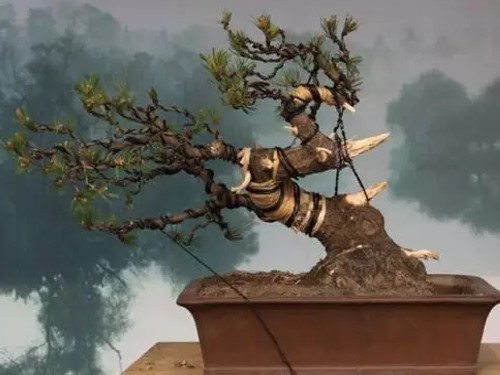
If you want to bend a large branch, the previous two methods are not very suitable. At this point you can use the trunk-splitting method. After splitting the bending point open with trunk-splitting pliers, combine it with the previous two methods, and bending will be much easier.
▲Figure 7, before splitting
▲Figure 8, use trunk-splitting pliers to split the trunk in two
When bending a large branch, you can split it 1-3 times in different directions. The material in the photo above is too small, so splitting once is enough.
After splitting, use the previous two methods: first wrap with tape, then wrap with wire. Then proceed with bending. You will find that bending becomes much easier after splitting.
▲Figure 9, after bending
When bending after splitting, if you also twist the trunk (branch), bending will be even easier. This can better disperse the pressure during bending.
If the bending cannot reach the desired position all at once, you can let it rest for one to two weeks before bending further. After one or two weeks, the bending point has adapted to the curve and released some pressure, making further bending much easier.
▲Figure 10
The photo above shows the effect after the tree in Figure 2 rested for one week and was then bent further.
When can the wire be removed? The timing differs for different tree species. I generally remove the wire after one year. After a year of growth, the bending point has usually set in shape. But remember to check often; if you find the wire starting to bite into the bark, it should be removed immediately. If the bending is not in place, you can rewrap wire to set the shape.
In actual practice, there are far more methods than those summarized above, but no matter which method you use or how many you use at the same time, you should use them flexibly according to your needs and after fully considering their respective advantages, disadvantages and the situation after recovery; you should not bend merely for the sake of bending. The above brief discussion is also intended to exchange experience; if there are any shortcomings, your criticism and correction are welcome.