Cutting Propagation Methods and Key Techniques for Potted Camellias
Camellia is a tree species of warm regions, mostly growing at the edges of sparse shade. It is shade-tolerant and fond of warmth; temperatures that are too low or too high are both unsuitable. It is especially strict about soil quality and suits acidic soil with a pH in the range of 5.0—6.5. It grows vigorously in loose, fertile sandy soil or pine-needle soil (a type of mountain soil), and in the north it is mostly grown in pots. Although camellias can be propagated by sowing seed, because of the great variation this produces, sowing is mostly used when raising rootstock, so the propagation method more commonly used for camellias is cuttings.
Camellia is one of China's ten traditional famous flowers. It likes a warm environment, with an optimum growing temperature of 18-25 degrees, and prefers growing in semi-shade with fairly high air humidity and in deep, fertile, loose soil with good drainage. It dislikes blazing sun and dryness. In the Jiangsu-Zhejiang area, around mid-June is the best period for propagating camellias by cuttings. When propagating camellias by cuttings, the following steps can generally be followed.
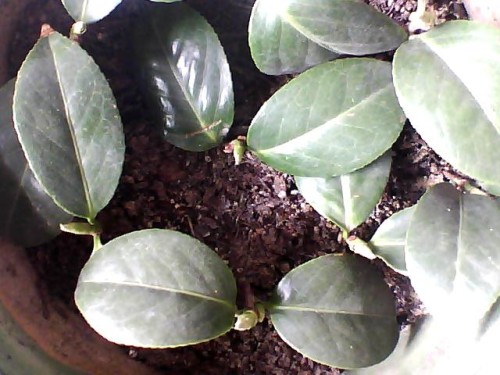
[Cutting Time]
Camellia cuttings are mostly taken in late spring and summer. In the Beijing area, cuttings are mostly taken indoors in April—May, keeping a temperature of 25—28°C and a relative humidity above 90%; in the Shanghai area, cuttings are generally taken in May—June.
[Substrate Preparation]
The cutting substrate should have properties such as heat retention, moisture retention, and looseness and air permeability. Generally, sandy soil or soil rich in humus can be chosen as the cutting substrate; when conditions do not allow it or when propagating in large quantities, clean loess of superior clay quality can also be used. About a week before cutting, the cutting substrate should be put under the sun to bake or disinfected with potassium permanganate solution. One to two days before cutting, water the cutting substrate to moisten it.
[Collecting Cuttings]
Young mother trees are mostly used. Select one-year-old tender shoots from the top, about 10 cm long, remove the lower 2—3 leaves, and cut flat or into a horseshoe shape below the node with a sharp blade, leaving the terminal bud and lateral buds at the upper end, and treat the cuttings with auxin. Before cutting, soak the base of the cuttings in 200—500 ppm naphthaleneacetic acid or indolebutyric acid. Cuttings can also be treated with vitamins. Before cutting, dip the base of the cutting in vitamin B12 injection liquid, take it out and wait about 1—2 minutes for the liquid to be absorbed into the cutting, then proceed with cutting.
[Treating the Cuttings]
As cuttings, shoots from young trees root more easily than shoots from old trees, and semi-lignified tender shoots root more easily than fully lignified old branches. Therefore, from camellia mother plants that are of good quality, stable in traits, robust in growth, free of pests and diseases, and relatively young, select current-year, well-developed, semi-lignified branches as cuttings, and cut them into 8-10 cm long cuttings, keeping the upper 2 leaves and removing the remaining leaves from the base of the petiole. Cut the upper end of the cutting flat at about 0.5-1 cm from the bud, and cut the lower end obliquely near the internode.
[Cutting Method]
When cutting, follow the principle of cutting as soon as collected. Insert 1/3 of the treated cutting branch into the moist substrate (generally about 3 cm; in dry areas it can be inserted somewhat deeper). To avoid damaging the cortex at the base of the cutting, first make a hole with a small wooden stick slightly thicker than the branch, then insert the cutting, and afterward press the soil gently with your fingers so that the soil is in close contact with the cutting. The cutting density should be such that the leaves just slightly overlap.
[Management After Cutting]
The management and the soil used are the same as for sand bed cuttings. If sealed with a plastic bag, the number of water sprays can be reduced. Keep the temperature at 25—28°C and the relative humidity above 90%; roots will form after 3 months. The four factors affecting rooting of cuttings are humidity, temperature, air, and light:
After cutting, immediately water the seedbed thoroughly once, and set up a hoop frame, cover it with plastic film, and keep the air humidity at about 95%, with the temperature controlled between 18-27 degrees. At first the seedbed should be shaded, and the degree of shading needs to be fairly high. If hot weather occurs, the temperature can be lowered by spraying water on the leaves or misting in the air. After 15-20 days, callus tissue begins to form; at this point the amount of watering can be gradually reduced, keeping the humidity at about 85%. About 20 days after callus tissue forms, rooting begins. After that the amount of watering can be further reduced, keeping the soil merely moist. While avoiding direct strong light, gradually increase the light duration so that the cuttings can carry out photosynthesis, and at the same time the two ends of the film can be appropriately opened to let in ventilation.
The cutting density of camellias in the seedbed depends on the variety and leaf size. It is required that after cutting the leaves do not overlap each other. Generally, a plant spacing of 4-5 cm and a row spacing of about 10 cm are used, inserting about 3 cm into the bed soil; shallow insertion favors rooting.
After cutting, spray water and shade promptly to prevent direct sunlight, keeping the temperature at 25-30°C and the relative humidity at 85-95%. Therefore, when taking camellia cuttings, plastic sheds are often used for heat and moisture retention, and a shade net or curtain is covered over the top of the shed, with water sprayed to lower the temperature.
When the cuttings grow new roots 30-40 days after cutting (without treatment), or 15-20 days after cutting (with plant growth hormone treatment), gradually reduce shading and increase light until the plastic film is removed and normal seedling-stage cultivation begins. Strengthen fertilizer and water management and loosening of the soil and weeding, so that the camellia cuttings have a good growing environment.
There are two cultivation methods: field planting and pot planting. If used for landscaping cultivation, shade trees are needed as companions. For pot cultivation, deep clay pots are better, and the potting soil should preferably be loose, fertile, and easily drained. Young seedlings are repotted once every 2-3 years. Fertilization must grasp 3 key periods, namely February—March, when nitrogen fertilizer is mainly applied. If flower buds are too dense, bud thinning should be carried out, so as to keep 1-2 flower buds per branch. The number of waterings depends on the climate, following the principle of keeping the soil moist. In the north, potted plants should be placed in a cold room with good light and ventilation in winter; in summer they are moved outside and placed under a shade shed or beside tree tops.