How to prune fruit tree bonsai? Detailed explanation of the correct method
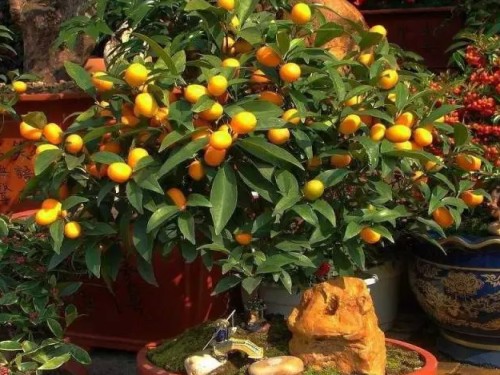
An outstanding fruit tree bonsai combines the abundant harvest beauty of fruit tree cultivation with the artistic beauty of traditional Chinese bonsai, possessing a distinct style and character of its own. When a fruit tree bonsai has too many branches, it easily leads to dispersed tree nutrients, insufficient internal light, poor fruit quality and other problems. Therefore, before fruit trees bud in spring, crossing branches, overlapping branches, diseased and pest-infested branches, and water sprouts should be pruned away. This is basically the same as pruning in other Clivia gardens and is called basic pruning.
During the summer fruit growth period, control the tree shape through pinching, bud removal, and heading back, and prevent the formation of apical dominance to promote fruit growth and swelling. In autumn, in order to improve the ornamental effect of the fruit tree bonsai, shaping should be the main focus; branches that affect the ornamental effect can be pruned away, and leaves covering the fruit can simply be removed.
The following principles should be grasped when pruning fruit tree bonsai:
1. Look at the age of the tree: For young trees, in order to increase the amount of branches and leaves, expand the crown, and form a good structure as early as possible, winter pruning should be carried out in November-December. For vigorous trees at the appropriate age for fruiting, winter pruning time can be appropriately postponed until early spring budding. For weak trees in full fruit period, in order to promote their vegetative growth and quickly restore a robust tree vigor, the winter pruning task should be completed before the end of December.
For vigorous trees in full fruit period, in order to weaken their tree vigor and form more flower buds, winter pruning can be carried out in January-February; look at the strength of the tree vigor: the degree of pruning should be grasped from both the whole and the parts, and overall the tree vigor should be kept balanced. The crown should be full and compact, with clear primary and secondary relationships, dense on the plane, and the upper-layer scaffold branches obviously shorter than the lower-layer scaffold branches; subordinate branches should give way to dominant branches, and the growth vigor of scaffold branches on the same layer should be approximately consistent. As long as the goal of firm and compact framework, ventilation and light transmission, and early fruiting and high yield can be achieved, it can be organized and guided according to its original tree shape and tree vigor. Do not overemphasize shaping, especially for young trees, as this often prevents them from fruiting early and producing early.
2. Look at the appearance of the branches:
① Fruit tree bonsai that is strong on top and weak below: prune the strong upper branches back to flower buds, change to a weak leader, or even saw off the strong upper part; for the weak lower branches, heavily cut back the main branch leader from the base at a plump bud.
② Fruit tree bonsai in which the growth vigor of the basal main branches is inconsistent: prune strong main branches back to flower buds, and heavily cut back thin and weak main branches from the top at a plump bud.
③ Fruit tree bonsai with no side branches or internal branches to speak of: choose the best upright branch and pull it with rope to a reasonable position, and thin out those that are too dense.
④ Fruit tree bonsai with no tree shape to speak of: saw off some obviously redundant large branches, open up the distance between layers, select scaffold branches for key cultivation, make long-term plans, and use methods such as "pulling, propping, and pressing" to make the tree structure as reasonable as possible. If there are very few or no flower buds, there should be more releasing, more thinning, and less heading back.
3. Look at the pruning response:
If the 1-year-old branches on the 3-year-old branch section have a large number of medium and short branches that are thick and strong, with plump buds, and whose growth length is significantly less than the extending leader, and some leaf cluster branches are also differentiated, it indicates that the pruning amount in the previous years was appropriate and can continue to be used that year. If the length of the 1-year-old branches on the 3-year-old branch section is similar to or exceeds the extending leader, it indicates that the pruning amount in the previous years was too heavy, and light pruning should be appropriate that year. If no medium or short branches grow on the 3-year-old branch section, and only some leaf cluster branches with very small leaves are attached, it indicates that the pruning amount in the previous years was too light, and heavier pruning should be appropriate that year; look at the number of flower buds: detailed work should be done locally to give flower bud branches and leaf bud branches an appropriate ratio, generally 1:2-3.
4. The "three sparse and three dense" principle, namely: large branches sparse, small branches dense; peripheral branches sparse, internal branches dense; upper branches sparse, lower branches dense. "One large and one small" means: lower part large, upper part small.
5. Treatment of branch groups and small branches of fruit tree bonsai.
Fruiting branch groups should be promptly retracted, rejuvenated, and renewed to maintain robust fruiting vigor. For other branches, new branch groups should be formed after treatment. Vigorous trees and vigorous branches should be mostly released and less cut, and retracted after fruiting becomes weak. For branches that have been released too long and gone past the head, they should be promptly retracted and rejuvenated, and cultivated into fruiting branch groups. For back branches, they should not all be thinned out, and should also be used according to the situation. Young trees have strong vigor, and back branches easily grow vigorously; they can be controlled by methods such as multiple pinching during summer pruning, branch pulling, and branch bending, turning the useless into the useful; trees in full fruiting period have already stabilized in vigor, and back branches do not easily grow vigorously, so they can be kept or removed according to space and position; for old trees after the full fruiting period, back branches should all be used in order to renew tree vigor and extend the fruiting years.
6. Methods for thinning branches of fruit tree bonsai:
First, do not remove small ones and not remove large ones. That is, when thinning branches, first consider removing large branches, and then consider removing small branches, to prevent the phenomenon of the whole plant becoming a "bare stick."
Second, for trees with too many large branches, do not thin out too many at one time; it can be done year by year, in batches, and no more than two at a time.
Third, do not thin out two opposite large branches at the same time, causing a matched wound, so as to avoid weakening the upper tree vigor.
Fourth, wounds should be disinfected and protected. They can be disinfected with 2% copper sulfate solution or original lime sulfur mixture, and coated with paraffin or anti-rust paint to prevent the invasion of pathogens and the evaporation of tree moisture.
7. Disinfection of pruning tools. Tools often come into contact with diseased scars due to carelessness; at this time, they should be promptly disinfected with 3-5 degrees Baume lime sulfur mixture or 50 times Fumei arsenic solution to prevent the spread of pathogens.