How to prune a cherry tree bonsai? A detailed explanation of the pruning techniques
Potted cherries bloom in spring and their fruit ripens in early summer; the flowers are beautiful and the fruit is colorful, giving them considerable ornamental value. The fruit ripening period is especially early and the flavor is relatively good, making them an early-summer seasonal fruit.
When pruning, note that after selecting and retaining good main branches on young trees, the vigorously growing branches should be medium-shortened to promote branching, and during the juvenile stage more branches should be grown. Once a certain number of branches is present, some slanting, moderately vigorous branches should be left unpruned to promote the formation of flower buds and encourage more flower buds. Sweet cherries (Prunus avium) bear fruit mainly on bouquet spurs, so when pruning, protect the terminal leaf buds of the bouquet spurs. Chinese cherries (Prunus pseudocerasus) can bear fruit on all kinds of fruiting branches, so some long, medium and short fruiting branches of various types should be developed. For potted cherries that have entered the fruiting stage, attention should be paid to renewal pruning by cutting back slender branches and aged branch groups.
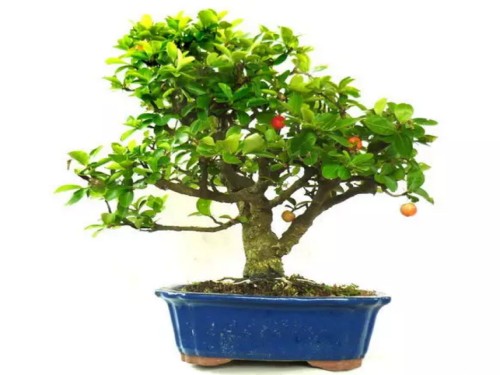
In principle, cherry pruning is mainly carried out during the growing season, but due to the constraints of actual production conditions, growing-season pruning is sometimes not done thoroughly, so it needs to be adjusted through pruning before bud break in spring. Pruning before bud break should avoid cutting large branches as much as possible to reduce wounds and prevent gummosis, and should focus on thinning out overly dense branches and competing branches, with few heading cuts. Pruning is generally required to be finished before March 10. The pruning principles for fruit trees at different stages are:
1. For young trees, thin out the excessively vigorous upright main branches on the central leader and the excessively vigorous water sprouts on the main branches; for the retained main branches and the lateral branches on the main branches, focus on bending branches down to open the angles and on notch budding. The opening angle of main branches should preferably be 60—70 degrees, and the opening angle of lateral branches should preferably be 70—80 degrees. When bending branches down, they should be pulled into a straight line, and by no means into a bow shape. Notch budding is generally carried out in early March before the buds sprout, and on the main branches its purpose is to promote the growth of lateral branches.
2. For trees in the early fruiting stage, 4—7 years old, the tree structure should be adjusted, with attention to developing fruiting branch groups on the main branches. First, gradually thin out main branches that are too low or too dense so that the main branches do not affect one another; second, appropriately cut back branches that have no branching in order to promote branching; third, cut back or head back overly weak lateral branches to rejuvenate them, and open the angle of overly vigorous ones to moderate their growth and promote flower formation.
3. For trees in the full fruiting stage, adjust the tree structure well and improve the light and air conditions within the canopy; surplus upright branches, overly dense branches, overlapping branches, crossing branches and the like that emerge within the canopy must be firmly thinned out, and the spacing between tiers should be opened up so as not to disrupt the tree shape or consume nutrients. If the tree is too tall, promptly cut back the top to open the center, using a weak branch as the leader to control the canopy height.
After pruning, the wounds must be properly treated. When sawing off branches, the saw cut should be flat and no stub should be left; splitting must be prevented. In order to avoid wound infection by diseases and to help the wounds heal, a sharp knife must be used to smooth the cortex and xylem around the wound, then 5-degree Beaume lime sulfur mixture or a fungicide should be used for disinfection, after which protection is carried out. Common protection methods include applying lead paint, paint, thin mud, wrapping with plastic film, and so on. All these wound protection methods can prevent the wound from losing water and from further enlarging, but they are less effective at promoting wound healing than applying a wound protectant. Some commercial wound protectants specially made for fruit trees are now available and can be chosen for use in production, or you can mix your own.
1. Liquid grafting wax: prepared with 6 parts rosin, 2 parts animal fat, 2 parts alcohol and 1 part turpentine. First heat the rosin and animal fat together until melted, stir well, remove from the heat and let cool, then slowly add the alcohol and turpentine, stir well, put into a bottle and seal for later use.
2. Rosin and clear oil mixture: prepared with 1 part rosin and 1 part clear oil (phenolic varnish). First heat the clear oil to boiling, then add the rosin powder and stir well. When used in winter, more clear oil should be added as appropriate; in hot weather, a suitable amount of extra rosin may be added.
3. Soybean oil and copper agent: prepared with 1 part each of soybean oil, copper sulfate and slaked lime. First grind the copper sulfate and slaked lime into fine powder, then pour the soybean oil into a pot and boil it, then add the copper sulfate and slaked lime to the oil, stir thoroughly, and it is ready for use after cooling.
In addition, cherry trees often split at the base of large branches after being bent down because the bending is not done in time or the branch angle is pulled too rigidly. For this kind of injury, a support stick should be used to prop and support it, and the split should be smoothed level in time, then wrapped with plastic film to promote wound healing. The split branch does not need to be tightly tied back to its original position; letting it remain in the split state often results in better wound healing than restoring it to the original position.