How to prune tree stump bonsai? Detailed explanation of pruning methods and techniques
Tree stump bonsai is a living work of art made by planting old woody plants in pots and, through years of artistic processing such as pruning, wiring, and fertilizing, plus meticulous management, giving the trunk rugged strength and the branches and leaves lush green foliage. It does not take its final form from the initial artificial shaping, but instead grows and changes continuously according to natural laws, therefore, routine care and management are very important.
Tree stump bonsai usually uses woody plants as the production material, selecting plants with graceful posture, short stature, small leaf shapes, long lifespan, tolerance to pruning, strong resistance, and ease of shaping. Without going against the growth habits of the trees, methods such as leaf removal and pinching are used to inhibit their growth and carry out shaping. In the cultivation process of this kind of bonsai, the maker can process it according to their own intentions into various artistic forms such as gnarled and interlocking roots, or rugged and upright. The care of tree stump bonsai mainly includes watering, fertilizing, pruning, soil replacement, and pest and disease control.
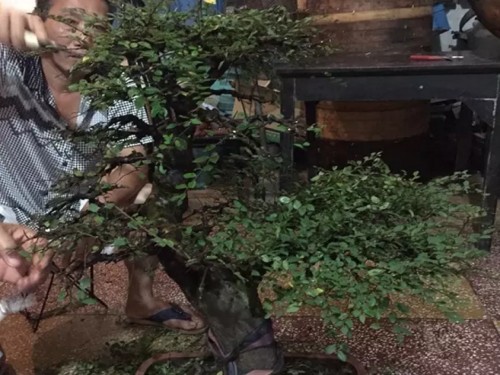
The fertilizing, watering, repotting, and soil replacement of tree stump bonsai are similar to those of potted flowering plants, but pruning is especially important. For bonsai that have already taken shape, measures such as pinching, tip pruning, branch thinning, bud removal, and leaf removal must be adopted separately according to tree species to keep them in a wonderful posture.
In particular, for some stump bonsai with shaped branch pads, new branches often suddenly grow during the growing season, and these protruding branches should be cut off in time to keep the branch pads flat and the layers clear. For tree species with strong sprouting ability such as Chinese bird plum and elm, pruning should be done 3-5 times a year; for tree species such as Buddhist pine and yew that grow slowly and have weak branching ability, pruning once each in June and October is enough.
For pine bonsai such as Japanese black pine, five-needle pine, Huangshan pine, and Japanese white pine, if you want short and dense branching, all the main buds on the branch tips should be removed in April, and the branch tips that grow again will be shorter; afterward, remove overly dense branches. For stump bonsai such as elm and Chinese bird plum, adventitious buds are easily produced on the trunk and branches and should be removed at any time to avoid the growth of forked branches that affect the beauty of the tree shape. For tree species such as Japanese maple, boxwood, and holly, after budding, leave 1-2 nodes and pinch the tips; pinch again after new growth, so that the branches are dense and short without losing proportion.
For flower-viewing and fruit-viewing tree species, pruning should be based on their flowering and fruiting habits. For example, firethorn and crabapple mostly bloom and bear fruit on short branches close to the main branches, so vegetative long branches can be appropriately shortened to make them produce fruit branches, while also allowing the existing flowers and fruit to be fully displayed. Plum blossom and winter jasmine are both heavily pruned after flowering to promote the growth of strong new branches and produce more flowers the following year. Winter is the best pruning period for deciduous tree species, and careful pruning should be carried out, cutting away drooping weak branches, messy branches, crossing branches, and overlapping branches, so that the crown is well spaced, clearly layered, and orderly.
In short, tree stump bonsai requires long-term care, careful observation, and patient pruning to cultivate a beautiful tree shape.
A pot of tree stump bonsai that has already been shaped by wiring or has good natural conditions often grows many new branches. To maintain its perfect posture, the bonsai must be pruned regularly; otherwise, it will gradually lose its layers, causing imbalance in proportions and a disordered tree shape.
1. Prune useless branches in time
Generally, crossing branches, parallel branches, wheel branches (that is, branches growing in a whorl around one place on the trunk), diseased and pest-damaged branches, and all branches that hinder beauty should be cut off whenever they are found. This can not only maintain the original posture of the bonsai, but also help regulate the reasonable supply of water and nutrients, so that flower-viewing and fruit-viewing bonsai bloom continuously and bear abundant fruit year after year.
2. Pruning of broadleaf tree species
Generally, broadleaf species such as Chinese elm, Chinese bird plum, and firethorn have relatively strong sprouting ability. If they are allowed to grow naturally after shaping, many new shoots will emerge at the top of the crown, and the pinching method should be used at any time to cut them flat and even, so as to maintain the original layers and posture of the bonsai. This pinching and shortening work needs to be carried out 3-4 times a year. Root suckers, side buds, and adventitious buds on branches and the main trunk should be cut off or removed in time after they sprout.
3. Pruning of coniferous tree species
For coniferous tree species such as five-needle pine, Huashan pine, Japanese black pine, and Huangshan pine, the main methods are shortening and bud removal to control the elongation of branches and prevent the leaf clusters from becoming too dense. The new shoots that grow after the terminal buds sprout generally grow very fast and often protrude beyond the root crown, damaging the tree shape. Therefore, in April each year, remove 2/3 or all of the main buds on the side branches by hand; two weeks later, 2-5 secondary buds can sprout at the same time from the place where the terminal buds were removed. These secondary buds disperse the nutrients within the plant and have very weak growth vigor, thus maintaining a relatively flat and dense crown with an even top. Two-year-old side branches should also be appropriately shortened; several new buds can sprout at the same time near the cut, which not only maintains the original layers of the crown but also creates a full, round, and natural tree shape.
4. Pruning of flower-viewing and fruit-viewing bonsai
Before pruning, you must first understand the flowering and fruiting habits of the tree species. For tree species that bloom on short branches, vegetative branches should be heavily pruned to encourage more axillary buds to sprout and form short branches; for tree species whose flower buds differentiate from terminal buds, do not shorten flowering branches, so as not to cut off the flower buds; for tree species that bloom in early spring, the flower buds on the branches were fully differentiated last year, so they must not be shortened in spring, and the correct pruning time should be after the flowers fade. For example, winter jasmine, Chinese rose, poinsettia, pomegranate, kumquat, and crape myrtle bloom on current-year branches, so these bonsai should be heavily pruned during the dormant period to promote the sprouting of new branches and increase flowering. For flower-viewing bonsai that bloom in spring on second-year branches, such as longevity peach, plum blossom, ornamental peach, and Japanese quince, pruning should be done after the flowers fade to promote the sprouting of new shoots and the formation of more flowering branches for the following year. Heavy pruning during the dormant period must be avoided.