How to Prune Roses - Pruning Methods for Potted Roses
Pruning is one of the important measures in rose management. Pruning must be carried out at every stage of growth to ensure abundant flowers and lush foliage throughout the four seasons. During the growing season, bud thinning, bud pinching and removal of spent flowers should be carried out. Bud thinning means removing the excessive young shoots that grow in spring, keeping 2 to 3 on the main branches and removing all the rest; bud pinching means keeping only the one central main bud and removing all the side buds. The purpose of both measures is to remove useless buds and stray branches so that nutrients are concentrated in the main branches.
Removal of spent flowers means promptly cutting off the flower and the two compound leaves below it once the flower has faded. The purpose is to prevent the several axillary buds near the flower from sprouting weak branches and producing small deformed flowers, which both wastes nutrients and spoils the beauty of the flower shape.
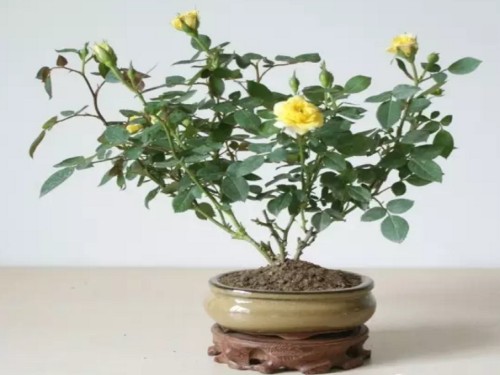
Pruning should also be done during the dormant period. The pruning time is around the Spring Festival, mainly cutting off from the base of roses over 2 years old the diseased branches, dead branches, weak branches, overlapping branches and crossing branches, and carrying out different degrees of "heavy pruning", "medium pruning" or "light pruning" according to the variety and characteristics of the rose and its growth conditions. Potted roses that are too small should not be pruned; those below 25cm high can simply be cut back by 1/3; those 25-35cm can be cut back by 1/2; those above 35cm can be cut back by 2/3.
Promptly cutting off spent rose flowers allows the plant to concentrate its nutrients and stay strong and blooming without decline. If spent flowers are not removed in time, the several axillary buds right below them often sprout and form weak branches. These small branches both consume nutrients and spoil the plant shape, and even if they do bloom, they are mostly deformed or poor small flowers. In addition, except for flowers being grown for seed collection, spent flowers must never be allowed to set seed.
After the first batch of flowers, medium branches should be cut back to medium length, keeping 3 to 4 buds on the branch; weak branches should be cut back hard, keeping 1 to 2 buds; strong branches should be pruned lightly, keeping 5 buds, to appropriately restrain growth. The second pruning should be light, cutting only above the second leaf below the spent flower and keeping the axillary bud of the second leaf. This is a bud with the best advantages in both growth and development, and it occupies the dominant position on the whole plant. Cutting off this bud will affect the next flowering period, flower quality and the plant's vigor.
After the Beginning of Autumn, post-bloom pruning (the third batch of flowers) uses medium cutting, keeping 3 to 4 buds on each branch. To balance the plant shape, you can also cut back down to the branches that flowered in the previous batch. Overlapping branches, crossing branches, overly dense branches and leggy branches should be cut off to facilitate ventilation and light penetration and to keep the plant shape well balanced.
At the same time, post-bloom pruning of roses should also be combined with controlling the flowering period. For roses used for National Day, pruning can be done 45 days before flowering, cutting back to medium length and keeping 3 to 4 buds, after which 2 small branches will sprout from each branch. After pruning, increase fertilizer and water, pay attention to preventing waterlogging and powdery mildew, and the flowers will open one after another in late September.
In addition, pruning can make cluster-flowered roses bloom earlier or later. Light pruning of such roses can retain more mature branches and make the plant bloom two weeks earlier; heavy pruning can make the plant produce strong branches that bloom in autumn, delaying the autumn flowers by two weeks. Therefore, different pruning can be adopted for the plant as a whole to advance or extend the flowering period.
Late August or early September is the time for autumn pruning of roses. Pruning at this time makes good use of their roughly 45-day growth period to produce beautiful flowers in early October.
Roses need frequent pruning. This is especially true for potted roses, because space is limited and nutrients are not very abundant, while pruning can reduce unnecessary nutrient consumption and at the same time make the plant shape more graceful and keep it blooming continuously. Otherwise, not only will flowering ability weaken, but disease resistance will also decrease.
As for winter pruning, which is relatively heavy, you must be patient and start pruning only after the roses have dropped their leaves, so that they will bloom better the following year. Of course, pruning can also be done during the growing season, generally from late August to early September, mainly so that there will be flowers to enjoy in autumn.
In the north, some roses can be pruned quite heavily, which prevents the branches from freezing injury and still allows them to sprout as usual the next year. But in some regions this is not necessary; generally cutting back 1/3-1/2 of the original height is enough.
When pruning dead branches and diseased branches, if the cut surface is brown or withered, you need to prune further down; if you see white cottony tissue, quickly put down the knife! The tissue left in this way is the healthy part.
When pruning roses, cut off the overly thin and weak branches; they only eat without growing (flowers), so what use are they! The old leaves that have not dropped from the branches may harbor many overwintering pathogens and pest eggs, so they must be removed and cleaned up thoroughly. Otherwise, next year what you admire will not be rose flowers, but a tree full of pests.
For shrub roses, pruning the branches is meant to make the center more open to facilitate ventilation and light, so branches that crisscross each other inside and thin, weak branches should be pruned, and those growing toward the inside should also be cut off.