Detailed Explanation of Daily Pruning Techniques and Methods for Bonsai
Daily sporadic pruning of bonsai refers to timely pruning during routine maintenance. Bonsai tree stumps cultivated from shrubs have a clumping growth habit; in bonsai styling, they can be trained into "small trees" to enhance their ornamental effect, so that what was originally a small shrub appears in the pot in the form of a "towering tree." As for the raw material, apart from the small branches (young shoots) kept as the main theme of the landscape design and those reserved to make up for deficiencies, the rest should be thinned out and cut off, with strict control over the form being directionally cultivated; otherwise they will easily grow wildly and randomly, violating the purpose of the styling.
Although many trees undergo two prunings in winter and spring while in the pot, because they have many latent buds, new branches will from time to time sprout from the roots, trunk, branches and other places, affecting nutrient distribution and the ornamental effect, such as Chinese holly (Ilex cornuta), trident maple (Acer buergerianum), Japanese bush cherry (Sageretia thea), elm (Ulmus), etc. Therefore, once discovered during routine management, they must be removed promptly to keep the form clean and complete, to facilitate ventilation and light penetration, and to be more conducive to viewing.
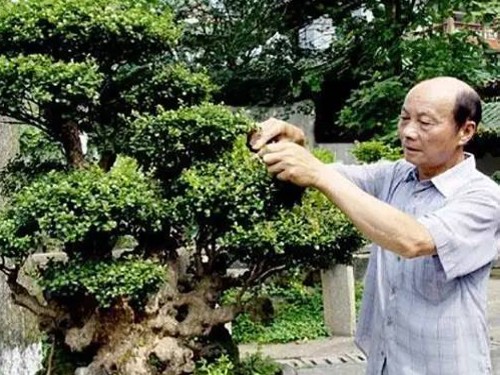
Proper and timely pruning can improve the resistance of bonsai. In daily pruning, attention should also be paid to clearing away diseased branches, diseased leaves, dead branches, and old, weak, or stunted branches; the cut branches should be thoroughly removed to avoid cross-infection. However, dead or residual branches intentionally left for compositional needs should not be pruned. There are also many bonsai tree stumps that obtain parental advantages through grafting, such as red maple, kumquat, etc. During routine maintenance and management, buds and branches sprouting from the rootstock should be promptly removed; otherwise they will compete for nutrients from the scion above, affecting the ornamental effect.
Through seasonal pruning, for small branches that have sprouted from already formed areas or branch pads, or small branches intentionally retained and cultivated, they should be allowed to grow for a period until they reach a high degree of lignification before being cut back to the required length. In this way, during the growth process they can accumulate some nutrients, and on the other hand the small branches are also cultivated to be thick and strong, in keeping with the overall style. One should not mistakenly think that leggy branches must always be cut; otherwise the tree will be pruned into a "dust whisk" shape, as happens with street trees when pruning is done improperly. They should be allowed to each grow thick and long, then be moderately shortened. Later, small branches will sprout from these cut points, and after they each grow long and thick, they are shortened again. Repeating this process gradually forms the shape and builds up branch pads; old stumps will form 6 to 7 grades of branches, gnarled and dense, truly beautiful to look at.
For the branch-cultivation portion of pruning, it is best to have a dedicated person responsible for daily pruning. First, they must understand the original cultivator's intention; second, they must avoid blind pruning. If branches intentionally retained or buds hoped to appear are cut off because the pruner lacks understanding or holds a different view, it will cause an irreparable mistake. With a dedicated person responsible, such errors can be reduced and avoided.
An experienced pruner, besides being sharp-eyed and quick-handed, also lies in being able to correctly distinguish between branches retained by previous pruning and branches that have grown leggy. The former have already had their tips cut, indicating they are to be retained for cultivation; the latter are complete branches with intact tips, indicating they can be cut as needed. As long as one is careful and meticulous, mistakes can be avoided.
The buds borne on a branch are called lateral buds. Their direction of growth is generally on the upper side and both sides of the branch; few are borne on the lower part, and after growing out they easily fail to receive sunlight and are eliminated. When pruning, one must consider the directionality of the buds, not only to create the twisting and turning changes of natural branch growth, but also to conform to the needs of the overall styling, with no duplication, covering, or mutual interference, forming an appearance with ventilation, light penetration, and moderate density.
What we are discussing here today is the timely pruning of bonsai trees in our daily lives. If a bonsai tree stump is a shrub, its growth habit is clumping. When we design the styling, we cultivate it into a "small tree"; what was originally a small shrub can also grow into a "towering tree" in the pot. Through this, we can improve the ornamental effect of the bonsai.
As for the raw material, apart from the small branches kept as the main theme of the landscape design and those prepared to make up for deficiencies, the rest must be thinned out and cut off. Only through strict control can the tree be prevented from growing wildly and randomly.
Although bonsai trees undergo two prunings in winter and spring, they have many latent buds and from time to time sprout new branches from the roots, trunk, branches and other places. During routine management, once discovered they must be removed promptly to ensure the styling remains clean and complete and to facilitate ventilation and light penetration.
During ordinary pruning, pay attention to clearing away diseased branches, diseased leaves, dead branches, and old, weak, or stunted branches; the cut branches should be thoroughly removed to avoid cross-infection. One point that needs to be mentioned here is that, for compositional needs, we should intentionally leave dead and residual branches.
For small branches sprouting from already formed areas or branch pads, the small branches should be intentionally cultivated, allowed to grow to a stage where they show a high degree of lignification, and then cut back to the required length. In this way, the branches can accumulate a certain amount of nutrients during growth, and the small branches can also be built up to be thicker and stronger.