Detailed Explanation of the Key Techniques for Styling Ilex Bonsai
Many studies have shown that, in addition to their medicinal value, plants of the genus Ilex are also excellent landscaping tree species. Their wild original species and cultivated varieties have strong cold tolerance; even when introduced further north to Shandong, they show good growth potential. Therefore, some scholars believe that quite a few Ilex species and varieties can be introduced to the North China and south-central regions of China, providing new tree species resources for local landscaping.
Ilex dimorphophylla is an evergreen shrub or small tree of the genus Ilex in the family Aquifoliaceae. Its stems are grayish-green, and its leaves are lanceolate or elliptically lanceolate with sharp teeth along the edges. The old leaves are dark green, while the new leaves are tender green with a reddish tinge, fresh and bright, extremely beautiful. Its leaves are small and dense, evergreen all year round, with strong sprouting ability and tolerance to pruning, making it very suitable for making bonsai.
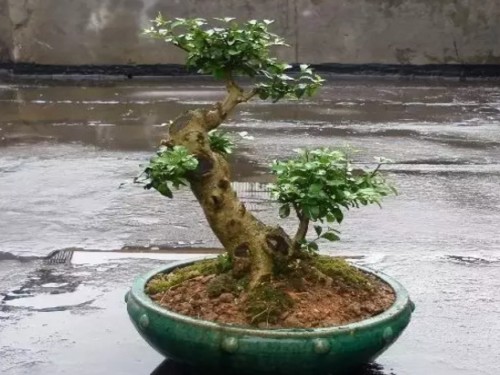
The digging and transplanting of Ilex dimorphophylla is mostly carried out before bud break in spring. Its root system is well developed with many fibrous roots, so it is very easy to survive transplanting. Before transplanting, first cut off unnecessary branches, cut the main root short, and keep more fine roots and fibrous roots. After digging, either coat the roots with mud slurry or put them in plastic bags to keep them fresh and moist, and plant them as early as possible.
Before planting, give the stump a shaping, cutting off branches not needed for styling and excessively long roots. First plant it in a clay pot or in the ground to “grow the stock”. After planting, water thoroughly to settle the roots, spray the trunk with water, then cover it with plastic film. Afterwards, pay attention to the humidity of the soil and inside the enclosure, and replenish water in time. As the weather warms up, the stump will sprout new buds, and the plastic film can be gradually opened for ventilation and hardening of the seedlings. The branches sprouted from the stump planted that year can be allowed to grow naturally and should not be cut off, so that they can produce more nutrients through photosynthesis, which is beneficial for the recovery and growth of the root system. Wait until the second year to carry out bud removal, pruning, or styling.
Ilex dimorphophylla stumps have rich forms, and styling can be guided according to the different forms of the stumps, processing them into different styles of bonsai such as single-trunk style, double-trunk style, forest style, multi-trunk-from-one-root style, cliff style, and waterside style. The crown can be shaped into either an elegant, loose natural form or pruned into a regular rounded-pad form.
The styling methods combine pruning and wiring. Wiring is mostly carried out in October, while pruning is done in late autumn and early winter. A well-made Ilex dimorphophylla bonsai can be moved into a fine pot such as a purple clay pot for viewing in spring or during the plum rain season. Because its root system is well developed, part of the roots can be raised above the soil surface to expose the roots and claws, so as to reflect the characteristic of vigor and antiquity, and rocks can be placed on the pot surface as needed.
Ilex dimorphophylla is suitable for growing in a warm, humid environment with sufficient sunlight. It tolerates semi-shade and has a certain degree of cold tolerance. Usually its management is relatively extensive. Do not fertilize stumps transplanted in the same year. When the potting soil is dry, replenish water in time. In summer, when temperatures are high, pay attention to shading to prevent exposure to the scorching sun. In the second year's growing season, apply a once every 20 days diluted liquid fertilizer that has been fully decomposed. In summer, shading is also unnecessary. Usually keep the potting soil moist, and when the air is dry, spray some water on the leaf surfaces to increase air humidity, making the leaf color glossy and emerald green. During the growing period, remove new branches and tender buds that affect the tree shape at any time to maintain the beauty of the bonsai.
Carry out pruning and shaping once every year in late autumn and early winter, cutting off diseased branches, crossing branches, parallel branches, and dead branches, so that the interior of the bonsai is ventilated and receives light. In winter, move it indoors, and the overwintering temperature should preferably be kept between 0°C and 10°C. Do not fertilize, and do not water too much. Repot once every 2 to 3 years in spring. It has low requirements for soil, but grows better in loose, fertile sandy soil with good drainage and air permeability.