Detailed Explanation of the Key Points of Seed Sowing and Seedling Cultivation Techniques for Flowering Almond (Prunus triloba)
In early May in the north, when dead wood comes back to life, the spring breeze blows with spring rain, and there is still a shivering chill. Some small flowers are so frightened by this chill that they dare not show their heads, but the flowers of the flowering almond, having perhaps inherited the character of the plum blossom, insist on occupying every branch, nurturing flower buds, and after being moistened by the spring rain, within a few days they are already a mass of blooming flowers. Seen from afar, they look like huge flower balls rolling with the wind, and just like that, spring in the north has arrived……
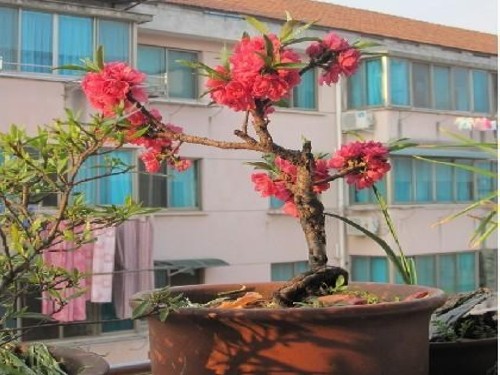
The flowering almond belongs to the Rosaceae family and blooms in April. It is an early-spring flowering tree species with dense branches and leaves and bright flower colors. It is suitable for planting in parks, on lawns, and along roadsides, and when planted together with evergreen tree species or with forsythia, it can produce an even better ornamental effect. The double-flowered flowering almond loves light and is drought-tolerant and cold-tolerant. Because its petals are in many whorls and its leaves resemble elm leaves, it gets its name, and it is an early-spring flowering tree species with relatively high ornamental value that is commonly cultivated in the northern regions of our country.
Below, the editor will introduce to you the seed sowing and seedling cultivation techniques for the flowering almond.
[Land Preparation]
Choose an area with open terrain, good ventilation and light, and good drainage. Before preparing the land, first irrigate thoroughly with bottom water so that the lower soil layer stores enough moisture to meet the needs of seed germination and emergence. The depth of land preparation is 10~20 cm, making the soil loose, fine, uniform, and moist.
[Seed Treatment]
1. Sand mixing to promote germination
When the fruit turns from green to red, the seeds can be collected. Soak them in clean water, remove the flesh, mix with 2~3 times their volume of wet sand, then store them in a pit or in a pile. After sand storage for more than 2 months, most seeds will have cracked open and can be sown.
2. Soaking seeds in quicklime
Soak the seeds in 5~10% quicklime for 3~5 days, and they can be sown once the seeds have cracked open.
[Sowing]
Open furrows and sow in spots, with a row spacing of 40 cm, a plant spacing of 10~15 cm, a furrow depth of 6~7 cm, and a soil covering of 3~4 cm.
[Seedling Stage Management]
During the seedling growth period, water more and weed frequently, and prevent black spot disease, white root rot, and aphids, etc. Black spot disease mainly harms the leaves, and it can be controlled by spraying Bordeaux mixture or a 600-fold dilution of 50% polymyxin. Aphids mainly feed by sucking leaf sap, and they can be controlled by spraying a 1000-fold dilution of 40% dimethoate emulsion.
[Pruning]
In order to increase the ornamental effect of the flowering almond, pruning should be carried out irregularly after flowering. Scientific and reasonable pruning can not only cultivate a beautiful tree shape, but also regulate the reasonable distribution of nutrients within the tree body, control excessive growth, and keep it blooming continuously.