Nasturtium Sowing Diary and Photos of Potted Nasturtium Climbing Frames
Nasturtium is an annual or perennial climbing succulent herbaceous plant. The stems are slender, succulent and hollow, smooth and hairless. The leaves have long stalks, are round and peltate, shaped like lotus leaves. The flowers are yellow or orange-red and give off a sweet fragrance; under suitable climate conditions, it can bloom all year round. The fragrance is rich and the colors are brilliant, making it deeply loved by people.
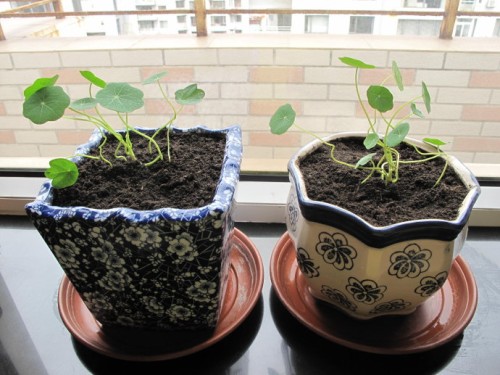
For gardening enthusiasts growing nasturtium for the first time, what they most want to know is certainly how to sow, when to pot up, and when to fertilize and pinch back. Below is a brief explanation of the growing process of nasturtium from sowing to harvest.
[Sowing]
Nasturtium can be sown in spring or autumn. Because autumn-sown nasturtium has a longer growth cycle, it performs much better than spring-sown nasturtium. The plant shape is compact, the flowers are abundant and concentrated, suitable for hanging, and the seeds are numerous and plump. Spring-sown nasturtium has slender, weak branches and long internodes, suitable for climbing, and the seeds are few and small.
Before sowing, you can pre-sprout the seeds. Of course, if you are as lazy as I am, then just sow them directly!
1. Pre-sprouting method:
① First, soak the nasturtium seeds in clean water for one day, until the wrinkled skin on the surface of the nasturtium seeds becomes stretched and no longer wrinkled.
② Use a disposable plastic lunch box, though other boxes are also fine. Place 2 layers of paper towels on the bottom of the box and spray them with water. Note: do not use scented paper towels. Put the seeds on the paper towels, then cover with another layer of paper towels and spray them wet as well. Then cover with the lid and begin pre-sprouting. When the temperature is above 20°C, the seeds generally show white sprouts in about 3 days.
2. Sowing:
① After the seeds extend their little white roots, they can be sown. First mix peat, perlite and vermiculite in a 1:1:1 ratio and put the mix into a seedling tray.
② Make a hole in the middle of the soil; the hole should be large enough to fit the seed. Gently place the pre-sprouted seed into the hole, being careful not to break the white sprout. Then gently cover with soil. Keep the soil moist, and after 3-5 days the seeds will break through the soil.
[Seedling Care]
① After the nasturtium seedlings break through the soil, they should be moved to a bright place as soon as possible and gradually moved into sunlight for care, so as to avoid leggy growth.
② When the nasturtium has grown 5-6 leaves, pinch off the growing tips to encourage side branches to sprout, so that it can bloom more later. For the first pinching, just keep 4 leaves.
③ No fertilization is needed during the nasturtium seedling stage. After the first pinching, once the roots have filled the seedling tray, it can be potted up and planted in place.
[Planting Out]
For planting nasturtium, the soil can be peat + perlite + vermiculite in a 1:1:1 ratio, plus 10% granular chicken manure fertilizer and 10% worm castings as a base fertilizer.
[Pinching and Top Dressing]
After planting out, carry out the second pinching when the side branches grow 4 leaves. Multiple pinchings are needed for the plant to achieve a full effect.
In order to make nasturtium bloom early, during the growing period, alternate root drenching with diluted potassium dihydrogen phosphate solution and foliar spraying with water every 7 days.
[Pollination]
After nasturtium blooms, if you do not need to save seeds, promptly cut off the spent flowers to avoid consuming too many nutrients and to help the formation of new flower buds.
Nasturtium grown outdoors does not need artificial pollination; wind and insects will complete this task. But if it is grown indoors, artificial pollination is needed to produce seeds.
Artificial pollination is best done on a sunny morning. When the stamens pop out pollen and the pistil is in a “Y” shape, dip up the pollen and apply it to the pistil. Pollination can be done with the same flower or a different flower. After pollination, the pollen will quickly wither. When the flower stalk bends into a spiral shape, it indicates successful pollination.
[Seed Collection and Storage]
Mature seeds will fall off on their own. At this point, dry the seeds in the sun and then store them in a cool place.
Potted nasturtium should be placed in a sunny spot in spring and autumn. In summer, it needs appropriate shading and should be placed in a ventilated, cool environment with timely watering. In the north, move it indoors in mid-October, or take some cuttings and place them in a sunny spot for care; with enough sunlight, they will continue to root, grow leaves and bloom.
Nasturtium is an annual or perennial climbing succulent herbaceous plant. The stems cannot stand upright; when they grow to 50 cm tall, a frame is needed. You can build various different styles. Below are a few photos of potted nasturtium climbing frames for everyone:
Hemispherical
Hemispherical
Spindle-shaped
Triangular prism-shaped
Cylindrical
Flat trapezoid