Rose root grafting technique - a root grafting method for bare-root rose grafting
Speaking of root grafting, we need to first talk about grafting. Why? Because root grafting falls under the "scion grafting" category of the two grafting methods, "scion grafting" and "bud grafting." Grafting is one of the artificial vegetative propagation methods for plants. That is, grafting a branch or bud of one plant onto the stem or root of another plant, so that the two joined parts grow into a complete plant. Root grafting uses a root system as the rootstock, onto which the scion is grafted. The root used as the rootstock can be a complete root system or a single root segment.
Root grafting is a nursery method that uses roots as rootstock and grafts cultivated varieties onto the roots. The timing of root grafting is the same as that of scion grafting, mainly carried out during the dormant period of the nursery stock.
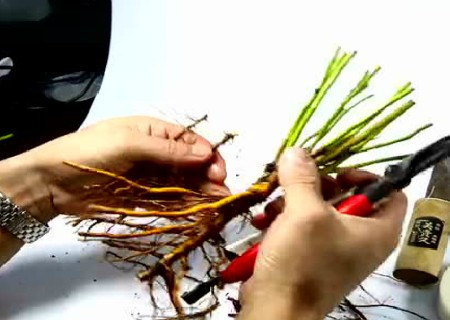
After the nursery stock is lifted in autumn, select one-year-old roots with a diameter of more than 1 cm and cut them into root segments of 10 cm—15 cm. Each rootstock root segment should carry several fibrous roots. If there are no fibrous roots, the length should be increased, and the root should be notched to promote lateral root development. After cutting, bury them in wet sand in a cellar for later use. During storage, pay attention to maintaining the moisture of the sand, preventing it from becoming too dry or too wet, and pay attention to the temperature inside the cellar to prevent the rootstock from heating up or freezing.
For the scion, select healthy, vigorous, pest- and disease-free one-year-old growing branches with a diameter of about 0.8 cm. You may select the best ones from branches pruned in winter. Branches that have already sprouted are not suitable for use as scions.
When grafting, first cut the scion into a wedge-shaped cut surface according to the requirements of cleft grafting or cut grafting, and insert it into the cut at the thicker end of the rootstock root. The cambium layers of the rootstock root and the scion must be aligned and closely joined. If the thickness of the rootstock root and the scion differs, and the root segment is thinner than the scion, cut the root segment into a wedge-shaped cut surface and graft it onto the scion, and be sure to align and closely join one side of the cambium layers. This is the key to whether root grafting succeeds.
After grafting, bind tightly with fine hemp fiber and store in a seedbed or cellar, covered with wet sand on top. Note that the binding material must be hemp fiber, because the graft union of root grafting is buried underground, and after survival it is not easy to remove the binding material, while hemp fiber buried in wet soil can naturally rot away. If plastic film strips are used for binding, they will hinder the growth of the grafted seedling, or even constrict and break it at the graft union, causing the death of the seedling. The temperature of the seedbed and cellar should be maintained at 4°C—7°C to facilitate the formation of callus tissue at the union.
In mid-March of the following year, plant them out in the nursery. When planting, make sure the fibrous roots on the rootstock root are spread out. The planting depth should be such that the top bud of the scion is level with the ground. After planting, water once thoroughly to promote new root growth, then carry out topdressing, irrigation, weeding, pest and disease control, etc., according to conventional management methods.
Specific operation steps:
1. Prune the root system and remove the upper rose branches. Cut a short section of branch with a plump bud from the branch. Choose a healthy root and cut off the part above its root.
2. Choose a branch with healthy, plump leaf buds and cut the base of the branch into a flat spade shape. Make two vertical cuts on the flat surface of the root, with a spacing and length of about 1CM, cutting through the bark to the hard part (cambium), and use a knife to pry open the outer bark.
3. Cut open the bark layer of the rootstock; the cut only needs to be kept the same length as the cut surface of the scion. Cut the lower end of the prepared scion at a 45-degree angle along the side with the bud point, then lightly shave off a little of the outer bark on the side facing away from the bud point.
4. Insert the scion into the rootstock, align the cambium layers, insert the scion into the pried-open bark with the bud point facing outward, and gently push it down a little with slight force.
5. Wrap with budding tape to prevent dehydration and drying out, leaving the bud point exposed. This completes the root grafting process. Bind with grafting film strips, paying attention to the tightness of the binding, then place in a cool place to recover.
6. After planting, place it outdoors for care. After about a week, the appearance of sprouts or small leaves indicates that it has survived.
Why do we choose rose root grafting? This requires explaining the advantages of rose root grafting:
1. Long lifespan: The rootstock used in root grafting is the entire root system of seed-grown wild rose. According to references, seed-grown wild rose can live for thousands of years, which is naturally far beyond that of ordinary cutting seedlings. In our actual growing experience, the lifespan of the roots is indeed longer than that of the "branches."
2. Few suckers: Since only the roots of wild rose are used and no rose bud points are included, the plant also has relatively few suckers.
3. Fast growth: This grafting method uses the entire root system of seed-grown wild rose. The nutrients that the powerful root system can provide to the seedling far exceed those provided by cutting seedlings. Therefore, the growth rate of root-grafted seedlings is far superior to that of cutting seedlings or ordinary grafted seedlings.
4. Strong root disease resistance and environmental adaptability: Among all rootstocks, the root system of seed-grown wild rose is highly resistant to pests and diseases, and also has a considerable degree of resistance to the cold and heat, dryness and wetness of the environment and climate.