Detailed Explanation of Bonsai Root Grafting Techniques: Root Grafting Methods and Key Operation Points
For bonsai enthusiasts, roots are an important factor determining stability and a sense of age. Therefore, the terms “first the root base”, “second the trunk”, “third the branches” are popular in the bonsai world. Thick roots exposed above the ground, with the trunk as the center, extending evenly in a horizontal manner in all directions, closely integrated with the ground - this is a good root base formation. The longer a bonsai is grown in a pot, the more beautiful the root base becomes, so the age and antiquity of the potted tree can be judged from the root base.
Roots are the foundation of tree growth; without root growth, there is no growth of other parts. After the root system of a tree stump has initially formed, root hardening should be carried out frequently. Bonsai plants should be placed under full-day sun exposure conditions, with strengthened lighting, increased fertilization and watering, alternating between dry and wet. Especially in summer, there should frequently be a slightly dry state, allowing the tree roots to seek development, and the roots will grow abundantly. If water is supplied abundantly for a long time, the leaves will grow wildly while the root system will not develop well.
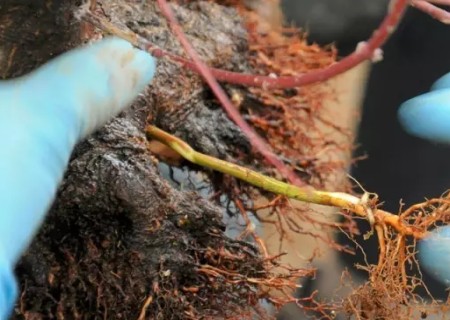
What should be done when a bonsai lacks roots? Below we will learn about the root grafting method using approach-grafted seedlings.
1. Cleft grafting method:
If the branches of the root system are robust, the side cleft grafting method can be used. Cut both sides of the branch into a 3.3 cm bevel, with one side thin and one side thick, and after cutting, insert it into the incision of the root system.
2. Inverted slant grafting method:
If the branch is more robust than the root, use the inverted slant cutting method. First cut a vertical incision in the middle of the branch, 3.3 cm deep, then cut the root system into bevels of 3.3 cm on each side, and insert the root system into the incision of the branch.
Regardless of which grafting method is used, the cambium layers of the root system must be aligned, and then the wound should be sealed with yellow mud or wax. When the number of grafts is relatively large, bury the grafted semi-finished seedlings in a trench, with a trench depth of about 1 m and a width of about 0.5 m; the length can be determined according to the number of seedlings. Lay a layer of wet sand on the bottom of the trench, and cover the top with 3.3 cm of fine sand. If the number of grafts is large, they can be placed in a vegetable cellar and buried with wet sand. Around the “Grain Rain” solar term in the following spring, plant the semi-finished seedlings in the nursery field. This method is very suitable for grafting mulberry, apple, and pear trees, with a survival rate of about 85%.
A method for cultivating bonsai through root grafting, comprising the following steps:
1) Select a trunk or branch on a growing tree, perform ring-barking on the lower part of the trunk or branch, and cut off the sieve tubes of the phloem;
2) Select several well-developed roots from the root system of the above-mentioned tree, and graft them onto the upper part of the above-mentioned bark-ringed wound;
3) Place a cylindrical container over the grafting site, fill the container with nutrient soil, seal the container, open several breathing holes on the container wall, and maintain humidity inside the container;
4) Cultivate until thick and strong roots have propagated inside the container, cut off the cultivated trunk or branch, remove the container, plant it into a pot, shape the trunk or branch, and maintain for 20-30 days.
This technology belongs to the technical field of bonsai cultivation methods, and specifically relates to a method for cultivating bonsai through root grafting, which solves the problems of long cultivation time and high consumption of manpower and material resources in traditional bonsai cultivation.