Bougainvillea old-branch cutting technique: learn to grow stump bonsai
Bougainvillea is a tropical ornamental flower suitable for beginners. For friends in the south, growing bougainvillea is relatively easy, especially for flower lovers in the more southern regions, where it can survive when casually planted in the yard. You can often see bougainvillea that has grown into a large flowering tree in small courtyards or beside fences, and some even climb up to the 4th or 5th floor, but propagating a bougainvillea generally relies on cuttings, and only a small section of branch is needed.
Besides being cultivated by air layering, bougainvillea bonsai trunks can also be grown by old-branch cuttings. Using pure river sand for trial cuttings, shoots are now beginning to emerge. If they can survive, bougainvillea does not need air layering; thick stems can be used directly for cuttings, saving both effort and time. With bougainvillea branches, thick branches root late but take shape quickly; one-year-old lignified green branches easily produce new roots and have a high survival rate. Generally, choose tightly structured, thick 1-2 year old outer sun-facing branches, and do not use overly thin branches, immature branches, leggy branches, or shaded branches.
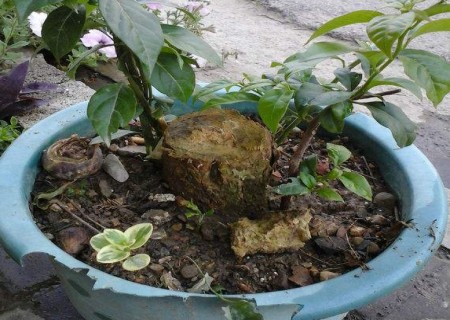
Making bonsai by old-branch cuttings has advantages that air layering cannot achieve:
First, it takes shape quickly. The selected bonsai trunk branches can be directly potted and cut, and once branches and leaves grow, pruning and binding can be carried out. Generally, when cuttings are taken in autumn during the “little Indian summer”, they can become a finished bonsai and leave the nursery the next year; if the bonsai trunk branches have a good shape, cuttings taken in early spring can also bloom, become a finished bonsai, and leave the nursery in late autumn.
Second, the mother plant is used highly efficiently, especially branches and mother plants discarded due to heavy pruning and other reasons. Branches large and small can all be used, turning waste into treasure, which is something air layering to cultivate bonsai trunks cannot do.
So how do you make bonsai from bougainvillea old-branch cuttings? The key technical points for making bonsai from bougainvillea old-branch cuttings are summarized below:
1. Cutting time
Cuttings can be taken in spring, summer, and autumn. For cuttings in late autumn, pay attention to cold protection and heat preservation.
2. Cutting and treatment of bonsai trunk branches
According to the design, cut off unnecessary branches in advance. Shape the bonsai trunk rough form, remove it with a saw or sharp knife, and make the cut slanted and smooth. Use it as soon as it is taken. The length of the bonsai trunk branch depends on the need; short ones can be several dozen cm, long ones lm—2m. Because they are old branches and very long, rooting is relatively difficult, so treating them with a rooting promoter gives better results. Tests have shown that soaking the base of the bonsai trunk branches in a 100PPM aqueous solution of 1-naphthaleneacetic acid, ABT No. 1, or No. 2 rooting powder, then potting and cutting two hours later, results in earlier rooting and a well-developed root system, can increase the survival rate, and brings earlier shaping and leaving the nursery.
3. Potting
Choose ordinary sandy loam or sand with good air permeability, mix with organic fertilizer at a ratio of 2:1—3:1, directly pot the bonsai trunk branches treated with rooting promoter, press firm, water thoroughly, and shade. If the bonsai trunk branches are unstable after potting, they also need support for fixing.
4. Shaping
Bougainvillea old branches can use nutrients stored within the body and water absorbed through the branches to sprout and grow leaves and carry out photosynthesis. Therefore, they generally grow branches and leaves first and root afterward. After new branches grow, pruning and binding can be carried out according to the pre-designed bonsai shape until it is formed and leaves the nursery, without having to wait until the root system is fully developed before trimming and shaping.
5. Water and fertilizer management
Do not water too frequently, to avoid water accumulation in the pot rotting the branches; keeping the soil moist is enough. After leaves grow, water can often be sprayed on the leaves. After rooting, enter normal water management. Those treated with rooting promoter root in about one month, while untreated ones root in about 2—3 months. When the bonsai trunk branches have just rooted, spray the leaves with 0.2% urea and compound fertilizer solution to promote synchronous growth of the aboveground and underground parts. After the root system is fully developed, enter normal fertilizer management; at this time, apply more phosphorus fertilizer or compound fertilizer to promote early blooming and more blooming.
Notes:
1) Avoid water accumulation
As we said earlier, bougainvillea fears waterlogging, so potted bougainvillea must not have water accumulating in the pot.
2) Prune frequently
Bougainvillea tolerates pruning. Do not be afraid of pruning it badly; frequent pruning helps it bloom more.
3) Protect against freezing in winter
Bougainvillea is not cold-tolerant and is very easily frostbitten or even frozen to death in severe cases, so be sure to pay attention to temperature changes. Generally, if the temperature is below 5°C for a long time, it may freeze to death; even in the southern winter, the lowest is only about 3°C.