How to prune a bougainvillea bonsai? A detailed guide to pruning methods
It is flower-viewing season once again. The bougainvillea blossoms dotting the green foliage burn like clusters of flames and dance like butterflies of every color. The golden sunlight brushes the petals with a faint gilding, radiating the vitality of life. Bougainvillea, also known as rhododendron and paper flower, is extremely beautiful and can be trained into bonsai in various forms such as single-trunk, slanting-trunk, double-trunk, curved-trunk and cascade.
Bougainvillea has sturdy, ancient-looking branches and colorful bracts. When in full bloom it is a riot of brilliant color, with a long viewing period, rich colors, strong sprouting ability and tolerance for pruning, making it an excellent tree species for bonsai. Among these, the Lingnan-style bougainvillea bonsai does not focus on the flowers but wins with the framework of its branches and trunk; after leaf removal the sinews are fully revealed, majestic and grand, full of masculine beauty.
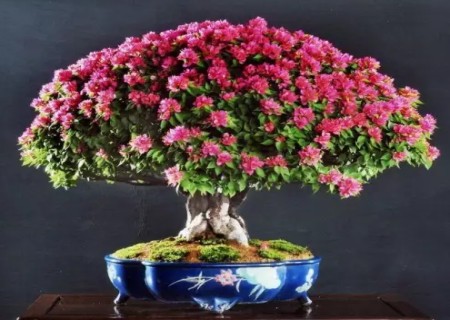
Bougainvillea has strong sprouting ability, grows rapidly and tolerates pruning. Shaping is mainly done by pruning, with wiring as a supplement. So how do you prune a bougainvillea bonsai? First, let us look at the benefits of pruning a bougainvillea bonsai!
The benefits of pruning a bougainvillea bonsai:
1. The soil and nutrients in a pot are very limited, and the growing space is limited too. It must be cut back so that the potted plant maintains a certain size and shape, avoiding insufficient nutrients, poor plant growth and naturally unattractive flowering.
2. People want potted flowers not only to bloom abundantly but also to have a beautiful shape when flowering. Pruning achieves an organic combination of potted flowers and bonsai, giving the bougainvillea potted flower a touch of bonsai character, so that the plant shape can be appreciated at ordinary times.
3. Prune away weak branches, dead branches and some useless branches, and create layers so that all branches receive light, allowing the healthy, thick branches you want to obtain more nutrients, grow more robustly, accumulate more nutrients and bloom more beautifully.
Of course there are more reasons, which will not be elaborated here. This is only the initial pruning; during the growth process you must slowly appreciate and slowly prune, and you must constantly pinch and disbud, removing some unwanted buds and branches. If there are too many buds and too many branches and leaves, the nutrients in the pot will always be insufficient.
Bougainvillea is generally pruned after sprouting in spring. It can also be pruned frequently at ordinary times; simply cut off old and weak branches, dead branches, leggy branches and crossing branches. After flowering, generally cut off the flower stalk and shorten the flowering branch by 1/3 of its length, and carry out appropriate thinning, and in winter prune in conjunction with repotting and changing the soil.
Bougainvillea is evergreen all year round and grows vigorously, so it is best to prune it twice a year. Below are 3 common pruning methods.
1. Heading-back pruning
Heading-back pruning means cutting off part of a one-year-old branch. Cutting off a lot is called heavy heading-back (for example, cutting off 1/2 to 1/3); cutting off a little is called light heading-back (for example, cutting off 1/3 or less); the middle level is called medium heading-back. The characteristic of heading-back is that it strongly stimulates the buds below the cut, with the first bud below the cut (often called the cut bud) receiving the greatest stimulation and producing the strongest new shoot growth, while the farther from the cut, the less the stimulation. After heading-back, the branching ability of the branch increases and its ability to form shoots is enhanced, with medium heading-back giving the best effect. Heading-back has a weakening effect on the thickening of the mother branch.
2. Thinning
Thinning is removing a one-year-old or perennial branch from its base. Thinning weakens the growth vigor of the shoots above the cut, while it promotes bud sprouting, shoot formation and growth of the buds and shoots below the cut. When what is removed is a weak branch, the above effects are not obvious at the pruned site, but overall it still promotes growth for the whole tree. Thinning can reduce shoot density, improve light within the canopy and promote growth.
3. Renewal pruning
Renewal pruning refers to the pruning of perennial branches. Its characteristic is that it promotes the growth of shoots behind the cut and the sprouting of latent buds, while it has a fairly strong weakening effect on the mother branch. Renewal pruning is often used to renew and rejuvenate old trees. The application of renewal pruning should also follow the principle of gradual progress; if the branch to be renewed is relatively large, it should be renewed in place over several cuts.
To make it easier for readers to understand, a few pictures of branch and plant pruning are selected below so that everyone can have an intuitive impression.
After a branch is cut, the wound left behind is called the cut, and the bud nearest the cut is called the cut bud. Bougainvillea pruning should also grasp three principles: short, heavy and thin, that is, heading back horizontal branches, heavily pruning new shoots, and thinning out dense (weak) branches.
Downward branches, vertically upward branches and crossing branches all need to be removed. Positioned about 5 mm above the cut bud, in a horizontal state, a flat cut leaves a smaller wound and is easy to heal, and is commonly used in the short pruning of small branches.
For an oblique cut on a bougainvillea branch, cut upward from the opposite side of the cut bud. Cut obliquely at a 45° angle so that the slope is slightly higher than the bud tip by about 5 mm. The lowest part of the slope is level with the base of the bud. In this state, the wound will not be too large and will also heal easily, and the cut bud will grow better.
If there are two parallel branches, the weaker one needs to be removed, that is, thinning out the weak branch.
After a branch is cut, the wound left behind is called the cut, and the bud nearest the cut is called the cut bud. Bougainvillea pruning should also grasp three principles: short, heavy and thin, that is, heading back horizontal branches, heavily pruning new shoots, and thinning out dense (weak) branches. Several of the most basic pruning methods are introduced below:
1. Heavy pruning: cutting off basically all the branches, leaving the stump and a few main branches, and the few main large branches left must also be cut very short. In particular, unwanted branches and branches that ruin the plant shape must be completely cut off. Heavy pruning is generally used when changing the style.
2. Medium pruning: lighter than heavy pruning, it only cuts off some dead branches and unwanted branches, and branches in good growing positions are merely shortened; the overall tree shape does not change much. Medium pruning is generally used on finished potted flowers and bonsai.
3. Light pruning: only slightly shortening some weak branches, cutting off diseased and dead branches, and slightly shortening healthy branches. It is generally used on seedlings, small plants and small trees, preserving as many branches as possible to form a strong tree vigor for photosynthesis, so that the small plants grow up quickly.
4. Cutting back: shortening all branches so that this year's tree shape is about the same size as last spring's tree shape, in order to free up space for the plant to grow and bloom, making the new branches more robust and the flowering more beautiful and spectacular.
Warm tips:
Bougainvillea pruning should be moderate. The above four methods can be organically combined for pruning, but do not prune too frequently, otherwise the bougainvillea bonsai will have no flowers to appreciate. You can decide how heavily to prune the bougainvillea according to the size of the pot. If it is not potted, you can prune according to the owner's own ideas.