What are the propagation methods for potted Cinnamomum kotoense (Ping'an tree)?
The Ping'an tree is a bright green, auspicious Cinnamomum kotoense (Cinnamomum, Ping'an tree). "Ping'an tree" is an elegant name for Cinnamomum kotoense. It has value as a potted ornamental, is one of the common foliage plants in homes, and is excellent at regulating the air! People gave it an auspicious name, the "Ping'an tree," to cater to urbanites' consumer psychology of loving greenery and beauty and longing for peace, and also to help relax people's nerves during tense work, eliminate fatigue and reduce stress. It is therefore very popular with urbanites; although the price is not low, it still sells well.
The propagation and seedling-raising methods for potted Ping'an trees include: sowing, cuttings and layering.
Ping'an trees are mostly propagated by sowing, usually by drilling furrows and sowing at intervals. When the seedlings grow 3-4 true leaves, apply liquid fertilizer once a month, stop fertilizing after autumn, and do a good job of cold protection, overwintering at an indoor temperature of no lower than about 5°C.
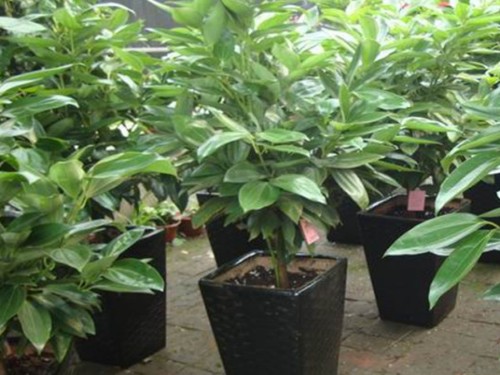
In South China, ripe purple-black fruits can be used for sowing from September to October. After washing off the fruit skin and flesh, float off the empty shriveled seeds, spread them in a cool place to dry, and sow them as soon as collected. If sowing cannot be done immediately due to bad weather or because the nursery plot is not yet ready, the seeds must be stored in moist sand in a cool place, taking care to prevent the seeds from becoming moldy. After the seeds crack and show white, sow them in the ground or in bags.
For seeds not pre-germinated by sand storage, before sowing soak them in a 0.3% formalin solution for 30 minutes, pour off the excess liquid, seal for 2 hours, then rinse with clean water to remove the liquid attached to the seed coat, and immediately soak in clean water for 24 hours; this can increase the germination rate. If the seeds are not disinfected, they can be directly soaked in warm water at about 40°C, which can also increase the germination rate.
Usually drill furrows and sow at intervals, with a row spacing of 20-25 cm, a plant spacing of 5 cm to 7 cm, and a soil covering depth of 1.5-2 cm. Cover with rice straw to retain moisture, and germination occurs after 20-30 days. Keep the seedbed moist; after 1/3 of the seeds have emerged, remove the covering in 2-3 rounds, and immediately set up a shade frame.
When the seedlings grow 3-4 true leaves, apply liquid fertilizer once a month as a top dressing, stop applying after autumn, do a good job of cold protection, and overwinter at a greenhouse temperature of no lower than about 5°C.
Because the plants have few fibrous roots, transplanting should be done early, or sand-bed germination can be used, with the sprouted seedlings transplanted into bags. In the southern regions, bag sowing or bag cultivation is used to produce commercial seedlings, with very good results.
Ping'an trees are also often propagated by cuttings. The best times for cuttings are April to May in the first half of the year and September to October in the second half, when the temperature is 22°C to 28°C. For cuttings, use nutrient pots or flower pots, with a substrate of pure vermiculite or vermiculite:peat = 1:1. The substrate must be disinfected before cutting; it can be drenched with 0.1% potassium permanganate or 600 to 800 times dilution of Dexon, or exposed to the sun.
For the cuttings, choose branches with strong apical dominance, semi-lignified current-year growth, robust and full, free of pathogen infection, and with bright green leaves. It is best to cut them in the morning when there is dew or on a cloudy day.
Cut the cuttings into 10 cm to 15 cm lengths, leaving 2 to 3 leaves to reduce water loss. Cut the lower end of the cutting into a slanted cut, leaving 3 cm to 5 cm. Soak the base 3 cm to 5 cm of the prepared cutting in rooting solution (2.5 g diluted in 2 kg of water, slow soak for 2 to 3 hours; or fast soak in 0.2 kg of water, soak for 15 to 30 seconds) or in a powerful rooting agent (each 5 g packet diluted in 0.5 kg of water, soak the base for 16 to 20 hours). After soaking, take them out and insert them into the substrate 3 cm to 5 cm. Too shallow and they easily fall over; too deep and they easily rot. Then press firm with your fingers. Insert one seedling per small pot. After cutting, water thoroughly until water flows out of the bottom of the pot. Cover the entire cutting with a plastic bag to maintain 100% humidity, and place in a cool place, avoiding direct sunlight.
About 4 days after cutting, water thoroughly once. In the north, add a few drops of hydrochloric acid or a few drops of edible vinegar each time you water, keeping the pH at about 5.8, and the cuttings will root easily. When the substrate humidity is high, do not water, but keep the substrate moist, with an ambient relative humidity of about 80%. Too little watering and the cuttings die of drought; too much watering and the wound tissue will rot. After about 15 days, tie on the plastic bag, and after about 20 days, remove the plastic bag.
After removing the plastic, increase the time of weak sunlight in the morning and evening. Rooting begins after 25 days, and new roots 1 cm to 2 cm long grow in about a month. In 2 months, roots 5 cm to 6 cm long grow. If the old leaves do not fall off and new roots form, it means the cutting has survived. At this stage, move them into larger pots, with a substrate ratio of leaf mold and fine sand at 2:1, or sandy loam. When repotting, pull up the cuttings with the substrate, plant them into large pots, then fill with the prepared substrate and water thoroughly. One week later, apply compound fertilizer at a concentration of 1‰.
After the plant sends out new leaves, apply a thin cake fertilizer water once a month. After autumn begins, apply 2 consecutive top dressings of 0.3% potassium dihydrogen phosphate solution to increase the plant's cold resistance, promote early lignification of the tender shoots, and help it overwinter safely. When fertilizing, avoid raw fertilizer, concentrated fertilizer and heavy fertilizer, and especially do not use high-concentration chemical fertilizer solution, otherwise it very easily causes fertilizer burn to the roots, leading to yellowing and scorching of the leaves and death of the plant.
In addition, flower enthusiasts can also try layering for seedling propagation.
In recent years, the Ping'an tree has become a representative flowering plant for indoor ornamental display, and it has very good ornamental value. In daily life, it can be placed on the balcony, beside the sofa, or around the table or in a corner. It can relieve people's nerves during tense work, eliminate fatigue, reduce stress, and make people feel relaxed and lively. It is also often used for garden cultivation and ornamental display.