How to prune a Chinese elm bonsai? Detailed pruning tips and methods
The Chinese elm trunk is slightly curved, the bark is mottled and elegant, the small branches droop gracefully, and the leaves turn red in autumn. It is a good ornamental tree and a species for factory greening and roadside greening, often planted as a solitary specimen to form a landscape, suitable for planting beside ponds and near pavilions, and can also be placed among rocks, except that it has relatively many pests and diseases. It has strong sprouting ability and is a good material for making bonsai.
The Chinese elm has a beautiful tree shape, an elegant posture, mottled bark, and fine dense branches and leaves, with high ornamental value. In courtyards, solitary planting, group planting, or combined planting with pavilions are all very suitable; as a shade tree, street tree, or for making bonsai, it all has good ornamental effects. Because of its strong resistance, it can also be selected as a greening tree species for factory and mining areas.
The bark of the Chinese elm is mottled and scaly-cracked, the branches and trunk are simple and unadorned, it has strong sprouting ability, tolerates pruning, and is easy to manage and care for, making it a traditional bonsai tree species. The branches and leaves of the Chinese elm grow quickly, so to maintain the bonsai's shape it should be pruned frequently; generally, when new bud branches extend to 5-6 cm, only 2-3 leaves are kept and the rest are all cut off. To control growth, buds and shoot tips can also be pinched off at any time.
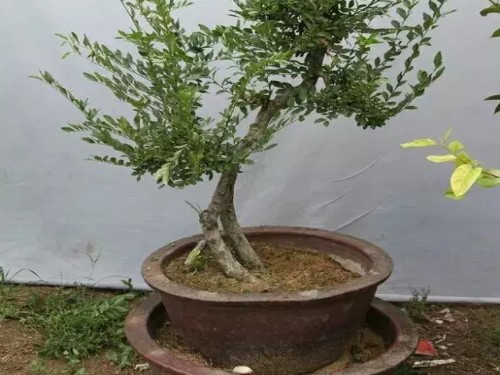
This is an inconspicuous small tree that originally grew by a wall. After the teacher discovered it, it was transplanted into a pot, and after many rounds of wiring and pruning, it has already begun to take shape. Below I will share the process of the most recent wiring and pruning. Through this small tree, I mainly want to introduce to everyone the “sacrifice branch.” Please watch patiently.
After the previous pruning, it grew for more than half a year and had already become overgrown.
Many new branches of varying thickness have grown. The thicker branches are too lignified, relatively brittle and hard; bending them with aluminum wire easily breaks them, and it is also not easy to achieve the ideal position, so they are cut off, leaving small thin twigs to be wired into shape.
After cutting off the thicker branches at the top, small thin twigs remain.
Proceed with wiring and bending. The key point of bending is: only bend at the base of the branch, make one to two bends, and do not bend the tip; let it grow freely, and after it grows to a certain thickness, depending on the situation, keep half a bend to one bend, or two bends, and cut off the rest.
Top the apex
The finished top. As mentioned earlier, after bending, let it grow freely, but here, in order to show everyone, the tip has been cut off. Everyone can clearly see that the newly shaped small thin twig is too thin, and its thickness ratio to the previous-level branch is not harmonious enough. The shaped small thin twig needs to be grown freely to a certain thickness.
The appearance after part of it is finished.
Now for the sacrifice branch. Everyone, please note the branch circled in red; it is the sacrifice branch. It was left from the previous pruning, or even the pruning before that, and after a relatively long period of free growth, it is clearly thicker than the other branches. The thickening of the sacrifice branch also drove the thickening of the branch circled in green, giving the branch circled in green and the branch circled in black a transition from thick to thin.
Now that the thickness transition of the branches is harmonious, the sacrifice branch is no longer useful, so it is cut off. It bravely sacrificed itself, hence it is called a “sacrifice branch.”
The teacher is working on the second trunk, single-mindedly (front). Brother and Uncle Sun (back) are watching carefully.