How Does Sago Palm Reproduce? A Detailed Guide to Common Propagation Methods
The sago palm (Cycas revoluta) is native to central and southern China, India, Japan and Indonesia, originating in East and Southeast Asia. It is widely cultivated in Zhejiang, Jiangxi, Hunan and Sichuan; in North China and Northwest China it is grown as a potted plant for indoor display. The sago palm likes sunlight, dry conditions and good ventilation; it is not cold-tolerant, responds well to fertilizer, prefers sandy soil and grows slowly.
In its native habitat the sago palm can reach 8 m tall, and as an indoor potted plant it can reach 3 m. The stem is a thick cylinder without branches, bearing large leaf scars that form a fish-scale pattern. The leaves cluster at the top of the stem as large pinnate compound leaves about 1 m long. The leaflets are linear, leathery, with hard tips, dark green and glossy, and the leaf margins roll back. Each spring it produces 2 to 3 whorls, while the old leaves drop off one after another; the flowers are unisexual, borne at the top of the stem, with male and female flowers on separate plants. The male flower is arranged in a spiral, shaped like a pineapple and covered with fine hairs; it is fresh pale yellow when it first opens and turns brown when mature. The female flower is larger, with many palmate scales, shaped like a flattened cylinder that gradually splits to form a pinecone shape. The sago palm rarely blooms; only old plants of twenty or thirty years can flower, hence the saying “a thousand-year sago palm blooms at last.” The flowering period is from June to August.
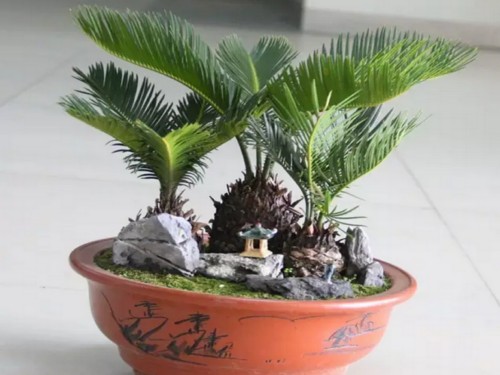
The sago palm, also known as the iron tree, has dark green pinnate compound leaves that are an excellent material for flower arranging. Using its small plants to make penjing (tray landscapes) gives an even better ornamental effect and is deeply loved by penjing enthusiasts. Sago palm propagation includes seed sowing, division, suckering and stem cutting; for home potted plants, the suckering method is the most suitable. The specific technique is as follows.
1. Time: early May.
2. Cutting bed: spread a 5 cm thick layer of river sand on the bottom, and on top a mixture of 1/3 river sand and 2/3 leaf mold soil, 15 cm thick. After spreading, drench thoroughly with a 3‰ potassium permanganate solution, cover tightly with plastic film, and it can be used after 1-2 days.
3. Method: choose an overcast day to carry out the suckering.
1. Cut off the leaves of the sucker bud to be separated right at the base.
2. Use a knife or saw to remove the sucker bud from the mother plant; make the cut as small as possible, keep aerial roots as much as possible, and shorten them if too long.
3. Apply plant ash to the cut surface of the removed sucker bud and place it in a cool, ventilated spot for 3-5 days.
4. Soak the base of the shade-dried sucker bud in a ‰ potassium permanganate solution to disinfect for 10 minutes. Open up the cutting medium and bury the sucker bud in it, not too deep; just cover the cut surface.
4. Management: after planting, no watering is needed, since the cutting medium was just disinfected; promptly set up a plastic hoop house to prevent rain and shade from the sun. After 1 month, the sucker bud will produce several whorls of neat, emerald green new leaves and begin to root. Once the root system is fairly vigorous, a light bran-cake liquid fertilizer may be applied, not too many times. At this point the hoop house can be removed and the plant left to grow naturally. Finally, pair it with a flower pot and wooden stand, and the sago palm penjing is complete.
In addition, the editor would also like to introduce other propagation methods for the sago palm, mainly seed sowing and division.
1. Seed sowing propagation
1. Seed collection
In October, collect sago palm seeds, or plump seeds no more than two years old.
2. Seed soaking
Soak in warm water at about 50°C for 24 hours, then soak in dilute hydrochloric acid or dilute sulfuric acid for 10-15 minutes, then rinse clean with fresh water; during soaking, change the fresh water once every other day.
3. Peeling
After the seed coat has fully absorbed water, swelled and softened, manually peel off the outer seed coat, wash away the fruit pulp, dry the seeds, and then store them properly.
4. Sand storage
Around December, carry out sand storage of the seeds. Because the seed coat is thick and hard, a alternating-temperature treatment can be used, and finally sand storage is carried out.
5. Sowing
Use clean sandy loam, river sand, perlite and other materials with good water retention and air permeability to make the sowing bed, with a thickness of no less than 40 cm, and water thoroughly. Sow the prepared seeds into the bed at a spacing of 5-20°C cm between plants and rows, about 3 cm deep. Then cover with river sand 3 cm thick, control the amount of watering according to the dryness of the bed soil and the fine sand cover; after watering, cover with plastic film to retain moisture and warmth, uncover the film once a week on a sunny morning for ventilation, water to keep moist when the soil is dry, and cover the film again at sunset in the afternoon. Generally, sago palm sand storage takes 4-6 months; during this period keep the temperature and humidity of the sand storage, with an optimum temperature of 18-25°C and a relative humidity of 80-90%, and do a good job of winter insulation, which must not be lower than 12°C. In May-June of the following year the seeds break through the shell, and in July-August they sprout and grow one true leaf.
2. Division propagation
Division propagation should be carried out in summer. Separate the suckers from the stem of the mother plant, insert them into open ground or a pot, burying half the soil; the survival rate of division propagation can reach 80-90%. Suckers grow slowly, so it is best to take suckers separated after 3 years; suckers with small wounds are easy to keep alive. You can also cut the stem into 15-20 cm long sections and bury them in sandy soil, so that new buds form around the stem section, and then divide and plant them for cultivation.
The sago palm is suitable for growing in direct sunlight or bright diffused light; in summer it is best to provide half shade, maintain the temperature at 15-20°C, and keep the soil and air humidity a bit higher, frequently misting the leaf cluster. This plant has no dormant period; the winter temperature should preferably be 12-16°C, and the plant has a considerable degree of cold resistance. From March to September, apply liquid fertilizer once a month; the growing medium should preferably be a mixture of equal parts organic soil, peat and fine sand. Change the potting soil once every 2-3 years, adding new soil and base fertilizer to aid growth.
In summer, liquid fertilizer can be applied several times, with ferrous sulfate solution added, which can make the leaf color even darker green; after autumn begins, reduce the amount of watering. Among the pests and diseases of the sago palm, scale insects harming the leaves are the most common. First of all, keep ventilation good; after discovering scale insects, observe the hatching period and spray with lime sulfur mixture or fluoroacetamide.