Detailed Explanation of Grafting Methods and Techniques for Ornamental Tree Peonies
China ranks first in the world in tree peony exports, accounting for about 70% of the total. Heze's tree peony exports account for about 80% of China's total exports, making it a veritable world number one tree peony distribution center. Annual exports of tree peonies and herbaceous peonies are basically around 3.5 million plants, of which tree peonies account for about half. During the past two years, when the entire landscaping industry has been rather sluggish, ornamental tree peonies have remained in short supply. In Heze, the planted area and sales volume of ornamental tree peonies have increased substantially for two or three consecutive years, and last year local seedlings were almost completely sold out.
Tree peonies are widely used in city parks, street green spaces, government offices, schools, courtyards, temples, classical gardens and so on, and their beauty can be seen everywhere. With their brilliant colors of every hue and their splendid decorative effect, they have become an important ornamental landscape in gardens. Planting is carried out in an orderly manner according to principles such as flower color and variety, selecting varieties with similar colors or the same plant height, pursuing a neat and uniform appearance, and planting them in blocks to form a massed landscape of clustered blossoms, making visitors feel as if they are wandering in a sea of flowers.
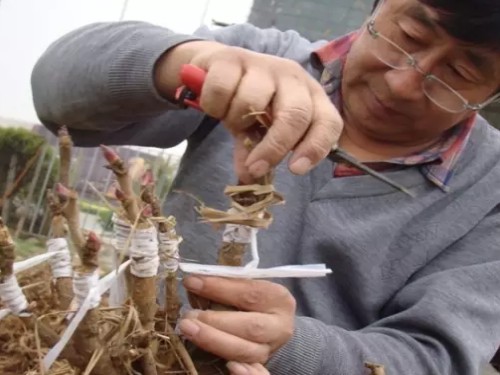
Grafting is the main method of propagating tree peonies. Grafting can well preserve the characteristics of the variety and has the advantages of low cost, high speed, a high propagation coefficient, and neat and standardized seedlings. The factors affecting grafting survival are mainly grafting time, rootstock, scion and grafting method, among others.
1. Selection of rootstock and scion
For the scion, it is best to choose robust terminal buds or soil shoots of the current year, used immediately after collection and not kept for long. If they cannot all be used for the time being, wrap them in a damp cloth and place them in a cool place, or bury them in damp sand. The survival rate of grafting is closely related to the varietal characteristics of the scion. Precious tree peonies are often those varieties with excellent traits that are also difficult to propagate.
There are two kinds of rootstock, namely the roots of three-year-old seedling plants of tree peony or herbaceous peony, with a root crown diameter of more than 1 cm and a length of about 20 cm. Grafting tree peony onto herbaceous peony roots is easy to perform and the young plants grow quickly, but the root system is not very good; grafting tree peony onto tree peony roots is relatively difficult to perform, but the grafting survival rate is high, the grafted seedlings develop a good root system, and the plants grow vigorously.
2. Grafting methods and timing
(1) Inlay grafting: mainly used for grafting onto herbaceous peony roots. The scion is inlaid into a cut on one side of the herbaceous peony root, with the cambium layers aligned, and the joint is wrapped tightly from top to bottom with hemp rope and smeared with mud.
(2) Cleft grafting: mainly used for grafting onto tree peony roots. The key operation is to first cut the lower part of the scion into a wedge shape that is thick at the top and thin at the bottom, then split the rounded top of the rootstock open with a grafting knife, insert the scion vertically, and finally wrap it tightly with hemp rope.
Inlay grafting and cleft grafting are the most commonly used grafting methods, and the best time for grafting is between late August and mid-October. Grafting is highly seasonal, and if the optimal time is missed, the grafting survival rate drops greatly.
Bud grafting and branch grafting are mainly used to propagate 'Shiyangjin' tree peonies. The grafting times are May to July and August to September respectively. They are rarely used in actual production.
3. Planting and management of grafted seedlings
Grafted young seedlings should initially be planted fairly densely, generally with a row spacing of 40 to 50 cm and a plant spacing of 10 to 15 cm. Before planting, prepare the land and rake it into beds, use a trencher to open a planting trench 30 cm deep, then place the grafted seedlings into the trench, with the depth such that the cut edge of the grafted seedling is 2 cm below the ground surface. Finally, fill in soil and compact it, rake up a soil ridge along the planting row, and bury the scion 3 to 4 cm below the soil.
4. Organizational arrangements
Because the grafting period is short and many materials are needed, if a large number of grafted seedlings are to be produced in a short time, careful planning, coordinated arrangements and close cooperation are essential.
5. Post-grafting management
(1) Removing shoots the following spring: because the rootstock sprouts new shoots in spring, which affects the growth of the scion, they must be removed.
(2) After the branches of the tree peony have slightly unfolded their leaves, routine management such as weeding and pest and disease control must be carried out, and if flower buds appear, they should be removed promptly. South of the Yangtze River, under normal circumstances, watering is generally not needed; if the soil is too dry, trenches or ditches can be opened for irrigation.
(3) Tree peony grafting usually uses one rootstock and one bud. After surviving in the second year, if stumping is not carried out in autumn, the scion will only grow taller without producing branches. Therefore, for surviving one-year-old grafted seedlings, cutting should be done above the graft union to stimulate adventitious buds at the root bud area to sprout branches. In this way, two-year-old grafted tree peonies can grow 2-4 short branches. Carrying out stumping pruning for two consecutive years and strengthening fertilizer and water management not only enables the grafted seedlings to quickly reach the standard for leaving the nursery, but the branches collected can also be used as scions.
In many tree peony gardens in China, structures such as peony pavilions, peony halls, peony corridors, peony towers, peony studios, peony fairy sculptures, peony screen walls and peony murals are often built, further heightening the theme of the peony garden. For example, the peony corridor in the Caozhou Peony Garden in Heze and the peony garden of Shanghai Botanical Garden, the peony pavilion in the "Hua Gang Guan Yu" (Viewing Fish at Flower Harbor) Park in Hangzhou, and the reclining peony fairy statue in the peony garden of Beijing Botanical Garden all give the peony gardens a thematic character and even more charming artistic appeal.