Lemon Potted Cultivation Methods - Potted Lemon Tree Propagation Methods
Lemons are grown in large quantities in the south, where grafting is suitable for propagation; in the north, where cultivation is limited, cuttings are mainly used, or grafted seedlings can be purchased for growing. Lemon roots have high requirements for water, nutrients and soil, so potting soil should be mixed into a well-draining, airy, water- and fertilizer-retentive, slightly acidic growing medium. Potting and repotting can be done after autumn or in early spring, flexibly according to the local climate.
Many gardening enthusiasts dream of growing a lemon tree and hope to propagate one themselves, so let's talk about lemon tree propagation. There are two propagation methods for lemons: cuttings and grafting, with grafting being the method commonly used for lemons.
1. Propagation by Cuttings
The common propagation method for lemons is cuttings. When taking cuttings, choose branches about one year old (or close to one year old; too tender will not work and tends to rot), cut off most of the leaves, leaving only two (or two half-leaves, for photosynthesis; too many will not work, as too many consume water). Make a slanted cut about 1 cm below the lowest node, then insert into the seedbed. Note: the branch should be about 15 cm long, that is, choose 3 or 4 nodes.
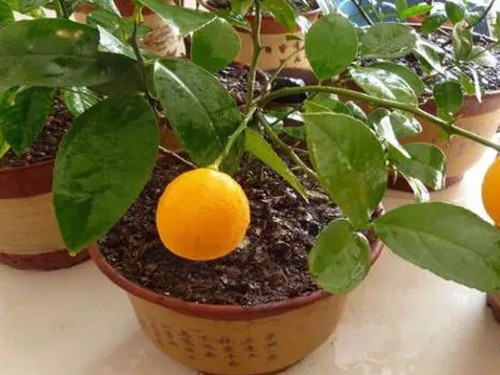
In late May, cut mature branches, each cutting about 6 cm long, keep two leaves with 4/5 cut off, and insert them into clean river sand, burying 2/5 of the cutting in the sand. Use a shallow pot or wooden box for cuttings, with the density such that the leaves of the cuttings do not touch each other. After cutting, water thoroughly, place in semi-shade, and cover with plastic film to maintain relatively high humidity, but not too much water, as excess water will cause the cuttings to rot. The optimum temperature for rooting is about 25°C. Without using any growth stimulants, rooting generally occurs in 60-70 days, with a rooting rate as high as 80%-90%. Once the new roots grow to 3-4 cm, the seedlings can be moved; it is best to transplant them into nutrient pots with humus, and when the seedlings reach 20 cm in height, they can be planted out.
2. Propagation by Grafting
Lemons are commonly propagated by grafting. For lemon rootstock, sour orange, rough lemon and citrange are commonly used abroad, and recently trifoliate orange × grapefruit has been shown to perform very well. In China, trifoliate orange (Poncirus trifoliata) is mostly used as rootstock, and mandarin, orange, lemon (native lemon) and red tangerine can also be used. Select superior individual plants for scions. Grafting methods: single-bud cut grafting in spring, small-bud side grafting in autumn.
1. Land Preparation
Choose a plot with loose, fertile soil and good drainage to establish the orchard. In autumn and winter, at a spacing of 3 m × 4 m, plant about 56 trees per mu; on hilly land, dig round holes 0.8 m deep and 0.8 m wide; for lowland planting, they can be shallower. Put 50 kg of farmyard manure and compost, 0.5 kg of lime, and 0.5 kg of superphosphate mixed in, into each hole, mix with topsoil and apply into the pit, with 5-10 kg of fully decomposed pig and cattle pen manure on the top layer. When backfilling the pit, mound it 20-30 m above the ground surface and shape it into a 0.8 m tree basin.
2. Planting
In areas with evenly distributed rainfall, or in gardens with good water conservancy and convenient irrigation, planting can be done all year round. Generally, lemon planting periods are divided into spring planting (February to March) and autumn planting (September to October). Choose an overcast day for planting, water thoroughly to settle the roots, then cover with grass to retain moisture, and water frequently thereafter depending on the weather to keep the soil moist.
3. Propagation Conditions
Best propagation time: propagation can be done all year round, with the best time in spring and autumn.
Best growing soil: Lemons are not strict about soil, but the best is slightly acidic soil with deep, loose layers, rich in organic matter, strong moisture and fertilizer retention, good drainage, a low water table, and a pH of 5.5-6.5.
Humidity requirements: Keep the soil moist but slightly on the dry side.
Best growing temperature: The best growing temperature for lemons is 23°C-29°C; growth stops above 35°C, and frost damage occurs at -2°C.
Best growing light: Lemons are light-loving plants, but excessively strong sunlight leads to poor growth and development, so appropriate shading is needed during high summer temperatures.