How to prune a winter red fruit bonsai? Detailed pruning methods and techniques
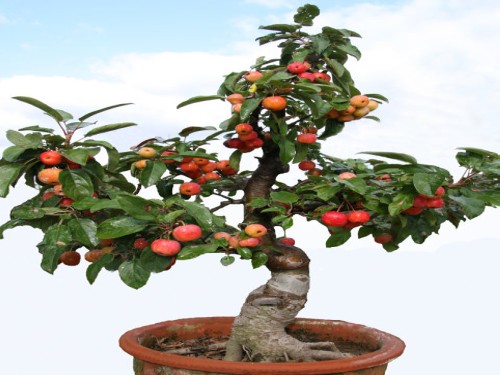
Winter red fruit is a variety of apple. Its tree form is compact, its branches are covered with light pink flowers in spring, and in autumn and winter the tree is covered with exquisite, lovely fruits whose shape closely resembles apples. It is suitable for garden planting or potted ornamental display and for making bonsai.
Sometimes, for ornamental purposes, part of the winter red fruit is left unpruned, and by the following April flowering period, a scene of flowers and fruits coexisting appears. Some people remove the leaves in order to admire the small, crystalline, brightly colored winter red fruits that are well spaced and cover the branches. Once the bonsai has been initially trained, pruning is the key step to stabilizing the tree's form, controlling the height of the crown, and achieving a tree full of flowers and fruits.
1. Growing-season pruning
In spring, promptly remove sprouts that are not being cultivated for a specific direction, so that nutrients are concentrated in the shoots being cultivated for a specific direction. Pruning measures such as girdling (notching), branch bending, and shoot twisting are mainly used to promote the conversion of accumulated nutrients in the tree into flower buds. In summer, when new shoots grow to more than 20 cm, pinching can be carried out several times to control vigorous growth, stabilize the tree form, and promote the formation of flower buds in the middle and lower parts of new branches.
Before bud break in spring, prune and shape the plant once, cutting off diseased and dead branches, crossing branches, overly dense branches, and water sprouts, and shortening overly long branches to improve ventilation and light penetration and maintain a graceful tree form.
2. Dormant-season pruning
After the winter red fruit drops its leaves, it enters the dormant season, which is the best time for shaping and pruning. On the premise of stabilizing the tree form, shorten the branches with axillary flower buds on side branches at all levels. The length left after shortening is generally 5-10 cm. Be careful to select relatively plump flower buds when shortening, retain medium and short fruit branches, very short branches, and leafy cluster branches, and thin out overly dense branches, thin and weak branches, diseased and dead branches, crossing branches, and water sprouts; for relatively vigorous branches, prune lightly, cutting back to weak buds, or leave them unpruned, and branch bending can also be used to open the angle.
For branches whose flower buds cannot be confidently identified, they may be left for supplementary pruning before flowering. Be sure not to prune too heavily, otherwise it will cause vigorous growth of the fruit tree and make it difficult to flower and bear fruit. During winter pruning, leave stubs of 6-10 cm, then the following year increase the plant spacing or replant, cultivate side branches according to the styling design, and complete the basic shape. After winter pruning, the tree should have branches and flower buds distributed evenly, with reasonable space, a balance of solid and open areas, and balanced tree vigor.