How to Shape a Podocarpus Bonsai? Practical Tips and Methods Explained
The Podocarpus bonsai has a lush, elegant, and vigorous tree form with an ancient, sturdy appearance. Its leaves stay fresh green in all four seasons, giving a sense of strength and noble purity. If attached to rocks and shaped into an eagle-claw-embracing-stone posture, it becomes even more antique and unique. A Podocarpus combined with bamboo and stones creates an extremely elegant landscape. A forest-style Podocarpus bonsai, paired with grazing scenery, can give people the enjoyment of rustic charm. If cultivated properly, it can remain thriving for decades or even a hundred years, becoming an excellent Podocarpus bonsai.
The shaping of Podocarpus is mostly done during the dormant period, mainly by wiring, with pruning as a supplement. Because Podocarpus branches are soft and easy to wire, and can also be pruned, its forms are diverse. Common forms include curved-trunk style, slanting-trunk style, reclining-cloud style, cascade style, and exposed-root style. The branches and leaves can be pruned into flat layers or bun shapes.
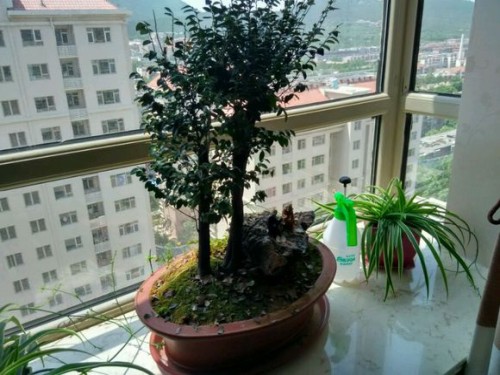
The potting and shaping of Podocarpus is mainly by wiring, appropriately combined with pruning. Wiring should be done during the dormant period, using palm fiber, making sure the fiber is not exposed, the trunk curved, the branches twisted, and the posture natural. Small branches and leaves are pruned into layered flat or hemispherical shapes, arranged in staggered layers. Podocarpus branches are soft, relatively easy to wire, and tolerant of pruning, especially the small-leaf Podocarpus with dense branches and small leaves, which can be processed into various forms. Nowadays, for convenience of shaping, metal wire can also be used for wiring, but after the shape is formed, the metal wire or palm fiber should be removed promptly to avoid wire bite.
During the growing period of Podocarpus, attention should be paid to pruning and pinching the already-shaped plants to prevent excessive growth of branches and leaves and to maintain the graceful posture of the Podocarpus. When repotting, pay attention to cutting off excessive roots and rotten fibrous roots, and also cut off overly dense branches and excessive-growth branches.
For the effect of trunk curvature, a post can be erected to cultivate a curved trunk. Use tools such as screws and measures such as notching and twisting to shape the trunk, bending the trunk. The height of Podocarpus is generally controlled at 1.5 m to 3.5 m, and the shaping principle is "shaping according to the tree."
1. Trunk shaping:
For the effect of trunk curvature, a post can be erected to cultivate a slanting trunk or curved trunk. Use tools such as metal wire and screws and measures such as notching and twisting to shape the trunk, bending and tilting the trunk. The height of a shaped Podocarpus is generally controlled at 1.5 m to 3.5 m, and the shaping principle is "shaping according to the tree."
2. Branch shaping:
Branch shaping includes the selection and removal of branches, adjustment of direction, control of growth vigor, and correction of extension posture. Select a Podocarpus with a slightly curved trunk, cut off weak branches, whorled branches, and branches below 1/3 of the trunk, proceeding branch by branch from bottom to top. Keep the thick side branch above 1/3 of the trunk as the first main branch. Generally, one branch is kept per layer, and the first branch on the trunk is longer.
Use metal wire to wrap from the trunk to the first main branch, wrapping at 45° to the end, then bend the first main branch into an "S" shape with an angle of less than 90° to the trunk, use metal wire to bind small branches in the same plane as the first main branch, then prune the whole into an oval shape. Afterwards, there should be appropriate distances between branches of each layer, so that branch distribution combines sparseness and density. Bind upward layer by layer in the same way, usually with the first main branch being the thickest and longest, gradually becoming thinner and shorter upward, then finish the top in a bun shape, with the overall layout forming a triangle.
Podocarpus has great plasticity and can be processed into many tree forms, such as curved-trunk style, slanting-trunk style, reclining style, cascade style, and exposed-root style. Through pruning and wiring, the branches and leaves can be made into cloud-layer style or bun style, with an antique and elegant posture. For bonsai that has already been shaped, attention must be paid to pinching and pruning to prevent excessive growth of branches and leaves, so as to maintain the original posture. Pruning and pinching work is best done during the spring and autumn growing periods.