A Detailed Guide to Pruning the Small-Leaf Red Sandalwood Bonsai
Red sandalwood is a tropical plant that loves sunlight and cannot tolerate low temperatures. Its root system is well developed and bears root nodules that can fix nitrogen, and it is not demanding about soil. Because it grows slowly, it needs no special pruning! However, yellow leaves, dry tips, dead branches and leggy growth spoil the beauty of the plant, so it should be pruned regularly to keep it looking good.
The small-leaf red sandalwood has fairly strong vitality, so you need not worry about making a wrong cut, but since it grows slowly, you should keep the main branches and remove the secondary ones. Still, this must be decided according to the tree's original shape and your own creative direction; trees are naturally so varied in form that it is hard to lay down a fixed rule! The branch-pruning method for the small-leaf red sandalwood bonsai is as follows:
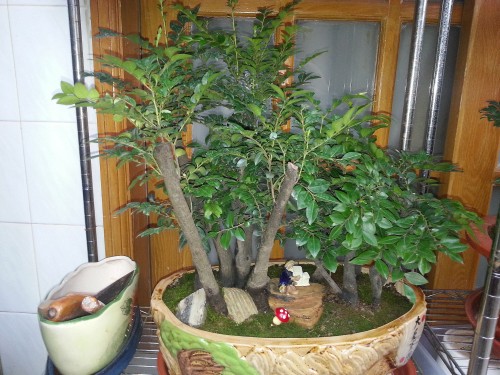
Pruning a bonsai should combine the plant's growth characteristics with the artistic shaping requirements of the bonsai. Shaping and ordinary maintenance pruning differ greatly. During shaping, once a tree's branches have been grown to a suitable thickness, cut a section off each branch. If this is taken as the first internode branch, then the lateral branches that later grow from it are the second internode branches; when the second internode branches have grown to a suitable thickness, cut a section off them again to produce third internode branches, and so on, producing fourth internode branches, fifth internode branches……
How long each internode is allowed to grow, and how many small branches are kept, must all be determined by the needs of the design and handled flexibly, so as to achieve a well-balanced density that gives the plant a painterly quality. The pruning period should be handled differently for different tree species. Generally, deciduous species are best pruned after leaf fall and before bud break, while evergreens are best pruned during vigorous growth, and flowering trees are best pruned after flowering. In addition, in spring and summer the tree should be allowed to grow for a period before pruning, so that nutrients can accumulate. By the same principle, trees with strong growth can be pruned frequently, while weak ones should be pruned less or not at all.
For trees that have already been shaped and matured, regular pruning is also needed to keep their form unchanged. Pruning not only maintains the original tree shape but can also modify it appropriately to make it more beautiful. This must be done with care, however, and requires a certain artistic ability. Generally speaking, crossing branches, parallel branches, wheel branches and any unattractive branches all need to be pruned. Diseased branches must be cut away. Overly dense foliage should also be thinned appropriately to allow good ventilation and light penetration.