What are the pruning methods for bonsai cloud bamboo (Asparagus fern)?
Asparagus fern (Asparagus setaceus) is a perennial trailing evergreen herbaceous flowering plant; in some places it is called cloud bamboo, Songshan grass, and cloud bamboo mountain grass. Although asparagus fern is evergreen year after year, improper pruning during care can cause yellowing of branches and leaves, affecting its ornamental effect.
If asparagus fern is kept for a long time, the plant will grow longer and longer; you should know that it is originally a vine plant. To maintain the plant's shape, controlling watering is one method: water less in the potting soil, fertilize less, spray some water on the leaves, and spray some urea plus potassium dihydrogen phosphate solution. In addition, when planting, do not cover the soil too deeply; expose the asparagus fern's rhizome crown (the junction of roots and stems) above the soil surface, so that new shoots will not grow too tall.
Asparagus fern is best when its leaf-like branches are dense and well-spaced with a pleasing, staggered height. However, after 3 to 4 years of cultivation, it produces tall trailing branches and flowers and fruit, and is no longer suitable for indoor viewing, so it must be pruned. Therefore pruning is very important.
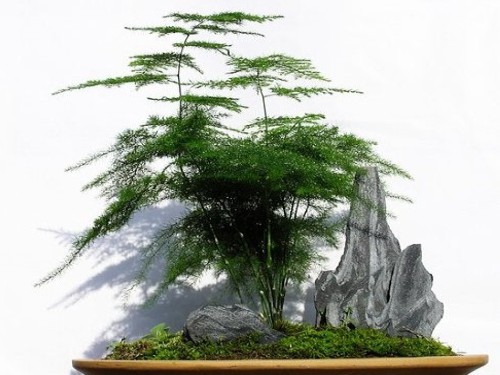
With asparagus fern, be careful not to let it become leggy. Choosing a slightly smaller flowerpot can control root growth, so the plant will not grow very tall. Properly prune dead branches and old vines to encourage new vines to sprout. After new shoots emerge, the fast-growing terminal buds can be appropriately pinched off to promote side shoot growth. When it has grown to a certain extent, you can use scissors to properly trim the branches and leaves.
Asparagus fern tends to grow in clusters. First, when repotting and adding soil, prune old and damaged fibrous roots and thin out excess stems and leaves to avoid excessive nutrient consumption and to protect the roots and leaves; second, cut off locally yellowed leaves; third, for stems and leaves that have yellowed at the same time, cut them off together.
Asparagus fern has strong vitality and grows quickly. Do not prune it excessively when it is young; increase pruning when it is mature. You can use scissors or professional pruning tools to first cut off the rotten roots and rotten leaves on the asparagus fern, which can reduce nutrient loss and better promote its growth. Then observe the overall shape of the asparagus fern and prune according to the shape you want, cutting off overly long parts. When pruning branches, pay attention to the principle of moderation; cutting off too much will affect the healthy growth of the asparagus fern. After the basic shape is set, a branch that is growing too short can also be placed in a sunny spot to increase light and photosynthesis and promote its rapid growth. When pruning, ensure the health of the asparagus fern first, and then consider the beauty of its shape.
1. Pruning for missing leaf-like branches
When the growth position of small leaf-like branches on the main branch is unsatisfactory or they are missing for some reason, you can cut back the main branch at an appropriate position to force the dormant buds there to sprout. Generally, the height of the cut is the height at which the leaf-like branches sprout; the position of the thorns on the branch is the position where the leaf-like branches sprout, and the thicker the branch, the higher the sprouting rate of the dormant buds.
2. Renewal pruning of the whole plant
If the branches and leaves of the whole plant grow poorly due to strong sunlight scorching, dry potting soil, lack of fertilizer, or some unknown reason, the whole plant can be renewed. During renewal pruning, all leaf-like branches can be cut off, but pay attention to the positions of the backward-pointing thorns on the branches, because they determine whether the distribution of the retained branches is even. Pruning in the growing season generally makes it easy for new branches to sprout; after pruning, watering should also be appropriately reduced, and the potting soil must absolutely not be kept too wet, otherwise the pruning will fail.
3. Pruning of trailing branches
Trailing branches are generally weak and slender. If you do not want to keep seeds and want the plant shape to look good, you can cut them off from the base all at once; if you want to increase the number of leaf-like branches or fill a gap, you can cut back at a certain position. When pruning, pay special attention to comprehensive management such as light fertilization.