How to shape an asparagus fern bonsai? Practical shaping methods taught to you
Asparagus fern, also known as cloud-pine fern, spiny asparagus, and cloud bamboo, is an evergreen foliage plant with high ornamental value. It is Asparagus plumosus of the genus Asparagus in the family Liliaceae. The roots of asparagus fern can be used as medicine, having effects in treating acute bronchitis and relieving cough, and possessing the function of moistening the lungs. It is mainly grown in pots for its foliage, and is also an important cut-foliage material.
Asparagus fern is one of the foliage flowers people love to grow. The whole plant is fresh green; its stems and branches, though slender, are upright, and its leaf-like branches extend horizontally in an almost triangular form, with leaves reduced to membranous scales attached to the branches like down feathers. Because its stems cluster from the base, varying in height, the cloud-like layers of branches and leaves pile up tier upon tier, which is why it is also called cloud bamboo.
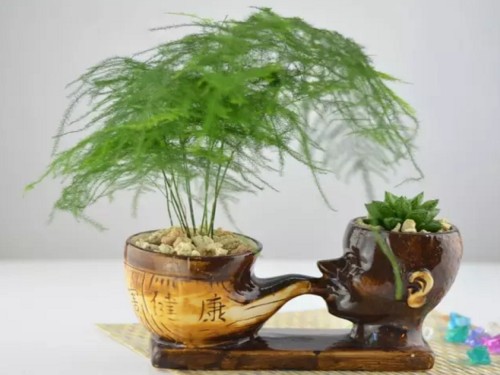
How can the ornamental value of asparagus fern be improved? First of all, you must start with shaping and pruning. The pruning and shaping methods for asparagus fern are briefly introduced below:
1. Pot control method
The size ratio between the pot and the plant should be controlled at 1:3, which can restrict root growth and keep the plant's size unchanged.
2. Remove growth points in time
When new shoots grow to 2-3 cm, remove the growth point to promote new branches and leaves on the stems, and to control it from growing vines, so that the branches and leaves spread out horizontally and the plant shape becomes fuller and fuller.
3. Make full use of the asparagus fern's phototropism
Turning the pot in time can correct the growth shape of branches and leaves and keep the plant full and graceful.
4. Object-blocking method
Use a piece of cardboard to press down on the branches and leaves or block the sunlight, so that when the branches and leaves grow and encounter an object blocking them, the stems turn or bend as they grow, thereby achieving the purpose of shaping.
5. Combined use of several shaping methods
(1) Tower-shaped shaping
Choose 2-3 tall, upright, and elegant stems as the main peak, remove all the growth points on the stems, and set the plant height at 30-35 cm. The remaining branches and newly grown stems should not be higher than the main peak. For new shoots, whether to remove the growth point can be decided according to the thickness of the stem. If its stem is thicker than the stem of the main peak, it should be removed; if its stem is thinner than the stem of the main peak, there is no need to remove it, and it can be allowed to grow. At the same time, it is also necessary to combine the object-blocking method and the plant's own phototropism to continuously adjust the plant shape.
(2) Double-clump shaping
Plant two asparagus ferns in the pot, one tall and one short, with the tall one about 30 cm and the short one about 18 cm. During the growing period, simply shape them as tower-style asparagus fern.
(3) Natural-style shaping
Focus on the natural growth shape of the asparagus fern, and use basic methods such as removing growth points, the object-blocking method, and making use of its phototropism to make the branches and leaves spread out, giving people a natural sense of beauty.
Due to limited indoor conditions, most families still hope that the asparagus fern at home can maintain its elegant, graceful posture, which requires special care methods to control the growth of its climbing branches.
The first is pruning and pinching. The appearance of the climbing branch of asparagus fern is characterized by being both long and thick, growing rapidly, and still showing no sign of producing leaves (the standard term should be "lateral leaf-like branches") even after extending to a height of more than 20 cm. Once such a branch is found, you can cut off the top branch at the height where you expect leaves to unfold (generally 10-15 cm), so that the plant loses apical dominance, and lateral branches will sprout from the first node below the cut, then unfolding the blue-cloud-like leaves.
The second is controlling water and fertilizer. Excessive water and fertilizer are also important factors causing asparagus fern to "grow wildly." When the asparagus fern sends up "bamboo shoots" from the roots, water should be withheld and fertilizer stopped, to the extent of slight wilting; otherwise, it easily "shoots up wildly" without unfolding leaves. Only when the "bamboo shoots" change from tender to old and their color changes from light to dark (this is a sign of lignification, and once a plant stem becomes lignified, vertical growth stops or slows down) may water and fertilizer be gradually added to make it unfold leaves; when it sends up the next batch of "bamboo shoots," repeat the same method.
The third is reasonable lighting. Many flower lovers mistakenly think that asparagus fern likes shade and therefore keep it indoors for a long time. In fact, asparagus fern is best grown under semi-shade or weak light conditions, and can even withstand short periods of exposure to the sun. Generally, except from July to September in midsummer when shade is needed after 9 a.m., it can receive sunlight at other times. On the contrary, if the light is insufficient, it will sprout messy climbing branches because it is "looking for light."
In addition, there is another "folk remedy," which is to avoid division. Like Acorus gramineus, asparagus fern is "suitable for pruning but not for division," especially when grown as a miniature bonsai. Once the asparagus fern in the pot grows too densely, excess branches and stems should be thoroughly cut off from the base in time rather than solved by division. Frequent pruning can make the plant full and compact; frequent division will only accelerate plant aging, promote leggy branches, and cause the seedlings to lose their lower leaves.
However, the above methods only "treat the symptoms, not the root cause."
Because, as mentioned earlier, asparagus fern is a vine, and it is also a normal physiological phenomenon for seedlings more than two years old to produce climbing branches. In this regard, we should also follow its natural laws. If indoor conditions allow, it is better to guide it according to the situation: when it begins to "bare its fangs and claws," you can set up a trellis and let it climb up, and you can also enjoy its graceful posture with green vines winding and soft branches spreading, which has a special charm of its own.
After the asparagus fern climbs the trellis, lighting should be strengthened, phosphorus and potassium fertilizer should be applied more, shade should be provided in summer, and warmth should be maintained in winter, so that it can bloom and set seed. Every spring, it can "continue the family line" by sowing seeds, and at the same time every 2-3 years the sown seedlings should be culled and renewed. In this way, cycle after cycle, you will always have a batch of seedling plants no more than three years old with beautiful form, like pines and yet like bamboo, and you need not worry about "having no bamboo where you live."