How to shape a crape myrtle bonsai? These methods you need to master
The crape myrtle (Lagerstroemia indica) has been an excellent bonsai tree material from ancient times to the present, and is one of the "Eighteen Scholars" of stump bonsai; it is widely used in the Hui and Chuan schools among the traditional eight major stump bonsai schools. The crape myrtle has the characteristic of exposed roots, and the older the tree, the more twisted and strange its roots become, giving it a vigorous, quaint, elegant and eye-catching effect. Many crape myrtle bonsai make good use of its exposed-root characteristic. When making bonsai, every effort should be made to simulate the exposed roots of the crape myrtle, so that the work has a natural, wild charm.
After the crape myrtle is potted, it enters shade-house management, and within 15 days it recovers its vitality. The crape myrtle trunk is relatively thin, so when making bonsai from small seedlings, the multi-trunk twisting method is mostly used to thicken the main trunk. That is, using the shoots sprouting from the root zone of the crape myrtle, twisting them one by one spirally along the main trunk; after 1-2 years, the shoots and the main trunk can heal together and become a single whole, and appear aged and quaint.
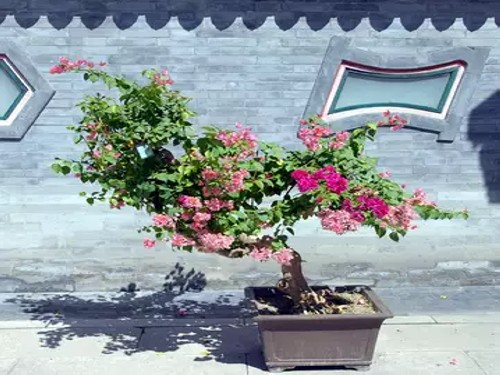
The crape myrtle tolerates pruning well, has strong branching ability, and new shoots grow in large amounts. Therefore, after flowering, the spent flowers should be cut off, which can extend the flowering period; water sprouts, overlapping branches, crossing branches, radiating branches and diseased branches should be removed at any time to avoid consuming nutrients. If small seedlings of different flower colors are planted together in one hole and their bases are bound together so that the main trunks intertwine with each other, after 2-3 years the same effect can also be formed. The crape myrtle's branches are slender and numerous, and are not suitable for excessive twisting and shaping; generally, pruning and shaping methods can be used to make it more beautiful.
1. When making bonsai from small crape myrtle seedlings, the multi-trunk (branch) twisting method can be used to thicken the main trunk. Use the shoots sprouting from the root zone of the crape myrtle to twist them one by one spirally along the main trunk, and fix them with thin string to prevent them from loosening. After 2-3 years, the shoots and the main trunk can heal together and become a single whole, making the main trunk noticeably thicker and appearing aged and quaint; you can also plant small crape myrtle seedlings of different flower colors together in one hole, bind their bases together with palm fiber, twist and twine the main trunks around each other, and fix them with thin string; after 3-4 years, the main trunk becomes vigorous, quaint and thick, and the same plant has rich flower colors, which is quite unique.
2. For the pruning and shaping of the crape myrtle, generally a severe pruning is carried out once in winter, keeping the branches evenly distributed and the crown complete during pruning, cutting off overly dense branches, sprouting shoots on the trunk, and inappropriately positioned branches; water sprouts are cut short by 2/3, and generally the retained branches are about 6 cm from the previous winter's pruning cut; when the new branches grow to about 15 cm in spring, pinching is carried out, retaining about 10 cm at the lower part, to promote the growth of two forked branches at the top; when the two forked branches grow to about 20 cm, pinching is carried out again, retaining about 15 cm at the lower part, to promote the sprouting of new branches; all other branches that affect ornamental value and shaping are removed. After the pruned branches grow flower buds, cut off the weaker flowering branches and buds unrelated to the shaping. After the flowers bloom, cut off the spent flowers; if pruned properly, the flowers can bloom until around National Day.
3. The crape myrtle is a deciduous tree species; under natural conditions it begins to shed leaves in mid-October. In order to extend the leaf-viewing period after flowering, the old leaves can be removed in early September. Note that when removing leaves, you must not remove all the leaves on a branch at once; they should be removed in batches. After leaf removal, frequently spray water on the branches and the remaining leaves; in 15-20 days new leaves will emerge. The new leaves that grow are small, red, thick and glossy, and the non-lignified branch stalks are all purplish-red; they can be enjoyed until December, and this does not affect the flowering and leafing of the following year.
4. The crape myrtle's branches are mostly slender, so the method of "combining pruning and wiring" should be adopted; excessive forced twisting is not suitable. The main trunk and branches should be appropriately coiled and wired, while the remaining side branches should be pruned and shaped. Palm fiber is mostly used for coiling and wiring. Wire coiling easily bruises the crape myrtle bark and should not be used. Coiling and wiring is mostly carried out from late autumn to the following early spring.
5. In order to make the smooth, flat crape myrtle bark show an aged, mottled appearance, during the vigorous growth period, use a knife or axe to cut or strike part of the bark, and apply lime-sulfur mixture to the xylem to make it turn white, giving people a feeling of having endured wind and frost for a long time. You can also split, break or twist-open the branches and trunk; after callus tissue grows, the trunk will be covered with knobby galls, showing an aged appearance. You can also take a smooth, flat large crape myrtle stump and use a sharp axe to chop off large pieces (decided according to the size of the stump and the creative concept and design), and use an electric drill, wood chisel, etc. to carve and decorate the exposed xylem, so that it shows a natural, withered and decayed form. The large stump pieces chopped off, after treatment with rooting powder and fungicide, are cuttings inserted in the nursery field, keeping the soil moist and paying attention to shading, so that they normally take root and sprout; generally after 1-2 years they can be potted. In this way, small or miniature deadwood-style bonsai can be made.
Shaping and pruning:
1. For the general shaping and pruning of crape myrtle bonsai, after leaf fall, according to the shaping needs of the bonsai, ordinary branches are heavily pruned leaving 1-2 buds per branch.
2. Pruning during the growing season mainly removes overly dense branches, water sprouts that disrupt the tree shape, and branches sprouting from the base of the trunk with no useful value; all of these should be promptly pinched off or cut off.
3. In order to make the crape myrtle bonsai bloom multiple times within a year and bloom well, after each flowering, the spent flowers should be promptly removed to prevent fruiting and to promote the rapid swelling of secondary flower buds, resulting in multiple blooms, but the flowering periods are earlier or later and not uniform enough; in addition, after flowering, if there are not many secondary flower buds, keep 1-2 buds per branch for heavy pruning; generally buds appear in 14 days, and in about 35 days the whole tree can be full of flowers. In this way, the branches of the crape myrtle bonsai can become thicker and shorter (average branch length within 15 cm), the tree shape is very compact, the flowers are abundant and colorful, and it is pleasing to the eye.
4. Branch pulling, branch propping, branch bending. These three techniques are mainly used from May to October, according to the shaping needs of the crape myrtle bonsai, to regulate and control the branches of the crape myrtle bonsai, increase and control the angle of the branch positions, and freely adjust the direction of the branch position angle, so that nutrients are concentrated and nutrients are accumulated. In particular, after some branches of the crape myrtle bonsai are treated with the pulling, propping and bending techniques, some branches become bow-shaped, and on the back of the bow shape multiple extremely short small flowering branches (within 10 cm) grow. In this way, not only is the number of flowering branches and flower buds greatly increased, but the color of the crape myrtle flowers is also very bright and beautiful.