When to sow Ranunculus asiaticus? Detailed potted sowing method
Ranunculus asiaticus, also called celery flower, before any flower blooms, gardening friends like to call it "pretending to be a vegetable," but this guy looks like a vegetable even without pretending. Anyway, before the Ranunculus asiaticus that Mochou grows on the terrace bloomed, my mother-in-law kept muttering, why plant such a big pot of celery for no reason, I almost got smacked! It is a cool-season flower; when the weather turns hot, the planted corms naturally go dormant, and when it turns cold they come back to meet you, so Mochou really likes it and specially recommends it to gardening friends!
The propagation methods of Ranunculus asiaticus mainly include tuberous root division propagation, seed propagation and tissue culture propagation. Because seed propagation gives high multiplicity and bright colors, but fewer flowers, a longer growth period, and higher requirements for cultivation skill. Therefore, the sowing method is used to produce commercial corms of Ranunculus asiaticus, and then the corms are used to produce finished Ranunculus asiaticus plants, so as to improve the cultivation efficiency of potted Ranunculus asiaticus.
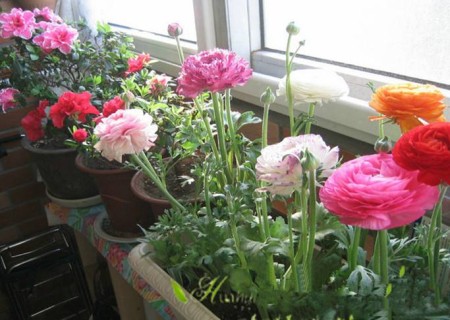
Friends, when it comes to Ranunculus asiaticus, it really makes us love and hate it at the same time. We have heard many principles about growing Ranunculus asiaticus, but still cannot grow this "green onion" well. So, how exactly do you sow Ranunculus asiaticus seeds? There is a lot of theoretical knowledge about sowing Ranunculus asiaticus online, and Xiaomei has specially collected and sorted out the experience of various gardening friends for beginner gardening friends to refer to. Well, please call me Lei Feng!
1. Sowing time for Ranunculus asiaticus seeds
Ranunculus asiaticus can be sown as early as mid-September. If you want it to bloom at New Year's Day and Spring Festival, it needs to be sown in early August, but it must first undergo low-temperature germination promotion and then be sown. It is said that research shows that when dry Ranunculus asiaticus seeds complete low-temperature pretreatment (minus 1°C plus or minus 0.2°C) in a sealed environment, the seed vigor is best, (at 5°C plus or minus 0.2°C the vigor will be somewhat lower than at minus 1°C), and at lower temperatures the vigor decreases.
2. Germination temperature of Ranunculus asiaticus
Ranunculus asiaticus seeds do not germinate easily above 20°C, so they should be sown in late autumn (because temperatures differ between north and south, gardening friends should consider carefully). Method: Ranunculus asiaticus seeds can be placed in the refrigerator to promote germination, because the best germination temperature for Ranunculus asiaticus is 5-15°C, and germination generally takes about 10-20 days, with some taking 30 days to germinate, so gardening friends need to be patient. Fresh Ranunculus asiaticus seeds germinate relatively easily.
3. Some basic time periods from sowing to flowering of Ranunculus asiaticus
From sowing to flowering, Ranunculus asiaticus takes about 5-6 months. For example, if it germinates at the end of October that year, it generally needs to bloom in early March of the following year. Ranunculus asiaticus is relatively difficult to get through summer, but the stage from autumn sowing to spring flowering the next year is still quite suitable.
4. Choose a suitable seedling-raising container
For the seedling-raising container, it is advisable to choose a hard plastic seedling box 50-60 cm long, 30-40 cm wide, 8-10 cm high, with many small holes in the bottom. You can make one yourself from wooden boards, with the size determined by the sowing amount, and the height should not be too high. If it is too high and holds a lot of soil, it is not easy to dry out after long waterlogging; if it holds little soil, the protruding four walls will affect light. The finished seedling box should have drainage holes punched in the bottom, and before use it must be soaked in water for 2-3 days until thoroughly soaked, otherwise the box and soil easily separate.
5. Choice of substrate
For the substrate ratio, mix fully decomposed and sifted barnyard manure, humus soil, fine sand and garden soil evenly in a ratio of 2:1:1:1, sift with a sieve that can sift out sorghum, and disinfect by exposing it to the sun for one day.
6. Sowing method
For the sowing method, put the seeds and fine sand in a basin at a ratio of 1:1500 and mix well, then evenly scatter them on the fine soil, then lightly press on the fine soil with a smooth wooden board, do not compact it, just let the seeds merge with the fine soil. Finally, place the seedling box in water to soak, the water level must not exceed the soil surface, add water as it soaks, until it is thoroughly soaked. Take the thoroughly soaked seedling box out of the water, cover it with a glass plate to retain moisture (do not use plastic film, because it easily drips and damages seedlings), drain slightly, and immediately move it to an environment suitable for seed germination.
It depends on the variety: the fast ones germinate in 4-5 days, while the slow ones germinate only in 7-10 days. After the seeds germinate, remove the glass plate immediately, and after most have emerged, move them to a suitable place for growth and care. It is worth noting that when the true leaves of the flower do not exceed 2, water must never be sprayed from above them.
Notes:
The temperature, humidity, light, soil, etc. required for Ranunculus asiaticus germination are very critical. For example: German primrose cannot be soaked before sowing; after soaking it easily loses vigor. Ranunculus asiaticus seeds like low temperatures, and the seedling-raising temperature should be around 8°C; above 12°C it is very difficult for seedlings to emerge. Seeds such as petunia need to be germinated at around 25°C; if after soaking they are left in a low-temperature place for 1-2 days, the seeds may rot and fail to emerge. Some seeds like light, some dislike light, and only under suitable environmental conditions can good seedlings be raised.