How to divide Cymbidium orchids? Detailed guide to the division method
There are many varieties of Cymbidium orchids, with large petals, brilliant colors and a wide range of flower colors, including red, yellow, green, white, pink, purple and various transitional and compound colors. The flower stems are upright and firm, and the flowering period is relatively long. They can be grown in pots or used as cut flowers, and are deeply loved by gardeners. They have become one of the most widely cultivated orchids in the world.
As a general rule, when the plant becomes too large, it should be repotted or divided and potted to promote growth and flowering. The best time for potting or repotting is after flowering or in early spring when new shoots have just sprouted. Before repotting, the plant needs to be taken out of the old pot, rotten roots and yellow leaves trimmed away, and the old substrate cleared out. Then place a layer of broken tiles or crushed bricks at the bottom of the new pot to aid drainage and aeration, put the plant into the pot, fill in fresh substrate, press down with your hands and water thoroughly.
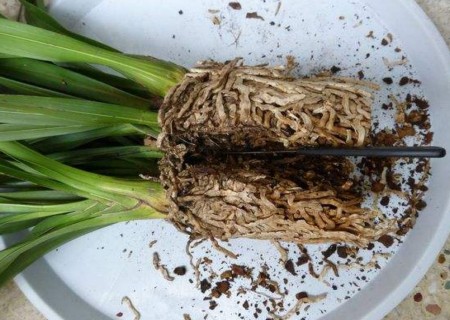
Usually, the propagation method for Cymbidium orchids is division propagation:
1. Choose the timing for division during the short dormant period after the plant has flowered and before the new shoots have grown large;
2. Carry out division when the plant's roots are slightly whitish, soft and dry;
3. A robust plant can be divided once every 2-3 years, and each divided cluster of orchid seedlings should carry 2-3 pseudobulbs;
4. Apply sulfur powder or carbon powder to the wounds on the plant to prevent infection;
5. After placing the orchid seedlings in a dry place for 1-2 days, they can be potted separately. Division propagation successful!
Cymbidium orchids are commonly propagated by division. The best time for division is from after the flowers fade until before new shoots emerge, and it is done once every 2-3 years. In short, take a robustly growing plant out of the pot, use a sharp knife to cut at the point where the pseudobulbs are connected, and divide it into several clusters. Each cluster should carry 2-3 pseudobulbs (one of which must be newly formed in the previous year). Promptly apply sulfur powder or charcoal powder to the cut surfaces, place the newly divided plants in a dry place to air for 1-2 days, then pot them separately.
For dividing and potting Cymbidium orchids, it is best to choose tall, deep unglazed clay pots with good permeability. According to the different needs of different varieties, washed sphagnum moss, bark, charcoal pieces, stones, crushed bricks, peat, etc. are mixed into growing media with different water-retention (moisture) properties, with a pH value between 5.5-6.0.
When planting, note that the pseudobulbs must all be exposed above the surface of the growing medium. After planting, place in a half-shaded, half-sunny spot. Because the growing medium is moist at planting time, do not water within 1 week after planting; only spray a fine mist on the leaf surfaces (generally spraying 4-6 times a day). After 1 week, gradually move to normal care.
Precautions for division propagation of Cymbidium orchids:
1. After division, Cymbidium orchids need to be placed in a half-shaded spot;
2. Do not water immediately. If the potting soil is found to be too dry, a small amount of water can be sprayed on the leaves and the pot surface;
3. Normal watering can only begin after new roots grow from the base of the new shoots;
4. Observe the plant's health and avoid leaf drying, leaf drop and pseudobulb shrinkage (replenish water).