How to divide a potted Clivia (Kaffir lily) by division? A full process in pictures
At the right time, cutting the axillary buds growing at the junction between the pseudobulb and the roots of the Clivia away from the mother plant and growing them separately is called Clivia division propagation. Clivia has strong adaptability and regenerative ability; a mature potted Clivia often produces several, or even a dozen, axillary bud seedlings in a year. These young buds, whether rooted or not, can all be cut from the mother plant and grown separately to develop into new plants.
Clivia division propagation is simple to carry out, has a high survival rate, and grows and develops quickly. During the division process, pay attention to the following key technical points.
1. Timing of Clivia division:
① Best time: The best time to divide Clivia differs from place to place. If greenhouse facilities are available, it can be done all year round; in the Yangtze River basin and areas to its south, division in the first half of the year can be done around Qingming (early April). Division in the second half of the year must be done between Bailu (White Dew) and Qiufen (Autumn Equinox), and autumn division should be done as early as possible so that the new plant, after being cut from the mother plant, has a longer growing period.
② Best leaf age: Is it better to divide in spring or in autumn? This depends on the size of the offset. Generally, dividing when the offset has grown 3 to 5 leaves is very beneficial to the growth of both the offset and the mother plant. In other words, if repotting should be done in the first half of the year, it must not be put off to the second half of the year, and even less to the following year.
2. Preparation before dividing Clivia:
① Flower pot: For home potting, choose the pot in advance, preferably a clay pot. Do not care too much about the pot's appearance and neglect its practicality; choose a clay pot with good air permeability at the bottom. As for porcelain or ceramic ones, do not consider them; their poor air permeability is not good for the plant's development.
② Soil: Once the soil is ready, it must be disinfected. Humus soil can be disinfected by spraying with a potassium permanganate aqueous solution; fine river sand can be put directly into boiling water to disinfect it, which can prevent the seedlings from being infected by bacteria and rotting.
③ Prepare charcoal powder: Charcoal powder can effectively absorb moisture. Division will inevitably leave wounds; applying charcoal powder to the wounds can absorb moisture and prevent rot.
④ Sharp knife: The knife used to cut the plant must be very sharp to reduce wounds on the plant. Before use, quickly dry-grind the knife on a whetstone; the heat generated in the blade can effectively sterilize it.
3. Steps for dividing Clivia:
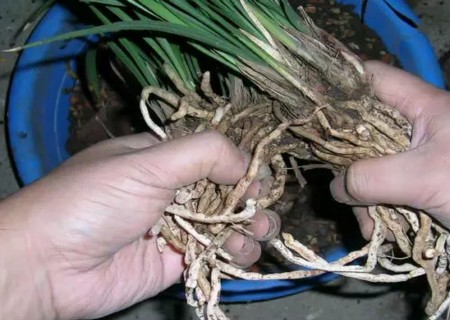
① First, take the mother Clivia plant out of the pot, remove the soil around the roots, and carefully observe where the roots can be divided. Clivia has fleshy roots; one root supports one leaf.
② If the offset grows on the outer edge of the mother plant and is small, it can be broken off directly by hand; if the offset is thick and sturdy, it can be cut off with a sharp knife. Do not force it off, so as not to damage the young plant.
③ Apply charcoal powder to the wound; cigarette ash also works.
④ Let the separated Clivia dry for a little while, and pot it up after the wound has dried.
⑤ When potting, the planting depth should not be too deep; just barely cover the base of the offset, then cover with a little disinfected fine sand. Water immediately after planting; after 2 weeks, when the root wounds have healed, cover with another layer of growing medium. After 1~2 months, the offset will grow new roots.