Detailed Guide to Care and Management After Planting Hyacinths
Generally speaking, for a hyacinth that has already bloomed, you only need to wrap the bulb in newspaper or the like, place it in a cool, ventilated spot, and take it out around October of the following year to replant. Of course, you can also buy bulbs for planting.
When selecting bulbs, choose ones with bright skin color, a firm texture, and no disease spots or insect holes. Usually, the color of the bulb's skin can basically tell you what color flowers it will produce. For example, if the outer skin is purplish-red, it will produce purplish-red flowers; if it is white, it will produce white flowers. However, some varieties developed through hybridization have more complex colors that are sometimes hard to distinguish, so it is best to ask the seller clearly before buying.
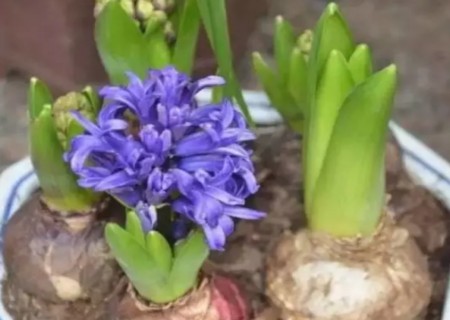
After bringing the bulbs home, to break their dormancy, first place them in the lowest compartment of the refrigerator for cold storage for about one month, so they can bloom smoothly later. But when taking them out of the refrigerator, it is best to move them to a cool place for seven to eight days before planting.
Because the flower buds of the bulbs have already differentiated and formed, hyacinth bulbs do not need a base fertilizer during planting. Plant the bulbs into the potting soil, with the soil level covering the highest point of the bulb by 2 cm. If you have no experience growing bulbs, it is recommended to leave the highest point of the bulb's top exposed about half a cm above the soil (mainly to prevent soft rot of the stem caused by overwatering; the latter is recommended). After planting is complete, water thoroughly until water runs out the drainage holes.
So, how should hyacinths be cared for and managed after planting?
After blooming, promptly cut off the flower stalk and apply cake fertilizer water twice, or a "general-purpose" fertilizer for home gardening, and continue growing the bulb. When the leaves wither in summer, take out the bulb, let it dry slightly, and store it in a cool, ventilated, rain-sheltered place until autumn planting.
1. Early-stage care
After planting, place it in an environment no higher than about 10 degrees to promote root growth and sprouting. The entire root-promoting and sprouting period takes about 20-30 days (it may vary depending on the ambient temperature). When watering, make sure to water thoroughly only after the soil has dried out. Be sure not to water at will; you can judge the degree of dryness and moisture by weighing the pot.
2. Later-stage care
After sprouting, you can appropriately raise the temperature of the growing environment to shorten the time needed for flowering. The growing temperature is best kept at around 15-20 degrees. Below 10 degrees, growth is relatively slow, but it does not have much effect on growth; above 25 degrees, blind flowers are likely to occur (the flower buds do not grow well and cannot bloom). Normally, you can extend the duration of sunlight. With more sunlight, the plant is relatively shorter and has a more graceful shape. Under normal care, it takes about 30 days from sprouting to flowering. If the ambient temperature is high, flowering will be earlier.
3. Care during the flowering period
The flowering period is about 10-15 days. If the ambient temperature is low, the flowering period is relatively longer. After flowering, it can be moved indoors for viewing, with an appropriate amount of light given daily to prevent the leaves and flower stems from growing leggy.
4. Post-bloom handling
After the flowers fade, you can remove the spent flowers and grow the bulb. In routine management, apply a nitrogen fertilizer (cake fertilizer) about once every 2 weeks to promote the development of the bulb in the soil. How well the bulb is grown directly affects whether it will bloom again the following year. After summer arrives, the leaves will gradually turn yellow and wither naturally, and the amount of watering can be gradually reduced. Once the bulb enters dormancy, stop watering completely and place it in a cool spot (below 30 degrees is preferable; too high a temperature is unfavorable for flower bud formation).
Note: During planting, be sure to water only after the soil has dried out, to avoid bulb rot caused by excess moisture.