How to Grow Mint in Water? A Step-by-Step Tutorial with Pictures
Mint seems to tirelessly give off its fresh fragrance, only stopping late at night, which earned it the name “night-breathing fragrance.” Mint is tough and can grow in almost any kind of soil. Its unique fragrance is refreshing and uplifting, making it a particularly useful garden plant.
Mint is one of the commonly used traditional Chinese medicines. It is a pungent, cooling diaphoretic and antipyretic medicine, used to treat influenza, headache, red eyes, fever, sore throat, swollen and painful gums, and other conditions. Applied externally, it can treat neuralgia, skin itching, rashes, eczema, and more. Mint picked from bright greenhouses is also a fresh vegetable on the Spring Festival dining table, refreshing and tasty. Normally, mint is used as a tea substitute to clear the heart and brighten the eyes. Previously, some flower enthusiasts tried growing mint in water, but all ended in failure. Today, the editor will discuss the method of growing mint in water based on the experience of flower enthusiasts, for everyone's reference and learning.
How do you grow a pot of artsy mint in water?
First, you need a pot of mint, or find someone who has mint and cut a few stems to bring back. Choose mint with thicker stems (easier to grow). Then find the bottom end of the stem and cut it off. When choosing, do not pick green stems; pick stems that have already turned red, because green ones are still too tender and rot easily, breeding bacteria, and will not survive. Red stems are old stems that have already become somewhat woody, do not rot easily, and root easily.
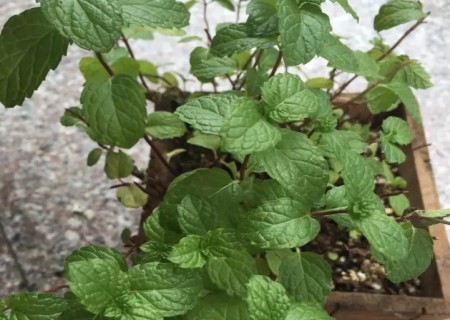
The stems of this pot of mint have basically all turned red, even the tender shoot parts are red, indicating that this mint has grown relatively old.
Cut a few stems, peel off the lowest leaves, and try to keep the leaves from soaking in the water, as leaves rot fairly easily.
Then find an artsy glass bottle and put the mint in. It is better to choose a bottle with a small mouth, otherwise the stems cannot be held up. Personally, I quite like this kind with hemp rope, a small glass bottle that can be hung. It can be placed on a surface, or hung outside the window, and it can also grow into a trailing style.
Remember not to let the leaves soak in the water. You can add some nutrient solution, but the nutrient solution must be diluted quite thinly, otherwise it is easy to burn the plant.
Actually, it is completely fine without nutrient solution. In summer, mint has a relatively large demand for water. I generally put some small stones used for succulents in the bottle. They contain minerals, and the minerals can slowly dissolve into the water.
Place the mint in a ventilated spot, preferably somewhere that gets scattered light. Do not expose it to direct sunlight. Summer sunlight is too strong and easily causes dehydration, especially during the rooting period, so never expose it to harsh sun. Usually, small rootlets grow in 3 days. Once small rootlets have grown, it is basically not going to die, as long as ventilation is maintained.
This is the result after 3 days. Small white rootlets have already grown out.
After that, you only need to check the water situation in the bottle every day. At the beginning, it does not absorb much water. If the bottle is large enough, 3 days is generally no problem. Once the roots have grown a lot, after growing for 1 month, you have to check the water situation in the bottle every day. At this time, the root system is well developed and the leaves have also grown, so it absorbs water easily, like a water buffalo.
Often, over the course of a day, half a bottle of water gets absorbed dry. So pay more attention and do not let it dry out and die.
After a few months, the roots will look like this, very well developed, and the root area begins to grow various small shoots. Wait for it to fill the pot, then divide and grow them separately!
Many small shoots have already grown here. They will slowly grow out, and the stems will become more and more numerous. It would be hard not to fill the pot!
Mint likes a sunny, warm, and humid environment. The suitable temperature is 20-30°C. It has strong adaptability and grows quickly. It can grow well in both full sun and partial sun environments. In winter, when temperatures are low, the aboveground parts tend to wither and enter a dormant state, but the underground rhizomes can overwinter safely even at minus ten-odd degrees Celsius. During the growing period, it needs relatively more fertilizer, with complete-element fertilizer being best, and nitrogen fertilizer appropriately increased.
I. Water Cultivation Time
Suitable time for water cultivation: spring, summer
II. Water Cultivation Method/Steps:
1. Cut several thick, pest-free and disease-free stems, rinse them clean with water, put them into a container, and add water to a suitable height (at least enough to submerge one leaf-removed node of all the mint stems is best). Place it in a bright environment, and be careful not to expose it to direct sunlight. It is best to use tap water that has been left standing for more than 2 days.
2. During the first week of water cultivation, there may be a phenomenon of leaves withering. You can temporarily move it to a cool, ventilated environment and appropriately spray some water mist on the leaf surfaces. Usually, after two days, this phenomenon disappears. After 2-3 days, the stems can grow lovely white roots. According to personal experience, the brighter the light and the higher the temperature, the faster the rooting.
3. During water cultivation, you can appropriately add some nutrient solution to the water to maintain what the plant needs during its growing period.
4. After one week of water cultivation, you can move it to a windowsill. Even if it gets exposed to the sun, the withering phenomenon will no longer appear. The root system also grows longer, and the stems have noticeably grown taller, entering normal management.
5. Mint has a strong phototropic tendency. Be careful to change the orientation of the container. Mint grown in water will grow very quickly. Be careful to use nutrient solution or spray the leaves several times a week with a compound fertilizer mainly composed of nitrogen fertilizer.
6. The leaves near the lower part wither and fall off very easily, so they should be cleaned up at any time. If the water quality deteriorates, the water should be changed promptly. During the vigorous growth period, water usually needs to be added about every 2 days.
7. After about 3-4 times, when the plant has grown too tall to match the container, the container should be replaced. You can also cut off the overly tall stems and re-cultivate them in water.
8. If you prefer a fuller plant shape, you can top the plant multiple times to promote the sprouting of side buds.
9. Friends who like shaping can use different varieties of mint for water cultivation. The method is the same as above, and management is simple.