What are the propagation methods for ivy?
Ivy's leaf color and leaf shape vary greatly, and it stays evergreen all year round. It is a beautiful climbing plant that can be used for vertical greening on trellises or walls. It is also suitable for indoor pot cultivation and is a very good indoor foliage plant, and can be used as potted plants, hanging baskets, topiary, shaped plants, and more. Ivy is also a material for cut flower arrangements. In addition, when planted together with other plants, it is a very good ground cover material.
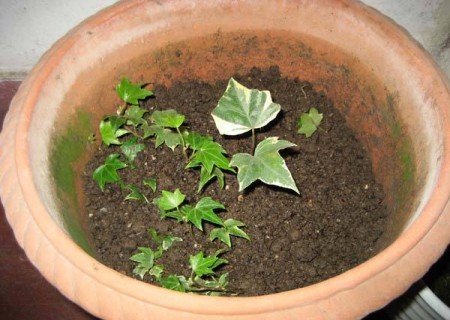
Ivy's air-purifying effect is excellent, and keeping it in a hanging pot is pleasing to look at, making this kind of green plant very popular. In addition, ivy's cold tolerance is also relatively strong. You can see people using it to beautify walls even in North China, which shows just how cold-tolerant it is.
Ivy is also called Changchun ivy, foreign climbing fig, and foreign ivy, and belongs to the genus Hedera in the family Araliaceae. It is a perennial evergreen vine. Ivy can be propagated by sowing, cuttings, and layering.
1. Propagation by sowing
Sowing can generally be carried out south of the Yangtze River and in South China. Ivy seed propagation mainly means collecting the fruit when ripe, piling it up for after-ripening, soaking and rubbing it, washing the seeds and drying them in the shade, and then sowing them; they can also be stored in moist sand and sown in spring the following year. After sowing, cover with 1 cm of soil and cover with grass to retain moisture. After the seedlings emerge, set up a shed for shade, and in the second spring, transplant or thin the seedlings and then grow them into larger plants.
2. Propagation by cuttings
Ivy's stems and vines root easily, so cuttings are usually used for propagation. Cut stem sections with three buds and insert them into loose plain soil, keep the room temperature at 15-25°C, and they can root in about a week. Among cutting propagation methods, some also root them in water; for water rooting, only soak the lower end of the cutting shallowly in water, keep the water clean and the room temperature suitable, and they will likewise root in about a week.
Under greenhouse cultivation conditions, cuttings can be taken throughout the year. For home propagation, spring from April to May and autumn from August to September are generally suitable for cuttings. The key to successful rooting of cuttings is the selection of cuttings and the cutting season. Generally, semi-lignified robust branches should be chosen; ones that are too tender or too old are not easy to root. Each section should have 3 nodes and be 10-20 cm long. Insert the lower 1-2 nodes that have aerial roots into the growing medium. The cutting substrate should be disinfected medium sand, with the temperature controlled at 20°C and humidity at 80%-90%, covered with plastic film. Before cutting, drench the roots with Kuaihao diluted 500 times. Roots can form in about two weeks. Each pot can hold 3-5 cuttings and can grow into a full plant. In terms of management, maintain relatively high air humidity and a scattered-light environment.
Note that cuttings cannot use perennial old branches; instead, choose thick and strong young shoots, remove the lower leaves, let the wounds dry slightly, and then they can be used for cuttings. Protect the buds on the cuttings, and they will root very easily.
3. Propagation by layering
Ivy produces creeping branches, and the creeping branches grow aerial roots at the nodes and penetrate into the soil, so propagating ivy by layering is also very easy. The layering method is to layer the stems and vines continuously, pressing them onto the stems with clods of soil so that the nodes root. After rooting, cut them into sections of 4-5 nodes. When the axillary buds sprout to 8-10 cm, they can be transplanted.