How to prune an asparagus fern bonsai? Detailed pruning methods and techniques
The asparagus fern (Asparagus plumosus) has a graceful form, with slender, soft branches arranged in an orderly high-and-low pattern, elegant and distinctive. But if it is not pruned, the asparagus fern will grow taller and taller. The asparagus fern is a climbing plant with semi-succulent roots, and it grows very rapidly. After a few years of cultivation, the branches will grow taller and taller, generally reaching 2 to 3 m, or even longer.
What should you do when the asparagus fern grows too tall? The answer to this question, in the editor's suggestion, is simply to cut it off. The asparagus fern is a climbing plant and grows rapidly; after a few years of cultivation, the branches will grow taller and taller. For an asparagus fern potted plant kept at home, the shape has long since been set, and when the asparagus fern grows taller it ruins the original shape, so the best solution is to prune it. Pruning of the asparagus fern can be done in any season, but it is best done during the slow winter growth period, thinning out the overly dense inner branches and the poorly shaped branches (those of a trailing, elongated form), to maintain the asparagus fern's cloud-like bonsai appearance.
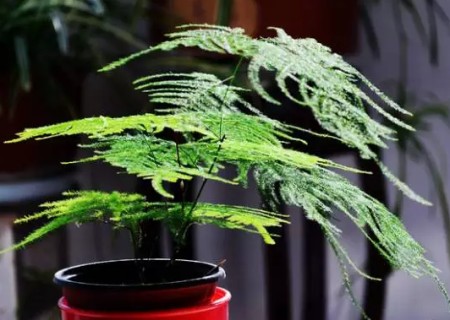
Methods for controlling the growth height of the asparagus fern:
1. Pruning: cut away the old branches, so that it always stays a fresh green (tender yellow-green). It is not about removing the new shoots as mentioned on the first floor (note: regular nutrient soil, add fertilizer).
2. Use that kind of "suoganling" (stem-shortening agent), at a ratio of three parts per thousand, and apply it, but it will not grow that welcoming-pine look.
3. Use half-sand soil, the kind without nutrients, as this can control growth.
The asparagus fern tends to grow in clusters. First, when repotting and adding soil, prune the old and damaged fibrous roots and thin out the excess stems and leaves, to avoid excessive consumption of nutrients and to nourish the roots and protect the leaves; second, cut off locally yellowed leaves; third, for stems and leaves that have yellowed at the same time, cut them off together.
The asparagus fern is best when its plant form and leaf-like branches are dense yet well spaced, with a pleasing high-and-low arrangement. But after 3 to 4 years of cultivation, it puts out tall trailing branches and flowers and fruits, and is no longer suitable for indoor display, so it must be pruned. Therefore pruning is very important.
1. Pruning for missing leaf-like branches
When the small leaf-like branches on the main branch grow in an unsatisfactory position or are missing for some reason, you can cut back to a suitable position on the main branch to force the dormant buds there to sprout. Generally, the height at which you cut is the height at which the leaf-like branches will sprout, and the position of the thorns on the branch is the position at which the leaf-like branches will sprout, and the greater the thickness of the branch, the higher the sprouting rate of the dormant buds.
2. Renewal pruning of the whole plant
If the branches and leaves of the whole plant grow poorly due to strong sunlight scorching, or the potting soil being too dry, lack of fertilizer, or some unknown cause, then renewal of the whole plant can be carried out. During renewal pruning, all the leaf-like branches can be cut off, but pay attention to the positions of the backward-pointing thorns on the branches, because they determine whether the distribution of the retained branches is even. Pruning during the growing season generally makes it easy to sprout new branches; after pruning, watering should also be appropriately reduced, and the potting soil must absolutely not be kept too wet, otherwise the pruning will fail.
3. Pruning of trailing branches
Trailing branches are generally weak and slender. If you do not want to keep them for seed, and want the plant form to look good, you can cut them off from the base in one go; if you want to increase the number of leaf-like branches or fill in a gap, you can cut back to a certain position, and when pruning pay special attention to comprehensive management such as small amounts of fertilizer.
Key points for pruning:
1. The asparagus fern has vigorous vitality and grows quickly. Do not prune it excessively during its youth, and increase pruning when it is in its prime.
2. You can use scissors or professional pruning tools to first cut off the rotten roots and rotten leaves on the asparagus fern, as this can reduce the loss of nutrients and better promote the growth of the asparagus fern.
3. Then observe the overall shape of the asparagus fern, and prune according to the shape you want, cutting off the overly long parts. When pruning the branches, pay attention to the principle of moderation; cutting off too much will affect the healthy growth of the asparagus fern.
4. After the shape is basically set, a branch that has grown too short can also be placed in a sunny spot to increase light and photosynthesis and promote its rapid growth. When pruning, ensure the health of the asparagus fern first, and then consider the beauty of its shape.