Detailed Explanation of Bougainvillea Bonsai Styling Techniques
Bougainvillea (also known as paperflower) has large bracts that are brightly colored like flowers and last a long time, making it suitable for garden planting or potted display. It can also be used for bonsai, hedges, and pruning to shape. Bougainvillea has very high ornamental value and is cultivated in southern China as a climbing flower for walls. Every Spring Festival, green leaves set off the bright red bracts, like a peacock spreading its tail, exceptionally dazzling. When grown in pots in the north, placed at doorways, courtyards, and hall entrances, it is very eye-catching.
For bougainvillea bonsai, shaping is mainly done by pruning, with tying and binding as a supplement. Young trees can be trained and bent according to styling needs. You can also take several bougainvillea plants of different flower color varieties, then plant them together and approach-graft them.
After the bougainvillea gradually grows and the basic shape has been determined, loosen the ties on the bougainvillea. And we need to peel off the outer bark at the junction of the stems and branches, then align the cambium layers for approach grafting. After approach grafting, both sides still need to be tied tightly, and at the same time pay attention to protecting the wound from rain and watering, so as not to affect the normal growth of the bougainvillea. After it grows firmly and forms as one, remove the binding wire.
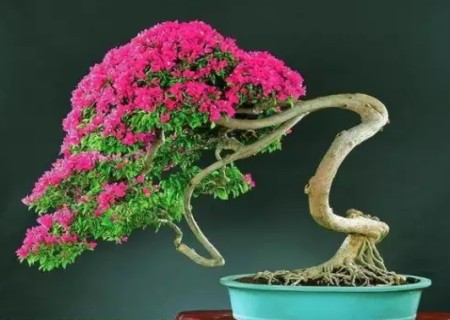
After approach grafting, the part below the approach-grafted section can be treated as the root of the bougainvillea. The root can be bent and shaped as needed, or it can also be paired with stones to create a root-embracing-rock effect. The part above the approach graft will grow many branches. At this time we need to prune the bougainvillea, and while pruning we should also pay attention to whether it deviates from the shape we have in mind.
1. Pinching and Topping
Bougainvillea shaping should start from young seedlings. Give appropriate watering, supplemented with foliar nitrogen fertilizer to promote thickening of the bougainvillea branches and trunk. By controlling apical dominance, promote budding at the lower part of the plant, control excessive shoot growth, and accelerate lateral branch growth to achieve the purpose of shaping.
According to styling needs, determine the timing of topping and pinching during the bougainvillea's growth period; according to the plant height, determine the pinching location by inducing branching sites. Generally speaking, when the stem tip has 4-6 leaves, it can be pinched and topped. For new shoot branches at the 6-leaf stage, remove 2 and keep 4. After the lateral buds become strong, remove 1-2 leaves and keep 2-3 leaves. After repeating pinching several times, the branches go from one to two, from two to four, until they develop into the desired crown shape. In addition, remove buds at sites where branches are not needed, to reduce nutrient consumption and speed up shaping.
2. Support and Fixing the Shape
The shaping of bougainvillea bonsai can be given appropriate training and bending, and support, according to actual needs.
Training and bending should be carried out promptly as the branches grow. After planting and resuming growth, begin training and bending. Use 0.6 mm diameter aluminum wire, from bottom to top, tightly wrapping from the main trunk to the young branches, to promote elongation of the internodes of young branches and form natural bends. You can also use plastic binding tape to bind thicker aluminum wire together with young branches and then bend them into shape. When branches grow too long, promptly shorten them moderately and cut them back to promote branching again, and at the same time cut off overlapping branches and other excess branches.
In order to maintain the form, you can insert a small bamboo stick into the pot and gently fix the bougainvillea branches to the bamboo stick with aluminum wire. And through technical measures such as bending branches and pulling branches, you can control the growth of apical dominance so that the plant develops according to the intended plant shape. During shaping, the plant must be given sufficient sunlight, to avoid problems such as thin and weak branch growth, faded leaf color, leaf drop, and failure to bloom.
3. Pruning Techniques
Because of its vigorous growth, bougainvillea needs comprehensive pruning at least once a year. Choose pruning before budding in February-March, following the principle of first pruning inner branches and then outer branches, removing reverse-growing branches, weak drooping branches, inner branches, excessive water shoots, dead branches, overlapping branches, shaded branches, and interfering branches. When branches are too dense, keep the relatively thick branches, shorten them, and leave space for new branches to grow and space for flowers to extend.
Pruning should be done by cutting from the base of the branch, leaving no stub. Generally speaking, the thicker the branch left after pruning, the stronger the sprouting. Conversely, new buds growing from thin and weak branches are often relatively thin and weak, not robust. During the long-branch period, apply sufficient fertilizer to facilitate healthy branch growth. But do not apply too much fertilizer, otherwise it is easy to cause the sprouting of excessive water shoots; controlling water can control excessive branch growth. When excessive water shoots are found, they need to be shortened, but ensure that the crown branches are evenly distributed and not lopsided.
After the basic crown has formed, it should also be regularly trimmed, cutting off branches unfavorable to the shape, and at the same time shortening branches to promote sprouting. From after flowering in November to before budding in February, cut back, removing weakened branches, shaded branches, flowering branches, and thin branches before long branches. This enables the shaped plant to achieve the ideal effect.
Notes:
1. When shaping bougainvillea bonsai, the concept must be clear in your mind.
2. When pruning, one point we need to pay attention to is that it should be carried out according to the overall image we have already determined. Be sure to have a clear plan before cutting, and never proceed blindly, otherwise it is likely to get half the result with twice the effort.
3. The branches left after pruning are not useless. We can use them for training, bending, and shaping. In addition, as time passes, the part below the approach graft will form a new trunk, with a rough and uneven surface, appearing even more vigorous and antique.