Rose Ring-Barking Cutting Technique - Illustrated Guide to Rose Ring-Barking Propagation
Ring-barking means removing a ring of bark, that is, after a ring of bark is peeled from the root, the nutrients in the trunk will not flow back to the root in autumn and winter. Then in spring, when plants sprout, the nutrients from the root are transported upward, and by the time the wound peeled last year has healed, the flowers on the tree have already bloomed and the young fruit has already formed. Ring-barking can temporarily increase the accumulation of carbohydrates in the parts above the ring-barked or girdled cut, and reduce the auxin content, thereby inhibiting the vegetative growth of the current year's new shoots, promoting reproductive growth, favoring flower bud formation and increasing the fruit-setting rate. This practice is often used on old trees.
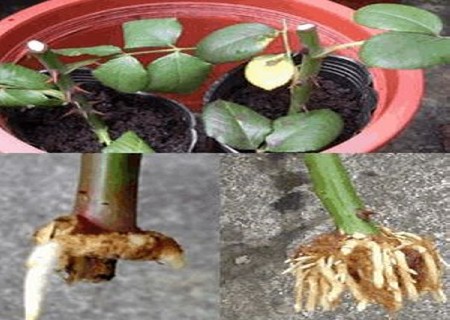
Ring-barking before cutting helps the cuttings grow adventitious roots; the ring-barking width is 5 mm to 7 mm. Soak the cuttings in water before planting, such as persimmon, walnut, etc., soak them fully in clean water and change the water several times, so that the tannins in their bodies are leached out to facilitate rooting of the cuttings.
Among the many propagation methods for roses, the ring-barking cutting propagation method is also a commonly used method. This method has a relatively high survival rate. For some varieties that are not easy to root from cuttings, you can try this method. In the high-temperature, rainy season of July-August, after cutting off the spent flowers, peel off a ring of bark about 3 mm wide at 2 mm below the leaf base of the third and fourth leaf nodes. The peeled area should be shaded by the branches and leaves of the same plant or another plant, and must not be exposed to direct sun; after one week, a callus will form. After two or three weeks, when the callus has grown into a semicircle and is slightly pale yellow, cut off the branch and insert it into fine sandy soil or ordinary potting soil, place it in semi-shade, and after two weeks it will root and survive and then grow normally.
Using the ring-barking technique, wait for the callus to grow to equal length before cutting.
A single branch can be ring-barked into multiple sections according to the length of the cuttings. The peeled openings should be wrapped with opaque tape.
Callus has grown.
Cut open.
First use a disposable cup as a culture vessel.
After a period of cultivation, it has sprouted.
You can see the advantage of the disposable cup - you can observe the rooting situation.
The first picture says to wrap the peeled opening with opaque tape. This is because after wrapping, avoiding light and wind, the callus will grow better. Compare the picture above: these two were peeled at the same time on the same branch, one was wrapped with tape, and the other was not wrapped with tape.
This one was wrapped with tape, and the callus is plump and fresh.
This one was not wrapped with tape, and it is obvious that the callus has grown worse than the one wrapped with tape.