Detailed Guide to Air Layering Propagation of Camellia, Step-by-Step Instructions
Camellia, also known as camellia japonica, late camellia, mandala tree, camellia, etc. It can bloom from mid-October to mid-April of the following year, but most bloom from February to April. Flower colors include red, pink, white and many other colors, deeply loved by urban and rural residents. Camellia can be propagated by various methods such as seeding, cuttings, layering, and grafting, with air layering most commonly used for propagation.
Air layering, also called ring-barking, is best done from May to September. The air layering site on the camellia should be more than 15 cm from the shoot tip, and it is even better if there are 2 or more branches. Air layering is best combined with shaping of the mother plant, carried out on prominent shoots on an uneven canopy.
Camellia often produces summer shoots successively around June. When air layering on such branches, the site should preferably be on the spring shoot below the junction of spring and summer shoots. At the selected site, use a knife to make two ring cuts along the branch with a spacing of 2 cm, then peel off the bark between the two rings. After the exposed xylem surface dries (generally requiring more than 2 days), wrap the ring-cut area with mud strips made by mixing grass with clay or with moss, and add a layer of transparent film to retain moisture.
New roots can emerge in about 3 months, then cut away from the mother plant, plant in a sand bed, and simply water to maintain moisture thereafter.
Air layering is mostly carried out from April to May. The method is to select branches from the previous year, make a ring bark peel at the air layering site, with a ring peel width of 0.5 cm; wrap the ring-peeled area with a suitably sized plastic film, with a wrapping length of 10-15 cm, first tie the lower opening tightly, fill with moist cultivation soil, keep the soil moist at all times, then tie the upper opening tightly; after roots develop, it can be cut off and planted separately.
Air layering is very suitable for species that are extremely difficult to root or when you want to separate a larger plant from the mother plant, and it can be combined with shaping and pruning the mother tree's crown, achieving two goals at once. This low-branched double-trunk Kramers Supreme is intended to be cultivated into two camellias with higher branches suitable for courtyard planting, and the separated daughter plants will be over 1 m tall.
Specific steps of the air layering method:
After determining the air layering site, use a knife to make two ring cuts on the trunk, with the two ring cuts about 3 cm apart, then cut deep to the xylem and peel off the bark between the two cuts. But do not peel it all off, only peel off eight-tenths, leaving a little bark to supply nutrients to the daughter plant.
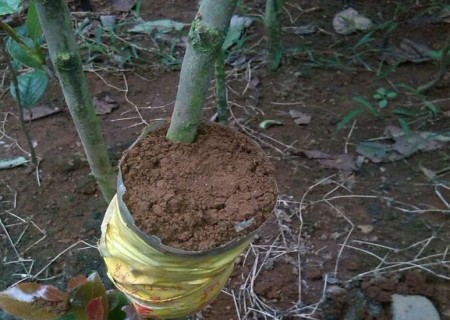
About 3 to 5 cm below the ring-peeled band, tie a piece of thick plastic sheeting, shape it upward into a pouch, add loess, decomposed pine leaf soil and filler into it and pack it firmly, then tie the pouch opening tightly about 3 cm above the peel opening.
When the branch diameter to be separated is less than 2.5 cm, you can use discarded cola bottles or mineral water bottles to hold the filler, which is very convenient: cut off a section from the bottom of the bottle, then slit it open lengthwise all the way through, then slip the bottle mouth downward over the branch, and fix the cup with the cup mouth about three cm above the upper edge of the ring peel opening, then add filler.
Finally, water thoroughly with a mixed solution of rooting agent and carbendazim.
After the air layering method is completed, enter the management stage, mainly replenishing water to maintain moisture when the filler in the pouch is too dry. In the later stage, the key point is that once roots have grown fairly vigorously, do not cut it off from the mother plant all at once when separating; instead, use wire tying or ring cutting and ring peeling methods to gradually stop the mother plant from supplying nutrients to the daughter plant until it can be separated.