How to prune a Japanese persimmon (Diospyros rhombifolia) bonsai? Detailed methods and techniques
The Japanese persimmon (Diospyros rhombifolia) is a star species in the bonsai world. At exhibitions, it not only earns the approval of bonsai enthusiasts but is also loved by the general public. Apart from tree-form Japanese persimmons, which are mainly grown for their fruit, the Japan Hime Persimmon Association has registered many cultivar names based on fruit color, shape, size, calyx, and the presence or absence of oil-drop spots. Enthusiasts can choose raw material or semi-finished plants to cultivate according to their preferred fruit shape, color, size, or spots, and soon they will have flowers and fruit to admire.
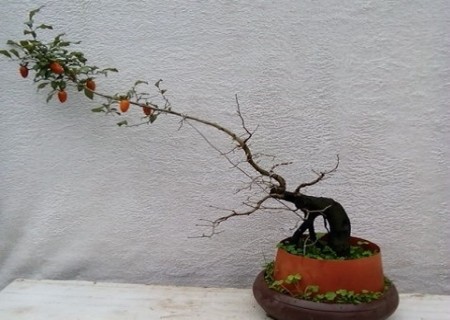
The Japanese persimmon (Diospyros rhombifolia) is irresistible because of its unique tree posture and delicate, lovely fruit. In addition, it is easy to cultivate and propagate, does not easily lose branches, and can be shaped into a distinctive bonsai with pruning alone, making it one of the best bonsai materials suitable for most people to grow and enjoy. The Japanese persimmon is relatively shade-tolerant and tolerant of pruning, making it a preferred species for landscaping and bonsai, with excellent prospects for development!
There are several key times for pruning a Japanese persimmon bonsai. The first is before spring bud break, before March, when pruning tends to stimulate new buds on the branches; the second is in summer, cutting back branches that grew too long in spring to maintain good proportions. After this pruning, the ornamental period is long, and it can make autumn buds draw back so the branch form becomes compact; the third is in early autumn, waiting until the branches thicken before pruning to foster spring buds. When pruning in autumn, be careful to retain the small fruiting branches so the female plant can bear fruit.
Seizing the three key times for pruning can make the tree form and branch structure compact and perfect. Cold-region Japanese persimmons mainly produce spring buds each year, so they must be cut back before mid-autumn; only then do they readily develop new buds to overwinter and burst forth with spring buds.
Thick roots pruned off during repotting can be buried for root propagation. After repotting a fruiting persimmon, some fruit can be removed to reduce the burden on the tree. Leaves with black spots are best removed immediately and discarded sealed in a zip-lock bag to prevent infection. Persimmons that have not flowered or fruited are suitable for shaping and pruning, and aluminum wire can be applied after leaf fall.
After leaf thinning, light pruning can be done. As a rule, just keep two to three buds per branch and cut off excess branches and buds. After leaf thinning and pruning are finished, thin branches can be wrapped with aluminum wire to correct the direction and angle of branch growth; but remember to remove it before it causes constriction marks (within about 2-3 months).