The correct method and precautions for dividing Clivia
After Clivia has generally grown for 3-4 years, it will produce many small shoots at the rhizome, ranging from as few as 1 to as many as a dozen or more. If these small shoots are transplanted and divided out, after proper care, in 1-2 years they can grow into large Clivia plants again and can even bloom!
When the plant's first leaf grows to 5-8 cm, it can be divided into pots according to variety and size. Choose good pots and prepare suitable soil, with two to four plants per pot; for premium plants, two are enough. You can also decide the number of plants for transplanting according to actual conditions. Do not wait until April to transplant together with soil replacement; once the plant is too large, it becomes difficult to transplant. Small seedlings can also be transplanted in February and March, with no effect on their later growth.
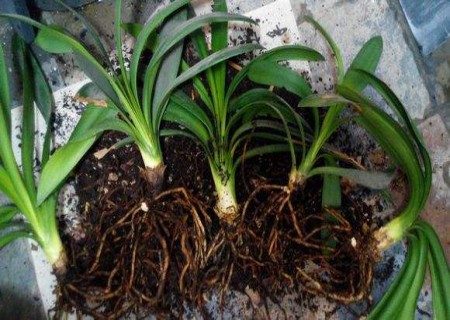
After Clivia has grown for some time, it will tiller out young plants around the mother plant, and after being transplanted they will become a new plant. The specific method is as follows:
1. Small seedlings should not be transplanted too early; if too early, the root system has not yet formed and survival is not easy. They should not be transplanted too late either; if too late, they consume the mother plant's nutrients, and because of limited growing space, they can also easily cause leaf deformities. The most suitable time is when the young plant has grown four or five leaves, when the young plant's root system has already formed and it can survive directly after transplanting.
2. When transplanting, clear the potting soil beside the young plant to expose the connection with the mother plant. Cut it off in one go with a sharp blade, and gently lift out the young plant's root system. Apply plant ash to the cut and let it dry, then plant it in moist humus soil and avoid strong light.
3. Some young plants grow in the leaf axils. When dividing this kind of young plant, peel off the outer mother plant leaves around the young plant, then proceed according to the previous steps.
The process of dividing Clivia:
1. Separate the tillers (offset bulbs) of more than 15 cm produced around the mother plant's rhizome, plant them in small pots, water thoroughly, and place them in shade.
2. After one week, move them to partial shade. If the small seedling has no roots, apply B12 solution to the cut, then insert the base into a clean sand pot. Because it has no roots, it easily falls over, so a fixing frame like a lamp hook can be made from wire; place the leaf in the hook ring and insert the handle into the sand, then cover it with a transparent plastic bag. Keep the sand in the pot at about 50% moisture content, place it in a cool shaded place, and keep the temperature at 20-25 degrees Celsius. After 20-35 days, new roots will grow, and then it can be potted for cultivation.
3. When dividing, the offset should not be too small or too large. If too small, it grows slowly; if too large, it affects the growth of the mother plant. The mother plant after division should also have its management strengthened. The cut should be coated with charcoal powder or plant ash. Within one month after division, appropriately control water and increase fertilizer application so that it grows robustly.
4. Division can also be done when repotting. When cultivating one-year-old seedlings, use 3-inch pots. In the second year, change to 5-inch pots, and afterward change to a pot one size larger every 1-2 years. Repotting is generally done in spring after flowering.
Precautions for division:
1. The time for division should preferably be chosen during April to June each year, but be careful not to break the root system.
2. It is best for cut axillary buds to have roots. After cutting, apply fungicide to the wounds of the mother plant and the small buds.
3. After the young buds are potted, control watering and place them in shade. After half a month, normal management can resume.